
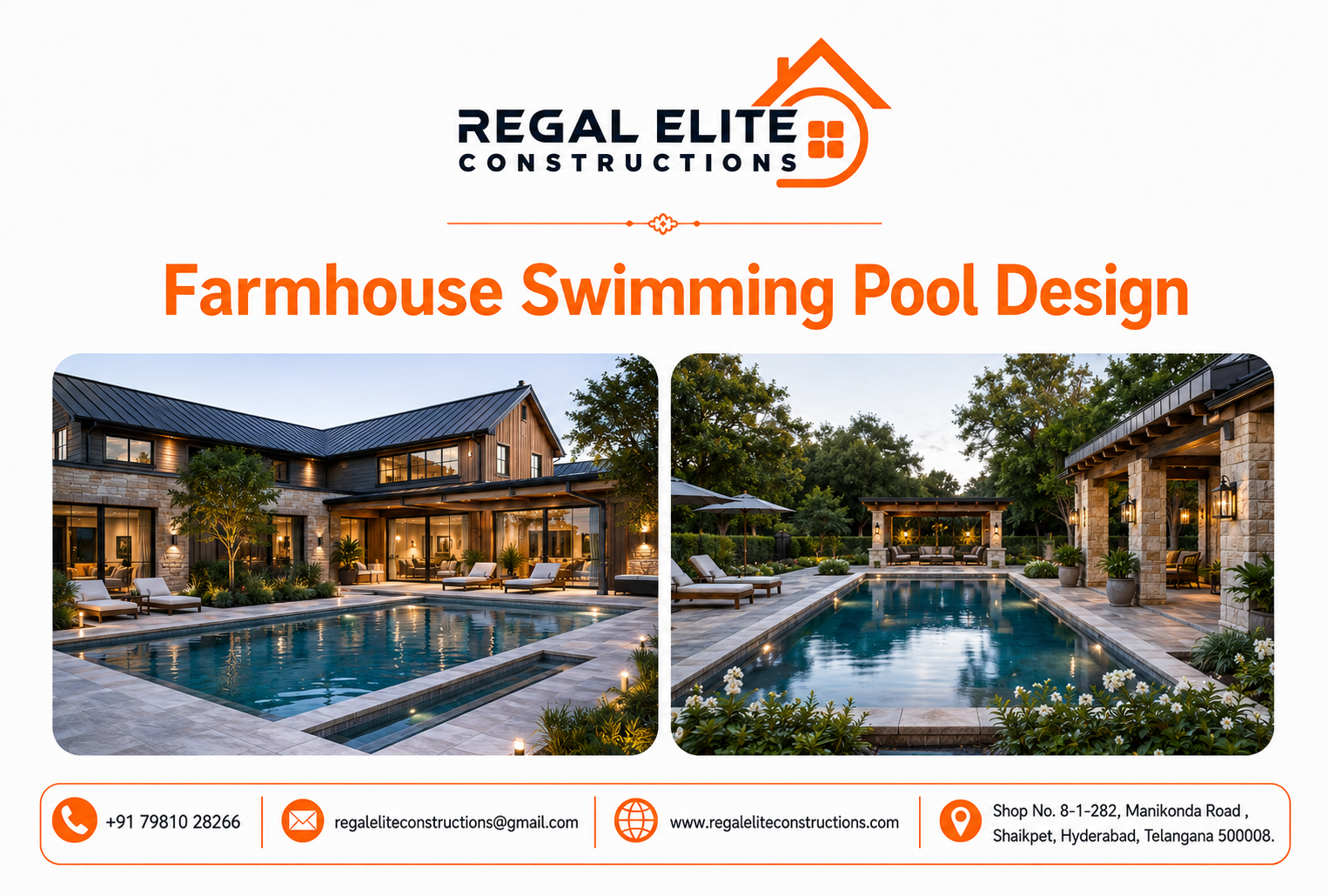
Modern Best Swimming Pool Designs for Farmhouses: Complete Farmhouse Swimming Pool Design Guide
A thoughtfully planned Farmhouse Swimming Pool Design can turn an open rural or suburban property into a private retreat for family weekends, celebrations, exercise and relaxation. The best pools are not simply attractive rectangles filled with water; they are architectural features that connect the farmhouse, landscape, deck, lighting, outdoor seating and surrounding views into one coherent environment.
For owners planning a new farmhouse or upgrading an existing property, Farmhouse Swimming Pool Design should begin with the site rather than with a catalogue image. Orientation, available land, soil, drainage, sun exposure, wind direction, tree cover, privacy and expected number of users all influence the right answer. A pool that looks spectacular on one plot may feel cramped, exposed or difficult to maintain on another.
This guide explains the most useful modern concepts, materials, layouts, safety ideas and technical considerations behind Farmhouse Swimming Pool Design. It also shows how to compare infinity pools, lap pools, courtyard pools, resort-style layouts, naturalistic pools and contemporary rectangular designs so that the final choice fits the architecture and the way the property will actually be used.
Whether the farmhouse is near Hyderabad, on the outskirts of the city, or part of a larger recreational estate, the goal of Farmhouse Swimming Pool Design is the same: create a durable, easy-to-use and visually balanced outdoor space that feels intentional from every angle.
Table of Contents
- Why modern farmhouse pools need integrated planning
- Site analysis and orientation
- Contemporary rectangular pools
- Infinity-edge concepts
- Resort-style family pools
- Courtyard and compact layouts
- Lap pools and fitness-focused designs
- Naturalistic and landscape-led pools
- Decking, landscaping and outdoor living
- Lighting and night-time ambience
- Finishes, tiles and material selection
- Pool size, depth and zoning
- Filtration, circulation and energy efficiency
- Safety, access and responsible planning
- Construction process
- Cost factors
- Common mistakes
- Why choose Regal Elite Constructions
- Frequently asked questions
1. Why Modern Farmhouse Pools Need Integrated Planning
The biggest difference between an ordinary backyard pool and a high-quality Farmhouse Swimming Pool Design is the relationship between the water and the wider property. A farmhouse usually has more open land than a city residence, which creates opportunities for generous decks, lawns, pergolas, outdoor kitchens, sunken seating, children’s zones and landscape buffers. The extra space is valuable only when it is organized well.
A successful Farmhouse Swimming Pool Design considers how people move from the house to the pool. The most comfortable route is direct, shaded where possible and free from awkward level changes. Guests should not need to cross muddy lawns or service areas to reach the water. Towels, changing spaces, toilets and refreshments should be conveniently located, especially when the property is used for gatherings.
Visual connection is equally important. When the main living room, veranda or dining area looks toward the pool, the water becomes part of the architecture even when nobody is swimming. This is why Farmhouse Swimming Pool Design often uses strong sightlines, clean pool edges and carefully located feature walls. The view from inside the farmhouse should look composed rather than accidental.
Maintenance must also influence early decisions. Large trees may provide shade but can increase leaf load. Deep pools can look impressive but may use more water and require more careful supervision. Waterfalls and fountains add drama but may increase evaporation and maintenance. A practical Farmhouse Swimming Pool Design balances atmosphere with long-term operating needs.
Finally, the pool should match the character of the farmhouse. A sleek glass-fronted villa may suit a geometric pool with large-format stone paving, while a rustic stone farmhouse may feel better beside warmer textures and softer landscaping. The strongest Farmhouse Swimming Pool Design feels like it was planned with the building from the beginning, even when the pool is added later.
2. Start with Site Analysis, Orientation and Privacy
Before selecting a shape, good Farmhouse Swimming Pool Design starts with a professional reading of the site. Survey levels, existing trees, access roads, underground services, drainage channels and soil conditions can all affect where the pool can be placed. On sloping land, level differences may become an advantage by creating an infinity edge or raised deck, but they need structural planning.
Sun orientation has a direct influence on comfort. A pool that receives useful daylight can stay more pleasant during cooler months, while harsh afternoon exposure may require pergolas, umbrellas, trees or shaded seating. In hot climates, Farmhouse Swimming Pool Design should provide both sunny and shaded zones rather than forcing every user into the same environment.
Wind deserves attention because it can cool the water, increase evaporation and blow debris into the pool. Hedges, boundary walls, planting and built structures can act as wind filters. Privacy is another priority, particularly on properties near roads or neighbouring plots. Thoughtful Farmhouse Swimming Pool Design can use landscape layers, screens and walls to create enclosure without making the pool area feel boxed in.
Drainage around the pool is essential. Decks should be planned so rainwater does not wash soil or garden debris into the water. Finished levels should also prevent runoff from lawns entering the pool. In a well-resolved Farmhouse Swimming Pool Design, the pool deck, landscape levels and external drainage work as a single system.
Owners should also think about future development. A plot may later receive a guest cottage, barbecue pavilion, changing block or expanded lawn. Leaving sensible circulation and service access around the pool protects those options. This makes Farmhouse Swimming Pool Design a long-term site-planning exercise, not only a decorative decision.
3. Contemporary Rectangular Pools: The Most Versatile Modern Choice
A clean rectangular pool remains one of the strongest options for modern farmhouses because it is simple, efficient and architecturally adaptable. In Farmhouse Swimming Pool Design, the rectangle can align with the farmhouse façade, veranda, lawn edge or a strong landscape axis. The result often looks calm and spacious, especially when paired with large-format paving.
Rectangular pools are also easy to zone. One end can include broad entry steps or a shallow lounging ledge while the centre remains open for swimming. Built-in benches can run along one side without disturbing the primary swim path. This flexibility makes Farmhouse Swimming Pool Design suitable for both family recreation and visual elegance.
For a more luxurious look, designers may hide overflow channels, use slim coping or continue the same stone from the deck toward the waterline. Neutral greys, sand tones and warm beige finishes help the water become the visual focus. A minimal Farmhouse Swimming Pool Design does not need excessive decoration; proportion and detailing create the premium effect.
The rectangular format is particularly practical when the owner wants a pool cover, regular swimming length or straightforward furniture placement. It can also be extended visually with a narrow reflecting section or a spa zone. For many sites, this is the safest starting point when developing a timeless Farmhouse Swimming Pool Design.
4. Infinity-Edge Pools for Scenic Farmhouse Properties
Infinity pools work best when the site has a view worth extending toward: a valley, open farmland, lake, garden or lower landscape. In the right setting, Farmhouse Swimming Pool Design can use a vanishing edge to make the water appear to merge with the horizon. The visual effect is strongest when the overflow edge is positioned away from the main approach so users see the illusion before they see the balance tank and technical components.
These pools require more detailed hydraulic and structural planning than a conventional skimmer pool. Water flows over the edge into a channel or catch basin and is recirculated. Because the edge is continuously moving, Farmhouse Swimming Pool Design must account for pump capacity, surge volume, waterproofing, wind and accurate level control.
An infinity edge does not need to run around the entire pool. A single strategically positioned side can create the desired effect while keeping construction more controlled. On some farmhouses, a raised pool with one overflowing edge can also solve a level difference. This approach allows Farmhouse Swimming Pool Design to respond to the terrain instead of fighting it.
Owners should choose infinity pools for genuine site value rather than trend alone. If the boundary wall is only a few metres away, the effect may be weak. When views, levels and architecture support it, however, infinity-edge Farmhouse Swimming Pool Design can become the signature element of the entire property.
5. Resort-Style Pools for Family Gatherings and Entertaining
Many farmhouses are weekend destinations where extended families and groups spend several hours outdoors. A resort-style Farmhouse Swimming Pool Design responds by creating multiple experiences around one water body. Instead of a single uniform depth, the layout may include broad steps, a shallow relaxation ledge, a deeper swimming zone and seating niches.
Comfort outside the water matters just as much. Large decks, shaded lounges, poolside dining, a gazebo, outdoor shower and easy access to toilets can transform the pool into a complete recreational zone. In this type of Farmhouse Swimming Pool Design, circulation should keep wet users away from indoor formal areas while still giving the pool a strong connection to the main house.
Features such as a swim-up counter, submerged stools or a sunken conversation pit can be attractive, but they should be used selectively. Too many features can make maintenance harder and reduce open swimming space. A refined resort-style Farmhouse Swimming Pool Design chooses a few strong experiences and gives each enough room.
Lighting, music, planting and furniture complete the atmosphere. Materials should tolerate water, sun and frequent use. Non-slip deck surfaces and clear walking routes are more important than decorative complexity. This practical approach helps a resort-style Farmhouse Swimming Pool Design remain beautiful even during busy gatherings.
6. Courtyard and Compact Pools for Smaller Farmhouse Plots
Not every farmhouse has an unlimited landscape budget or large open field. A compact Farmhouse Swimming Pool Design can be highly effective when placed in a courtyard between the main building, guest rooms and a boundary wall. Enclosure can create privacy, reduce wind and make the pool feel like an outdoor room.
Courtyard pools benefit from precise geometry. Long narrow forms, plunge pools and square pools can work well when deck space is limited. Built-in benches and corner steps reduce clutter. In compact Farmhouse Swimming Pool Design, every edge should have a purpose because wasted circulation space can make the area feel tight.
Vertical elements become important when the footprint is small. A textured wall, greenery, a controlled water sheet or architectural lighting can create a focal point without occupying much floor area. The best compact Farmhouse Swimming Pool Design uses walls and planting to add depth while preserving easy access around the water.
Owners should avoid forcing oversized furniture into a small deck. Two well-positioned loungers and a shaded bench may work better than a full outdoor living set. When scale is respected, compact Farmhouse Swimming Pool Design can feel more intimate and luxurious than a much larger but poorly organized pool area.
7. Lap Pools and Fitness-Focused Farmhouse Pools
A long, narrow pool is ideal for owners who see swimming as daily exercise rather than occasional recreation. In a fitness-focused Farmhouse Swimming Pool Design, the primary dimension is swimming length. A clean lane with minimal obstructions allows uninterrupted laps and creates a strong architectural line through the landscape.
Lap pools can sit beside a boundary wall, veranda or side garden where a wider family pool may not fit. The surrounding deck can remain narrow on one side and expand near the entry or lounge area. This makes Farmhouse Swimming Pool Design efficient on elongated plots.
Depth can be relatively consistent for swimming, while broad steps are kept outside the main lane. If the pool also needs to serve children or casual users, a separate shallow bay may be added at one end. A combined Farmhouse Swimming Pool Design should protect the lap path rather than filling it with benches, islands or decorative features.
Linear lighting, disciplined landscaping and a simple material palette reinforce the elegant appearance. When aligned with a corridor, terrace or view, the water can visually extend the house. This is why lap-focused Farmhouse Swimming Pool Design is popular in contemporary properties where architecture and fitness share equal priority.
8. Naturalistic Pools and Landscape-Led Concepts
Some owners prefer a softer atmosphere that blends with gardens rather than a sharply geometric composition. A landscape-led Farmhouse Swimming Pool Design can use curved edges, stone textures, planting pockets and natural colours to create a relaxed resort character. The goal is not necessarily to imitate a pond, but to reduce the visual separation between pool and garden.
Curves should be controlled. Random shapes can create awkward corners that are difficult to clean or furnish. Strong naturalistic Farmhouse Swimming Pool Design uses broad, confident curves with clear circulation around the perimeter. Decking may transition into grass or planted areas, while selected boulders or textured retaining walls create visual anchors.
Plant selection is especially important. Trees that drop heavy leaves directly above the water can increase maintenance. Thorny plants and aggressive roots should also be kept away from pool edges. In landscape-focused Farmhouse Swimming Pool Design, greenery is chosen for shade, privacy, texture and manageable maintenance.
Warm stone, muted tile colours and low-level lighting can make the pool feel connected to the site. This approach suits rustic or tropical farmhouses particularly well. A naturalistic Farmhouse Swimming Pool Design should still use professional waterproofing, circulation and filtration even when the finished appearance is informal.
9. Decking, Landscaping and Outdoor Living
The pool itself may occupy only part of the overall recreational zone. In a complete Farmhouse Swimming Pool Design, the deck determines how comfortably people can walk, sit, supervise children, serve food and access the water. The minimum deck should not be treated as an afterthought; it is active living space.
Non-slip performance is essential. Highly polished stone may look attractive indoors but can become unsafe when wet. Textured natural stone, suitable outdoor porcelain, concrete pavers and other slip-resistant finishes are more appropriate. Material decisions in Farmhouse Swimming Pool Design should consider heat underfoot, stain resistance, maintenance and how the deck feels barefoot.
Landscaping can soften large paved areas. Grasses, palms, shrubs and layered planting create privacy and reduce glare. However, narrow planting pockets right against the pool edge can drop soil into the water. Balanced Farmhouse Swimming Pool Design leaves a practical buffer where necessary and uses planting to frame views instead of blocking them.
Outdoor structures can extend pool use throughout the day. A pergola gives shade, a gazebo can support dining, and a pool house may contain changing rooms, storage and equipment. Integrating these elements early helps Farmhouse Swimming Pool Design avoid the common problem of adding mismatched structures after the pool is complete.
Furniture placement should preserve circulation. Loungers need sufficient space behind them, tables should not block access routes, and wet traffic should have a clear route toward showers and changing areas. When these details are considered together, Farmhouse Swimming Pool Design becomes a functional outdoor living plan rather than a collection of separate features.
10. Lighting for Safe Movement and Night-Time Ambience
Farmhouses are frequently used in the evening, so lighting should be part of Farmhouse Swimming Pool Design from the concept stage. Underwater lights reveal the shape of the pool, but deck lighting, pathway lighting, step illumination and landscape accents are equally important. The objective is to create safe visibility without producing glare.
Warm landscape lighting usually complements greenery and stone, while underwater lighting can be neutral or slightly cool depending on the water finish. In modern Farmhouse Swimming Pool Design, fewer well-positioned fittings often look more premium than many bright fixtures. Hidden light sources and controlled beams maintain a calm atmosphere.
Electrical systems around water must be designed and installed by qualified professionals according to applicable local requirements. Equipment locations, cable routes and maintenance access should be planned early. Safe Farmhouse Swimming Pool Design never treats underwater electrical work as a decorative afterthought.
Lighting can also create hierarchy. A feature tree, stone wall or pergola can be highlighted while less important areas remain softly illuminated. When balanced correctly, Farmhouse Swimming Pool Design provides enough visibility for movement and supervision while preserving the relaxed character expected from a private retreat.
11. Choosing Pool Tiles, Coping and Finishes
Material selection influences both appearance and maintenance. In Farmhouse Swimming Pool Design, the interior finish determines the perceived colour of the water. Light blue finishes create a bright familiar look, deeper blue surfaces feel more dramatic, and grey or green-toned finishes can suit natural landscapes.
Small-format pool mosaics can handle curves and detailed surfaces, while larger tiles may create a cleaner appearance where installation conditions allow. Grout quality, adhesive compatibility and workmanship are critical because constant water exposure is demanding. Durable Farmhouse Swimming Pool Design depends on the complete installation system rather than the visible tile alone.
Coping forms the transition between water and deck. It should be comfortable to grip, resistant to slipping and detailed to manage water effectively. Some contemporary pools use flush coping for a seamless look, while others use a contrasting stone band. In either case, Farmhouse Swimming Pool Design should avoid sharp edges where people sit or enter the pool.
Deck materials should coordinate with the farmhouse exterior. If the building uses warm stone and timber tones, a cold industrial palette may feel disconnected. Conversely, a modern white villa may benefit from understated grey paving. Cohesive Farmhouse Swimming Pool Design repeats or complements selected architectural materials without copying every finish.
Owners should request physical samples whenever possible. Colours shift under sunlight and look different when wet. A small sample viewed beside the house can prevent expensive mistakes. This practical step helps Farmhouse Swimming Pool Design achieve the intended tone before large areas are installed.
12. Pool Size, Depth and Functional Zoning
Bigger is not automatically better. The right Farmhouse Swimming Pool Design matches the number of users, available deck space, maintenance budget and purpose. A moderately sized pool with generous surrounding space can feel more luxurious than an oversized pool squeezed against walls and buildings.
Length is important for swimming, width for group use, and depth for safety and comfort. Many family pools benefit from a shallow entry zone and a gradually deeper swimming area. The exact configuration should be planned with the contractor and relevant specialists. Good Farmhouse Swimming Pool Design avoids sudden or confusing depth changes.
Children’s use requires special attention. Rather than assuming a shallow zone alone is sufficient, owners should combine physical planning with active supervision and appropriate barriers. A family-oriented Farmhouse Swimming Pool Design can include broad steps or a shallow ledge, but these features do not replace responsible safety practices.
For entertaining, seating ledges can provide places to relax in the water. For exercise, the central swim line should remain clear. For senior users, comfortable steps and handholds may be important. This is why Farmhouse Swimming Pool Design should begin with a written list of users and activities before dimensions are finalized.
Depth also affects excavation, structure, water volume and operating requirements. A deep pool designed mainly for visual impact may increase cost without improving everyday use. Efficient Farmhouse Swimming Pool Design gives each depth a reason and keeps the overall profile as simple as the intended activities allow.
13. Filtration, Circulation and Energy-Efficient Equipment
Clear water depends on a properly designed circulation and filtration system. The technical side of Farmhouse Swimming Pool Design includes pump sizing, filter selection, skimmers or overflow systems, return inlets, suction points, balancing arrangements and accessible equipment placement. Decorative choices should never force poor hydraulic planning.
Variable-speed pumps can offer efficiency advantages when correctly selected and operated. ENERGY STAR provides information on certified pool pumps and their energy performance, which can be useful when comparing equipment options. citeturn918679search10 Efficient Farmhouse Swimming Pool Design therefore considers operating cost as well as initial purchase price.
Equipment rooms should be dry, ventilated and reachable for maintenance. Hiding equipment too far away or inside a cramped enclosure may make future servicing difficult. Practical Farmhouse Swimming Pool Design gives technicians safe access while screening the equipment from primary recreational views.
Water treatment options vary according to pool type, bather load and local conditions. Owners should follow professional guidance on disinfection, water balance and testing. The CDC’s Healthy Swimming resources emphasize healthy and safe swimming practices and provide useful background for pool users. citeturn918679search14 Responsible Farmhouse Swimming Pool Design includes a maintenance plan from day one.
Automation can help with schedules for pumps, lighting and selected water-treatment equipment, but technology should simplify operation rather than create unnecessary complexity. A reliable Farmhouse Swimming Pool Design prioritizes proven equipment, correct sizing, available service support and easy access to replacement parts.
14. Safety, Barriers, Access and Responsible Use
Safety is a design requirement, not a finishing touch. Any Farmhouse Swimming Pool Design used by families should consider access control, visibility, supervision, slip resistance, safe entry points and clear rules for guests. Exact legal requirements vary by location, so owners should check applicable local regulations and professional advice.
The CDC recommends measures including close supervision and four-sided fencing that separates a home pool from the house, with self-closing and self-latching gates. citeturn918679search1turn918679search2 These principles are useful references when discussing safer Farmhouse Swimming Pool Design, even though final requirements must be confirmed for the project location.
The U.S. Consumer Product Safety Commission also publishes Pool Safely information and residential pool barrier guidance focused on reducing drowning and entrapment risks. citeturn918679search3turn918679search17 A responsible Farmhouse Swimming Pool Design should therefore consider barriers, gates, drain safety and supervision together rather than relying on a single protective feature.
Accessibility is another valuable design consideration. For public or covered facilities, accessibility requirements can include specific means of pool entry. The U.S. Department of Justice explains accessible pool entry concepts such as lifts and sloped entries in its ADA guidance. citeturn233552search0 While private residential situations differ, inclusive Farmhouse Swimming Pool Design can still benefit from comfortable steps, handrails and easy deck circulation.
Professional standards organizations also publish technical guidance for pool and spa design. The Pool & Hot Tub Alliance maintains information on standards and codes that can help project teams understand recognized industry practices. citeturn918679search9turn918679search18 For every Farmhouse Swimming Pool Design, local structural, electrical, plumbing and safety requirements should take priority over general online advice.
15. Step-by-Step Construction Process
A clear process reduces surprises. Professional Farmhouse Swimming Pool Design normally begins with a site visit, measurements, discussion of intended use and review of access for excavation and construction. Concept plans then establish pool shape, orientation, levels, deck zones and the relationship with the farmhouse.
After design approval, technical planning addresses structure, waterproofing, plumbing, electrical systems, filtration and equipment. Coordinating these systems before excavation helps prevent later conflicts. Detailed Farmhouse Swimming Pool Design should also identify drain positions, inlets, lights, steps and water features before concrete work begins.
Excavation and structural construction follow the approved drawings. The exact structural system depends on site conditions and engineering. Waterproofing is critical and should be applied as part of a specified system with proper substrate preparation. Durable Farmhouse Swimming Pool Design depends heavily on workmanship during stages that will later be hidden by finishes.
Plumbing pressure tests, waterproofing tests and other inspections should be completed at appropriate stages before covering work. Tiling, coping and deck construction then shape the final appearance. In well-managed Farmhouse Swimming Pool Design, these finishing trades coordinate around precise levels so waterlines, edges and paving align cleanly.
Finally, equipment is commissioned, the pool is cleaned and filled, water chemistry is adjusted, and the owner receives operating guidance. Handover should include information about filtration schedules, cleaning, water testing and equipment care. A complete Farmhouse Swimming Pool Design project is not finished until the owner understands how to operate and maintain it.
16. What Influences the Cost of a Farmhouse Pool?
The cost of Farmhouse Swimming Pool Design depends on far more than length and width. Site access, soil conditions, excavation depth, retaining requirements, structural system, waterproofing, tile selection, deck area, landscaping, filtration equipment, lighting and special features all influence the total investment.
Infinity edges, spas, water features, automated covers, extensive lighting and complex landscape structures generally add cost. Large decks and premium stone can also represent a significant portion of the budget. Value-focused Farmhouse Swimming Pool Design prioritizes structural quality, waterproofing and reliable equipment before optional visual features.
Owners should request a clearly defined scope rather than compare headline prices alone. One quotation may include filtration, lighting and deck work while another may cover only the pool shell. Accurate comparison of Farmhouse Swimming Pool Design proposals requires matching specifications and understanding exclusions.
Long-term cost matters as well. Energy-efficient pumps, easy maintenance access, sensible water features and durable finishes may cost differently upfront but affect years of operation. Financially smart Farmhouse Swimming Pool Design considers both construction budget and future maintenance burden.
| Design Option | Best For | Key Strength | Planning Priority |
|---|---|---|---|
| Rectangular Pool | Modern villas and family use | Timeless geometry | Proportion and deck balance |
| Infinity Pool | Sloping or scenic sites | Strong visual impact | Hydraulics and level accuracy |
| Resort-Style Pool | Large gatherings | Multiple activity zones | Circulation and shade |
| Lap Pool | Fitness-focused owners | Efficient swimming lane | Length and clear path |
| Courtyard Pool | Compact plots | Privacy and intimacy | Space efficiency |
| Naturalistic Pool | Garden-led farmhouses | Landscape integration | Plant selection and cleanability |
17. Common Design Mistakes to Avoid
One common mistake is choosing a pool shape before understanding the site. A reference photo may be beautiful but unsuitable for the available levels, architecture or orientation. Good Farmhouse Swimming Pool Design adapts inspiration to real measurements and conditions rather than copying an image literally.
Another mistake is allocating too much space to water and too little to the deck. People need room to walk, supervise, dry off, sit and gather. Balanced Farmhouse Swimming Pool Design gives equal attention to the spaces around the pool, especially near stairs, loungers and shaded seating.
Poor equipment access can create years of inconvenience. Filters, pumps and valves should be serviceable without moving furniture, digging landscaping or entering uncomfortable pits. Professional Farmhouse Swimming Pool Design considers maintenance routes as carefully as guest routes.
Finally, owners sometimes add too many decorative features. Waterfalls, fountains, lights, fire elements, bridges and multiple materials can compete with one another. Sophisticated Farmhouse Swimming Pool Design usually selects a limited palette and allows water, landscape and architecture to create the main visual experience.
18. Why Choose Regal Elite Constructions for Your Farmhouse Pool?
Regal Elite Constructions provides construction, interior design and swimming pool solutions, allowing owners to coordinate multiple parts of a property through one team. citeturn918679view0 For clients developing a Farmhouse Swimming Pool Design, this broader understanding can help align the pool with the farmhouse structure, outdoor areas and overall visual language.
The company’s website describes a focus on quality materials, techniques and quality checks across its construction work. citeturn918679view0 A carefully executed Farmhouse Swimming Pool Design depends on coordination between layout, structural work, waterproofing, services and finishes, making disciplined project execution important.
Regal Elite Constructions also presents bespoke swimming pool design as part of its service offering. citeturn918679view0 This makes it possible to discuss a Farmhouse Swimming Pool Design in relation to the actual property instead of selecting a generic solution without considering the site.
For owners around Hyderabad who want a pool integrated with broader construction or outdoor improvements, discussing requirements early can simplify planning. A successful Farmhouse Swimming Pool Design is strongest when the architecture, deck, landscape, equipment and finishing decisions are coordinated from the start.
Frequently Asked Questions
1. Which pool shape is best for a modern farmhouse?
A rectangular pool is often the most versatile because it suits contemporary architecture, swimming and simple deck planning. However, the best Farmhouse Swimming Pool Design depends on plot dimensions, house orientation, landscaping and how the family intends to use the pool.
2. Is an infinity pool suitable for every farmhouse?
No. Infinity pools work best where the site has a meaningful view or level difference. If the pool faces a nearby boundary wall, the visual effect may not justify the extra complexity. Site-specific Farmhouse Swimming Pool Design should determine whether an infinity edge genuinely adds value.
3. How much deck space should be planned around the pool?
There is no single ideal dimension for every property. The deck should comfortably support walking, seating, supervision, access to steps and the furniture selected for the project. Practical Farmhouse Swimming Pool Design gives the busiest sides of the pool more usable space rather than using the same narrow strip everywhere.
4. What materials are good for poolside areas?
Outdoor porcelain, textured natural stone, suitable concrete pavers and other slip-resistant exterior materials can work well when correctly specified. Heat, stain resistance, water exposure and maintenance should be evaluated. Material selection is a major part of Farmhouse Swimming Pool Design because people frequently walk barefoot on wet surfaces.
5. How can I make a farmhouse pool easier to maintain?
Use an efficient circulation system, provide proper deck drainage, avoid excessive leaf-dropping plants near the water, keep equipment accessible and follow a regular water-testing and cleaning routine. Maintenance-friendly Farmhouse Swimming Pool Design starts before construction by reducing unnecessary complexity.
6. Should I choose a skimmer pool or overflow pool?
Both systems can work well. Skimmer pools are commonly used and can be simpler, while overflow systems can create a premium level-water appearance and may be preferred for certain high-end layouts. The decision should consider hydraulic design, budget, aesthetics and maintenance expectations.
7. Can a swimming pool be added after the farmhouse is completed?
Yes, provided the site has suitable space, access and conditions for excavation, structure, drainage and services. A site survey should confirm how the new pool will connect to existing buildings, landscaping and utilities without causing avoidable disruption.
8. How important is pool lighting?
Lighting is important for visibility, safe movement and atmosphere. A balanced plan includes underwater lighting along with pathways, steps, deck edges and landscape features. Electrical work near water should always be handled by qualified professionals and coordinated with applicable local requirements.
9. What should be finalized before pool excavation begins?
Confirm the pool dimensions, levels, depths, steps, benches, lighting points, plumbing, equipment location, drainage, deck transitions and major landscape interfaces. Finalizing these elements early reduces rework and helps different trades coordinate accurately.
10. How do I choose a pool contractor?
Review completed work, clarify the scope, discuss structural and waterproofing methods, understand equipment specifications, ask about testing and commissioning, and confirm how maintenance guidance will be provided. A clear written proposal is more useful than choosing solely on the lowest initial price.
Practical Pre-Construction Checklist for Farmhouse Owners
Before construction begins, create a written brief that records how the pool will be used during ordinary weekends as well as larger family events. Note the approximate number of regular users, whether children or senior family members will use the space, whether exercise is important, and whether the pool area should support parties, dining or overnight guests. This simple exercise helps the design team separate essential requirements from features that are attractive but unnecessary.
Confirm the relationship between the pool and the farmhouse entrance, bedrooms, kitchen, washrooms and outdoor seating. Think through the path a wet swimmer will take after leaving the water. Towels, showers, changing facilities and toilets should be easy to reach without forcing guests through formal indoor rooms. Also consider where cleaning equipment, chemicals and outdoor furniture will be stored so that service items remain accessible but visually discreet.
Review the site during different times of day. Morning and afternoon sunlight can produce very different comfort conditions, while evening winds may affect both water temperature and poolside seating. Observe where existing trees cast shade, where leaves collect naturally, and which neighbouring viewpoints need privacy screening. If the farmhouse is still under construction, coordinate pool levels with verandas, steps, stormwater routes and finished landscape levels before paving is finalized.
Ask for a clear technical scope covering excavation, structure, waterproofing, plumbing, filtration, electrical work, lighting, finishes, coping, decking, testing and handover. If landscaping, pergolas, outdoor kitchens or changing rooms are being handled separately, identify exactly where one contractor’s scope ends and another begins. Clear boundaries reduce gaps, duplicate work and last-minute changes.
Finally, set aside a realistic contingency for unforeseen site conditions and design refinements. Pools combine civil work, waterproofing, hydraulic systems, electrical services and decorative finishes, so coordination matters. A disciplined pre-construction checklist helps owners make decisions earlier, protect the budget and create a pool area that remains practical long after the initial excitement of construction has passed.
Authoritative Swimming Pool Resources
The following external resources can help property owners and project teams learn more about safety, healthy swimming, technical standards, accessibility and efficient equipment. They are provided for general educational reference; local Indian regulations, engineering requirements and professional advice should be followed for an actual project.
- CDC – Healthy Swimming citeturn918679search14
- CDC – Drowning Prevention and Swim Safety citeturn918679search2
- U.S. Consumer Product Safety Commission – Pool Safely citeturn918679search3
- Pool & Hot Tub Alliance – Standards & Codes citeturn918679search9
- ENERGY STAR – Pool Pumps citeturn918679search10
- ADA.gov – Accessible Pools: Means of Entry and Exit citeturn233552search0
Final Thoughts
The best farmhouse pool is not necessarily the largest or most complicated. It is the one that fits the property, supports the people who will use it, works with the landscape and can be maintained confidently over time. Rectangular, infinity, lap, courtyard, resort-style and naturalistic pools can all be excellent when their dimensions, finishes and technical systems are selected for the site rather than for fashion alone.
Start with clear priorities: swimming, family recreation, entertaining, relaxation, visual impact or a combination of these. Then evaluate site levels, privacy, sun, wind, drainage, access and future landscape plans. Allocate enough space to the deck, shade and circulation. Prioritize structure, waterproofing, filtration and safety before optional decorative features. With those fundamentals in place, lighting, planting, furniture and finishes can create the final character.
For a farmhouse in or around Hyderabad, working with a team that can coordinate construction and pool requirements can make the planning process more consistent. Regal Elite Constructions offers construction, interior and swimming pool solutions and can be contacted to discuss site-specific requirements. citeturn918679view0
Contact Us :
Phone: +91 79810 28266
Email: regaleliteconstructions@gmail.com
Address: Shop No. 8-1-282, Manikonda Road , Shaikpet, Hyderabad, Telangana 500008.
Website: https://regaleliteconstructions.com/