
Best Boundary Wall Materials for Long-Term Durability: Complete Guide for Hyderabad Properties
A boundary wall does much more than mark the edge of a property. It protects a home, farmhouse, villa, apartment project, commercial property, warehouse, school, resort, or industrial site while also contributing to privacy, security and the overall architectural appearance of the premises. Selecting suitable Boundary Wall Materials is therefore one of the most important decisions to make before beginning boundary wall construction.
Property owners often focus primarily on the initial construction price. However, a boundary wall remains exposed to sunlight, rain, dust, temperature variation, moisture, vehicle pollution and ground movement throughout its life. The best Boundary Wall Materials should therefore be evaluated according to structural strength, weather resistance, maintenance requirements, architectural compatibility and total lifecycle cost rather than purchase price alone.
Hyderabad presents its own construction conditions. Long periods of intense summer heat, seasonal monsoon rainfall, expanding urban development and varying soil characteristics can all influence wall performance. Choosing appropriate Boundary Wall Materials along with a properly designed foundation, columns, reinforcement, drainage and protective finishes can significantly extend the service life of a boundary structure.
This comprehensive guide from Regal Elite Constructions explains the major Boundary Wall Materials available today, their strengths and limitations, expected applications, maintenance considerations and practical factors that property owners should evaluate before construction.
Why Boundary Wall Material Selection Matters
The performance of a boundary wall is directly influenced by its constituent materials. High-quality Boundary Wall Materials provide a reliable base for achieving structural stability while reducing problems such as excessive cracking, moisture penetration, surface deterioration and repeated repair work.
Different properties also need different solutions. A compact urban home may prioritize privacy and appearance. A farmhouse may require a long boundary at a practical cost. A premium villa may use stone cladding and architectural lighting. A factory may need a reinforced wall designed primarily for security and durability. This is why no single set of Boundary Wall Materials can automatically be considered ideal for every project.
Before selecting Boundary Wall Materials, consider:
- Wall height and total length
- Expected security level
- Local soil conditions
- Foundation requirements
- Exposure to rainwater and surface runoff
- Available construction budget
- Desired architectural appearance
- Long-term maintenance expectations
- Availability of skilled labour
- Whether decorative cladding or grills will be added
- Need for future extensions or modifications
What Makes Boundary Wall Materials Durable?
Durability refers to the ability of a wall system to maintain its intended performance during its expected service life. Durable Boundary Wall Materials should withstand everyday environmental exposure without suffering premature deterioration.
1. Compressive Strength
Walls primarily experience compressive loads from their self-weight and associated construction. Masonry units and concrete components therefore require adequate strength. The selection of strong Boundary Wall Materials becomes particularly important for taller walls and heavy architectural designs.
2. Moisture Resistance
Water penetration is one of the most common causes of deterioration in exterior walls. Rainwater, groundwater and poor drainage can lead to damp patches, efflorescence, paint peeling and deterioration of finishes. Suitable Boundary Wall Materials, waterproofing measures and properly detailed coping can substantially improve resistance to moisture.
3. Heat and Weather Resistance
Hyderabad experiences significant solar exposure. Continuous heating and cooling cause expansion and contraction of construction components. Appropriate Boundary Wall Materials, movement detailing and high-quality workmanship help minimize weather-related distress.
4. Structural Compatibility
Bricks, blocks, concrete columns, reinforcement and plaster need to function together rather than as unrelated components. Even premium Boundary Wall Materials can perform poorly when the supporting structure is inadequately designed.
5. Maintenance Requirements
A wall that requires frequent painting, crack repairs or replacement of deteriorated finishes may become expensive over decades. Property owners should compare Boundary Wall Materials according to lifecycle maintenance as well as initial construction cost.
Best Boundary Wall Materials for Long-Term Performance
Modern construction provides several practical material choices. The most suitable Boundary Wall Materials depend on the project location, structural requirements, architectural design and budget.
1. Reinforced Cement Concrete (RCC)
Reinforced cement concrete is widely associated with durable structural construction because concrete provides compressive resistance while embedded steel reinforcement contributes tensile capacity. Among commonly considered Boundary Wall Materials, RCC is particularly relevant for columns, foundations, grade beams and certain solid or precast wall systems.
The American Cement Association notes that concrete is non-combustible and does not rot or warp, while durable concrete construction can reduce long-term maintenance requirements. Property owners can review additional technical information through the American Cement Association's guidance on concrete resilience and durability.
Advantages of RCC
- Excellent structural strength when correctly designed
- Good resistance to weather exposure
- Suitable for columns and structural framework
- Can accommodate different wall heights and configurations
- Works effectively with masonry infill
- Can be used for precast systems
- Relatively low routine maintenance after proper finishing
Limitations
RCC requires proper mix design, reinforcement placement, formwork, vibration and curing. Poor workmanship can produce honeycombing, cracking or exposed reinforcement. Consequently, selecting good Boundary Wall Materials must always be supported by proper site execution.
2. Burnt Clay Brick Masonry
Traditional burnt clay brick remains one of India's most familiar masonry products. Brick masonry is versatile, readily understood by masons and can support a wide variety of plastered, painted and decorative boundary wall designs.
For many residential projects, bricks continue to be practical Boundary Wall Materials when good-quality units are combined with suitable mortar, properly spaced structural columns, an appropriate foundation and protection from prolonged moisture exposure.
The Bureau of Indian Standards lists IS 1077 for common burnt clay building bricks among standards relevant to building materials. Property owners and professionals can explore the National Building Code information available from the Bureau of Indian Standards when reviewing broader construction guidance.
Advantages of Brick
- Well-established construction method
- Easy availability in many locations
- Good compatibility with cement plaster
- Easy to create curves and decorative features
- Simple repair where local damage occurs
- Suitable for numerous residential architectural styles
Potential Issues
Brick quality varies considerably. High water absorption, irregular dimensions or weak units can reduce overall wall performance. When bricks are selected as Boundary Wall Materials, material quality and workmanship should be verified rather than relying only on a low quoted price.
3. Solid Concrete Blocks
Concrete masonry blocks are increasingly used for residential, commercial and infrastructure walls. Their larger dimensions can allow faster construction than traditional small-format masonry units.
Good concrete blocks can be highly practical Boundary Wall Materials where contractors require consistent dimensions, good masonry speed and substantial wall construction.
Benefits of Concrete Blocks
- Faster masonry construction due to larger units
- Relatively uniform sizes from quality manufacturers
- Strong and robust wall construction
- Suitable for plastered exterior walls
- Can reduce the number of masonry joints
Concrete block walls nevertheless require appropriate structural support. A long wall without suitable columns, movement consideration or foundation detailing may develop cracks regardless of the quality of the Boundary Wall Materials.
4. AAC Blocks
Autoclaved Aerated Concrete, commonly called AAC, is a lightweight masonry product. AAC provides advantages in thermal performance and construction speed because the blocks are relatively large and light compared with many conventional masonry alternatives.
CPWD information on alternative building materials discusses AAC and other lightweight concrete systems and notes their thermal-insulation and material-efficiency benefits. Readers can refer to the Central Public Works Department integrated green design material guidance for additional information.
While AAC is useful in many construction applications, whether it should be chosen among Boundary Wall Materials depends on the structural design, moisture exposure, height and required impact resistance of the wall.
AAC needs appropriate exterior rendering and waterproof protection. It should not automatically be treated as an interchangeable substitute for heavier masonry where impact resistance or specific structural performance is required.
5. Natural Stone Masonry
Natural stone has been used for walls for centuries and remains highly attractive for farmhouse boundaries, resorts, villas and premium landscape projects. Suitable stone can produce a strong, visually distinctive wall with excellent longevity.
BIS building-material guidance describes stone as a durable natural resource used for masonry, cladding, retaining walls and other construction applications, while noting that its durability depends on characteristics such as physical structure and chemical composition. For premium projects, natural stone is among the most attractive Boundary Wall Materials when selected and installed properly.
Advantages of Stone
- Excellent architectural appearance
- Good compressive strength
- Strong visual connection with landscaping
- Suitable for rustic and luxury properties
- Can age attractively when properly detailed
- Available in multiple colours and textures
For technical information on stone properties and relevant Indian standards, property owners can consult the Bureau of Indian Standards building materials handbook.
Stone Masonry vs Stone Cladding
It is important to distinguish full stone masonry from stone cladding. In one system, stone forms an important part of the wall itself. In another, a structural masonry or concrete wall receives stone as a decorative exterior finish. Both approaches use stone, but the underlying Boundary Wall Materials and construction details differ substantially.
6. Precast Concrete Boundary Walls
Precast construction involves manufacturing concrete components in controlled or semi-controlled conditions before transporting them for installation. Precast panels and posts can provide rapid boundary installation, especially for large properties, industrial premises, plots and projects with long wall runs.
Precast concrete can be an efficient choice among Boundary Wall Materials because installation speed and factory repetition can reduce the volume of conventional onsite masonry work.
Advantages
- Rapid installation
- Reduced wet construction at the property
- Repeatable panel dimensions
- Useful for long property boundaries
- Potential reduction in labour time
- Various moulded surface patterns available
Points to Evaluate
Panel thickness, reinforcement, concrete quality, post spacing, foundation design, transportation and installation method should all be evaluated. Precast Boundary Wall Materials should be sourced from experienced manufacturers rather than selected solely on the basis of panel price.
7. Fly Ash Bricks
Fly ash brick is another masonry option used in contemporary construction. Good-quality units can provide consistent dimensions and are commonly used for masonry walls. Their suitability as Boundary Wall Materials depends on the quality of production and the complete structural wall system.
Because manufacturing standards and product quality can vary, builders should verify the supplier, strength characteristics and intended application before purchasing materials for a major external wall.
8. Laterite Stone
Laterite has distinctive earthy colours and can complement landscape-oriented architecture. It is used more frequently in some regions than others. Its suitability as one of the primary Boundary Wall Materials should be assessed according to local availability, material quality, weather exposure and design.
Because some natural stones can be porous, protective detailing and suitable jointing materials are especially important. Exposed masonry aesthetics should never eliminate the practical need for water management.
9. Granite
Granite is a strong natural material frequently used as cladding, coping, pillar detailing and architectural features rather than constructing an entire conventional boundary wall from solid granite.
When integrated with RCC and masonry, granite can upgrade ordinary Boundary Wall Materials into a premium architectural system. It is particularly useful around entrances, gate pillars and prominent elevations where durability and visual impact matter.
10. Metal and Masonry Combination Walls
Modern properties frequently combine RCC or masonry with metal grills, vertical fins, perforated screens or fabricated sections. This approach provides visual openness without eliminating the strength of a solid lower wall.
Combination systems make it possible to optimize Boundary Wall Materials according to function. The lower portion provides impact resistance and privacy, while the upper metal section can improve visibility, ventilation and architectural character.
Metal components exposed outdoors require suitable corrosion protection. Galvanizing, appropriate primers, exterior coatings and periodic maintenance should be considered according to the chosen metal system.
Comparison of Popular Boundary Wall Materials
| Material | Durability Potential | Construction Speed | Maintenance | Appearance | Common Application |
|---|---|---|---|---|---|
| RCC | Very High | Moderate | Low when properly constructed | Modern / customizable | Columns, beams, structural wall systems |
| Clay Brick | High with proper protection | Moderate | Moderate | Highly customizable | Homes, villas, commercial properties |
| Concrete Block | High | Fast | Low to Moderate | Usually plastered | Residential and commercial boundaries |
| AAC Block | Application dependent | Fast | Requires suitable exterior protection | Usually plastered | Selected lightweight wall applications |
| Natural Stone | Very High with correct stone selection | Slower | Low to Moderate | Premium / natural | Villas, farmhouses, resorts |
| Precast Concrete | High | Very Fast | Low | Functional to decorative | Large plots, industries, developments |
| Fly Ash Brick | High when quality controlled | Moderate | Moderate | Usually plastered | General masonry |
The table demonstrates why comparing Boundary Wall Materials involves more than asking which product is strongest. Construction speed, appearance, installation method and maintenance should be considered together.
Best Boundary Wall Materials for Hyderabad Climate
Hyderabad's climate makes heat and seasonal rainfall important considerations. Exterior walls remain directly exposed throughout the year, so Boundary Wall Materials need protective finishes and construction detailing suitable for these conditions.
Summer Heat
Exterior surfaces can become extremely hot during peak summer conditions. Dark stone and metal components can absorb significant solar heat. Thermal movement should therefore be considered when different Boundary Wall Materials are combined.
Monsoon Rain
Rainwater should not be allowed to remain on horizontal wall surfaces. Sloped coping, drip details and drainage around the wall are important because even durable Boundary Wall Materials can deteriorate faster when continuously exposed to trapped moisture.
Dust and Pollution
Properties along busy urban roads may accumulate significant dust. Highly textured finishes can require more cleaning. When selecting decorative Boundary Wall Materials, consider whether the appearance can be maintained realistically.
Soil Conditions
Boundary wall foundation dimensions should never be decided solely by looking at the visible wall. Soil bearing characteristics, wall height, structural system and site levels affect foundation requirements. The best Boundary Wall Materials cannot compensate for an unsuitable foundation.
The Foundation Is as Important as the Wall Material
Many boundary wall problems that appear to be material failures actually originate below ground. Settlement, insufficient footing dimensions, inadequate reinforcement or poor drainage can produce cracks even when high-grade Boundary Wall Materials are used.
A professionally planned foundation should consider:
- Wall height
- Wall thickness
- Soil characteristics
- Column spacing
- Gate openings
- Adjacent road levels
- Groundwater and drainage
- Neighbouring structures
- Changes in ground elevation
- Potential surcharge or retaining conditions
Where a wall retains soil at different levels, the design becomes more complex than a simple free-standing boundary wall. Such conditions should be reviewed by a competent structural professional.
Importance of RCC Columns and Plinth Beams
Masonry panels are commonly divided by reinforced concrete columns. This creates a more stable structural arrangement than an excessively long unsupported masonry run.
Correctly integrated RCC components complement masonry Boundary Wall Materials by helping distribute loads and control the behaviour of wall panels. However, actual column sizes, reinforcement and spacing need project-specific structural design.
A plinth or grade beam may also be incorporated depending on the design. Its purpose and reinforcement should be specified by the project engineer rather than copied from another property.
Boundary Wall Materials and Water Management
Moisture management is one of the most important contributors to long-term wall durability. Even the strongest Boundary Wall Materials may develop staining or surface damage when water continuously enters through the top or rises from the ground.
Provide Proper Coping
The top of the wall should generally be protected with appropriately designed coping. A slope encourages rainwater to move away rather than remain on the wall.
Use Drip Details
Drip grooves or projections can help keep flowing rainwater away from vertical wall faces. This small detail helps protect plaster, paint and exposed Boundary Wall Materials.
Control Ground Moisture
Standing water along a boundary wall should be avoided. Site grading and drainage systems should direct water appropriately.
Use Appropriate Exterior Coatings
Where paint or coating systems are applied over masonry Boundary Wall Materials, use products suitable for exterior exposure and follow manufacturer preparation requirements.
Internal Resource: Swimming Pool Construction for Premium Properties
Many villa, farmhouse and resort projects combine boundary development with landscaping, outdoor entertainment areas and swimming pools. If you are planning an integrated outdoor project in Hyderabad, also read Regal Elite Constructions' guide to best swimming pool construction in Hyderabad for homes, villas and resorts. Coordinating landscape levels, pool areas, drainage and Boundary Wall Materials at the planning stage can create a more cohesive finished property.
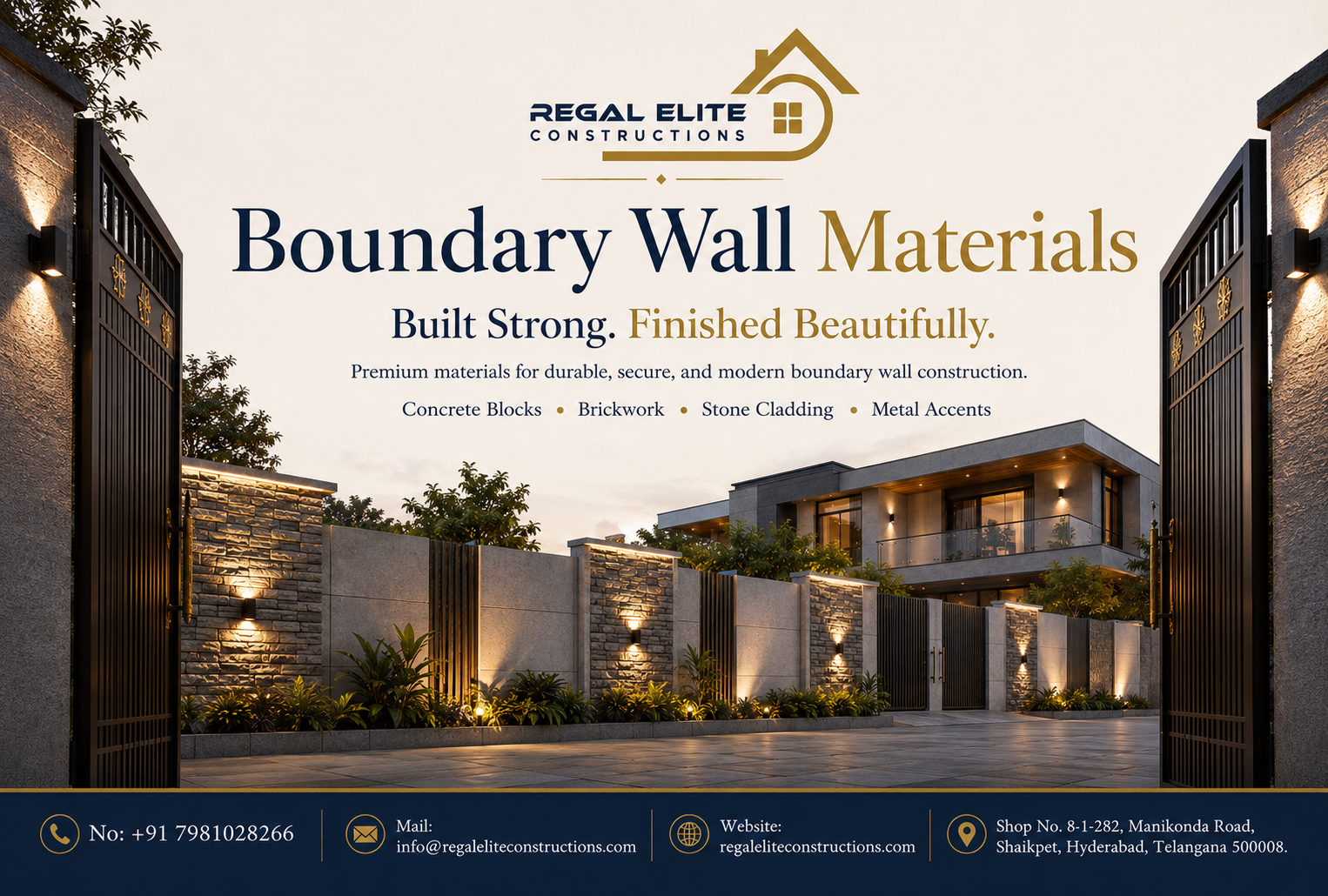
Choosing Boundary Wall Materials According to Property Type
Residential Homes
For independent houses, privacy and architectural appearance often receive the most attention. RCC columns combined with brick or concrete block masonry are common solutions. Stone, tiles, textured plaster, exterior paint and metal features can then transform basic Boundary Wall Materials into a modern elevation.
Luxury Villas
Villa walls often become an extension of the home's architectural identity. Natural stone, granite, architectural concrete, wood-look exterior products, decorative metal and lighting can complement structural Boundary Wall Materials.
For luxury properties, simplicity often produces better long-term results than excessive decoration. A limited material palette is usually easier to maintain and creates stronger visual consistency.
Farmhouses
Farmhouse boundaries can extend over substantial distances, so material economics become important. Precast concrete, masonry and strategically used stone are common options. The most economical Boundary Wall Materials should be assessed on total installed cost and expected maintenance rather than material price per unit.
Commercial Properties
Commercial boundaries often need to balance branding, visibility and security. RCC and masonry can be combined with grills or perforated metal screens. Low-maintenance Boundary Wall Materials are useful for properties where maintenance access may disrupt business activity.
Industrial Sites
Industrial boundary walls generally prioritize security, robustness and practical maintenance. Precast or reinforced masonry systems may be attractive because of installation speed and long boundary lengths. The exact Boundary Wall Materials should reflect security requirements and structural conditions.
Schools and Institutional Properties
Institutions need safe, stable and easily maintainable walls. Sharp architectural projections and difficult-to-maintain finishes may be undesirable. Durable, straightforward Boundary Wall Materials generally provide the most practical solution.
Resorts
Resorts often need perimeter security without creating a visually harsh environment. Natural stone, landscape planting and selective metal elements can soften the appearance of conventional Boundary Wall Materials.
Stone Cladding Over Masonry Boundary Walls
Stone cladding allows property owners to achieve a premium natural appearance without necessarily constructing the entire wall from solid stone. Brick, concrete block or RCC forms the main wall while stone becomes the visible finish.
This system combines two categories of Boundary Wall Materials: structural materials and finishing materials. Both need to be compatible.
Cladding installation must account for stone weight, substrate preparation, adhesive or fixing system, joints and moisture. Large or heavy stone pieces may require mechanical fixing depending on the specification.
Modern Boundary Wall Finishing Materials
Once structural Boundary Wall Materials are selected, the visible finish can be designed according to the property's architecture.
Exterior Paint
Exterior-grade paint remains one of the simplest ways to finish plastered walls. Lighter colours may also show less heat absorption than extremely dark shades.
Texture Coatings
Texture coatings can hide minor visual irregularities and create architectural depth. Heavy texture, however, tends to collect more dust.
Natural Stone
Granite, slate, sandstone and other stone products can create feature zones around entrances and columns without covering every square metre of the wall.
Porcelain and Exterior Tiles
Exterior-rated tiles provide numerous finishes but installation quality is critical. Expansion, adhesive selection and water ingress should all be considered.
Metal Screens
Laser-cut and perforated screens are widely used in contemporary architecture. They can contrast effectively with conventional Boundary Wall Materials while allowing partial visibility.
What Is the Most Durable Boundary Wall?
There is no universal answer because wall performance depends on the complete system rather than one product. For many permanent projects, an appropriately engineered reinforced concrete structural system with quality masonry infill and protective finishes provides excellent durability.
Natural stone can also perform exceptionally well. Precast concrete can offer excellent practicality. High-quality brick and concrete blocks remain proven Boundary Wall Materials when correctly used.
The key lesson is that durability comes from combining material selection with sound engineering and workmanship.
Which Boundary Wall Material Requires the Least Maintenance?
Precast concrete and properly constructed exposed stone can provide relatively low-maintenance solutions in appropriate applications. A rendered masonry wall may require periodic repainting.
However, maintenance cannot be predicted by comparing Boundary Wall Materials alone. Decorative coatings, metal elements, vegetation, water exposure and road pollution can significantly affect maintenance frequency.
Best Boundary Wall Materials for a Premium Look
Premium architecture does not necessarily mean selecting the most expensive material. A well-proportioned wall combining durable Boundary Wall Materials with carefully selected finishes often looks more sophisticated than a wall containing many decorative elements.
Popular premium combinations include:
- RCC and masonry with natural stone feature panels
- White or beige textured walls with charcoal metal grills
- Granite-clad gate columns with clean plastered wall sections
- Exposed concrete textures with landscape lighting
- Stone masonry with modern black metal gates
- Masonry with vertical fins and warm architectural lighting
Best Boundary Wall Materials for a Limited Budget
Budget-conscious construction should focus on lifecycle value. Good-quality brick or concrete block masonry supported by a properly designed RCC framework can provide excellent results without excessive decorative costs.
Instead of reducing the quality of essential Boundary Wall Materials, consider simplifying the elevation. Structural stability, foundation quality, mortar, reinforcement and waterproof protection should receive priority over expensive decorative elements.
Why Cheap Boundary Wall Construction Can Become Expensive
Low initial quotations can sometimes result from thinner wall sections, reduced reinforcement, poor materials, inadequate foundation work or omitted waterproofing details. Such reductions can create substantial future repair costs.
When comparing contractor quotations, request clarity about:
- Foundation dimensions
- Concrete grade
- Reinforcement
- Masonry unit specification
- Mortar
- Plaster thickness
- Coping
- Waterproofing
- Paint or finish system
- Gate column construction
This makes it easier to compare the real value of different Boundary Wall Materials and construction proposals.
Quality Checks Before Purchasing Boundary Wall Materials
- Purchase from established suppliers wherever possible.
- Check manufacturer specifications and applicable standards.
- Inspect bricks or blocks for major dimensional irregularities.
- Avoid visibly damaged or cracked units.
- Store cement away from moisture.
- Keep reinforcement appropriately stored before use.
- Verify stone quality before ordering the full quantity.
- Confirm colour and texture variations for natural materials.
- Use exterior-grade finishing products.
- Ensure water used for construction is suitable.
Quality inspection protects the value of your investment because defective Boundary Wall Materials become much more difficult and costly to replace after the wall is completed.
Importance of Good Mortar
Masonry units do not work independently. Mortar joints transfer loads and help create a unified wall. Poor mixing, inconsistent proportions, contaminated sand or premature drying can weaken otherwise good Boundary Wall Materials.
The appropriate mortar composition should follow project specifications and material requirements. Contractors should avoid arbitrary onsite changes simply to reduce cement consumption.
Why Curing Matters
Cementitious materials require proper curing to develop intended performance. Insufficient curing can contribute to surface weakness and cracking.
This means durable Boundary Wall Materials can still produce disappointing results when construction is rushed. Proper curing time should therefore be built into the project schedule rather than treated as an optional activity.
Importance of Expansion and Movement Considerations
Long boundary walls can experience movement from thermal variation, drying shrinkage, soil behaviour and structural action. Extremely long continuous walls may require appropriate movement detailing.
The need, location and design of joints should be determined professionally. Adding good Boundary Wall Materials without accounting for movement does not eliminate the potential for cracking.
Gate Pillars Need Special Attention
Gate locations create concentrated loads and frequent movement. Heavy sliding or swing gates should not simply be attached to inadequately designed masonry pillars.
Structural gate supports need to be designed according to the gate's dimensions, weight and mechanism. Strong Boundary Wall Materials should be combined with an appropriate RCC support system where necessary.
Should a Boundary Wall Use Natural Stone?
Natural stone is an excellent choice when durability and premium appearance are priorities. However, full stone masonry can be labour intensive, and some projects achieve a better cost-to-appearance ratio by using stone selectively.
For example, standard structural Boundary Wall Materials can be used for most wall surfaces while stone is reserved for gate columns, architectural bands or feature elevations.
Brick vs Concrete Block for Boundary Walls
Both materials can work effectively. Brick offers flexibility and familiarity, while concrete block construction can be faster because blocks are larger. Choosing between these Boundary Wall Materials should depend on material quality, wall design, local supply and contractor expertise.
Do not assume that one material is always superior. Poor-quality concrete blocks may perform worse than quality bricks, while poor bricks may perform worse than certified concrete masonry units.
AAC vs Brick for Boundary Walls
AAC is significantly lighter than conventional masonry and can simplify handling. Brick is denser and has a long history in external masonry applications.
When comparing these Boundary Wall Materials, consider wall height, impact exposure, structural support, moisture detailing, desired finish and manufacturer guidance.
CPWD documentation notes the insulation and embodied-energy benefits associated with AAC, but exterior boundary walls have different performance priorities from internal partitions. Material suitability must therefore be project-specific.
Precast vs Traditional Masonry Boundary Walls
Precast systems offer fast installation, making them attractive for industrial sites, vacant plots, farm boundaries and large developments. Traditional masonry provides greater flexibility for custom architecture and openings.
The correct choice of Boundary Wall Materials depends heavily on whether the project prioritizes speed, appearance, customization or construction economics.
RCC vs Masonry Boundary Wall
RCC and masonry frequently work together rather than competing against each other. A common approach uses reinforced concrete for structural columns and beams while bricks or blocks fill the panels between them.
This hybrid arrangement allows different Boundary Wall Materials to perform the roles for which they are best suited.
How High Should a Boundary Wall Be?
Wall height depends on privacy requirements, security, architecture, local regulations and structural feasibility. Higher walls experience greater wind effects and create additional foundation and structural demands.
Before increasing height, property owners should verify local permissions and have structural requirements reviewed. Changing height without modifying foundations or structural Boundary Wall Materials can create safety problems.
How to Increase the Life of a Boundary Wall
Durability begins before construction and continues throughout the wall's service life. Good Boundary Wall Materials combined with periodic inspections can reduce major repair costs.
- Design the foundation according to actual site conditions.
- Use quality masonry products and concrete materials.
- Provide adequate structural columns and beams where required.
- Protect the top of the wall with properly designed coping.
- Avoid water accumulation against the base.
- Repair cracks early before water penetrates deeper.
- Maintain paint and protective finishes.
- Control large tree roots near the foundation.
- Maintain metal components against corrosion.
- Inspect wall movement after nearby excavation or construction.
Role of Landscaping Around Boundary Walls
Landscaping can dramatically improve a boundary wall, but plant selection and placement matter. Large trees planted too close to foundations may eventually influence walls through root growth or soil-moisture changes.
Irrigation systems should also avoid continuously soaking masonry Boundary Wall Materials. Drip irrigation and suitable drainage can reduce unnecessary water exposure.
Architectural Lighting for Boundary Walls
Well-designed lighting can turn an ordinary boundary into an attractive night-time feature. Wall washers, recessed fixtures, pillar lights and landscape uplights are popular choices.
Electrical conduits should ideally be planned before plastering or cladding. Cutting into completed Boundary Wall Materials later can damage waterproofing and finishes.
Security Enhancements
A strong wall can be combined with security features such as controlled gates, CCTV systems, lighting and other legally appropriate measures. The security strategy should be integrated with the Boundary Wall Materials instead of added randomly after construction.
For commercial and high-value properties, camera positions and electrical conduits can be planned during construction to achieve a cleaner result.
Sustainable Boundary Wall Construction
Sustainability considerations are increasingly influencing material choices. Locally available products can reduce transportation requirements, while efficient structural design can reduce unnecessary material consumption.
CPWD publications discuss alternative materials such as AAC, cellular lightweight concrete, stabilized earth products and ferrocement. The best sustainable Boundary Wall Materials should nevertheless meet the project's durability and safety requirements rather than being selected only because they are marketed as environmentally friendly.
The Concrete Centre's technical resources on concrete and masonry walling also provide useful background on masonry wall systems and material performance.
Standards and Good Construction Practice
Material standards help define minimum specifications and test procedures for many construction products. The BIS National Building Code addresses materials, structural design, construction safety, sustainability and other aspects of building practice.
For lightweight concrete masonry, BIS maintains information for IS 6042, Code of Practice for Construction of Lightweight Concrete Block Masonry.
Using recognized specifications when selecting Boundary Wall Materials is preferable to purchasing products whose performance characteristics are unknown.
Common Boundary Wall Construction Mistakes
Choosing Materials Only by Price
The cheapest Boundary Wall Materials may increase plaster consumption, slow construction or require earlier repairs.
Weak or Inadequate Foundation
A foundation needs to correspond to the wall and site conditions. Copying foundation dimensions from another property is risky.
Long Unsupported Masonry Panels
Long masonry sections can be more vulnerable to cracking and movement. Structural column spacing should be determined appropriately.
Poor Drainage
Water sitting against the wall base can gradually damage finishes and accelerate moisture-related deterioration.
Flat Wall Tops
Flat tops can encourage standing water. Proper coping helps protect underlying Boundary Wall Materials.
Insufficient Curing
Rushing construction and neglecting curing reduces the quality of cement-based work.
Using Interior Products Outdoors
Paints, adhesives and cladding products should be rated for exterior conditions where required.
Ignoring Gate Loads
Heavy gates require proper support. Attaching them to weak columns can cause cracking or movement.
How Regal Elite Constructions Approaches Boundary Wall Projects
A durable wall begins with understanding the property rather than immediately choosing a decorative elevation. Regal Elite Constructions evaluates the application, site, architectural requirements and practical construction conditions before recommending Boundary Wall Materials.
A typical boundary wall planning process can involve:
- Site assessment
- Measurement of property boundaries
- Understanding wall-height requirements
- Reviewing ground levels
- Selecting suitable construction methods
- Planning structural support
- Selecting finishes and cladding
- Coordinating gate locations
- Planning lighting and electrical conduits
- Considering drainage
- Preparing quantities and execution stages
How to Compare Boundary Wall Quotations
Two quotations can appear to describe the same wall while specifying very different construction quality. Before comparing prices, determine whether each contractor is quoting equivalent Boundary Wall Materials and structural specifications.
Ask each contractor to clearly identify:
- Wall length and height
- Excavation scope
- Foundation specification
- RCC column specification
- Reinforcement quantity or design basis
- Masonry type
- Plaster specification
- Coping details
- Exterior finishing system
- Cladding area
- Gate supports
- Electrical works
- Debris disposal
A detailed scope makes the true cost of different Boundary Wall Materials easier to understand.
Lifecycle Cost Matters More Than Initial Price
A wall that costs slightly more initially but lasts longer with fewer repairs can deliver better value than a cheaper structure requiring frequent maintenance.
Lifecycle assessment should consider the cost of:
- Initial construction
- Exterior painting
- Waterproofing repairs
- Crack treatment
- Metal repainting
- Cladding repair
- Structural corrections
- Cleaning and routine maintenance
When Boundary Wall Materials are compared from this perspective, durable construction often becomes the more economical choice.
Are Decorative Boundary Walls Durable?
Yes, decorative walls can be durable when architecture does not compromise basic construction principles. Problems arise when decorative components create water traps, unsupported projections or difficult joints between incompatible Boundary Wall Materials.
A successful decorative wall should look attractive while still allowing water to drain, surfaces to be maintained and structural elements to perform correctly.
Can an Existing Boundary Wall Be Upgraded?
Existing walls can sometimes be upgraded with plaster repairs, paint, stone cladding, metal screens, new coping, lighting and redesigned gate columns. However, the structural condition should be checked first.
Adding heavy finishing Boundary Wall Materials to a weak or unstable wall is not advisable. Structural defects should be addressed before cosmetic improvements.
Maintenance Schedule for Long-Lasting Boundary Walls
Every Few Months
Visually inspect the wall after severe rain, neighbouring excavation or unusual ground changes.
Annually
Check cracks, coping, drainage points, metal corrosion and loose cladding. Minor issues are easier to correct before they affect underlying Boundary Wall Materials.
When Paint Deteriorates
Exterior coatings should be renewed according to exposure conditions and product recommendations rather than waiting until widespread peeling occurs.
After Major Nearby Construction
Deep excavation or heavy construction near a property boundary can affect surrounding ground. Inspect the wall if nearby conditions change significantly.
Expert Recommendations for Durable Boundary Wall Construction
For homeowners and developers seeking long-term value, the following principles are more important than chasing a single "best" product:
- Choose Boundary Wall Materials according to application rather than popularity.
- Do not underestimate foundation requirements.
- Use structural engineering for tall, unusual or load-retaining walls.
- Purchase masonry units from reliable manufacturers or suppliers.
- Use quality concrete and reinforcement.
- Plan drainage before construction.
- Protect the top of the wall against rainwater.
- Use exterior-rated finishes.
- Plan gate columns independently according to gate loading.
- Inspect workmanship throughout construction rather than only at completion.
Frequently Asked Questions About Boundary Wall Materials
1. Which material is best for a long-lasting boundary wall?
RCC combined with quality masonry is one of the most widely used durable solutions, while natural stone and precast concrete can also provide excellent longevity. The best Boundary Wall Materials depend on wall height, soil conditions, architectural requirements, budget and expected maintenance.
2. Is brick good for boundary wall construction?
Yes. Good-quality burnt clay bricks can produce durable exterior masonry when used with appropriate mortar, structural support, plaster, coping and moisture protection. Brick remains one of the most established Boundary Wall Materials for residential construction.
3. Are concrete blocks better than bricks?
Concrete blocks have larger dimensions and can accelerate construction. Brick offers excellent versatility and widespread mason familiarity. Neither is automatically better in every situation. Quality of the individual units and the overall wall design matter more than the material name alone.
4. Can AAC blocks be used for an exterior boundary wall?
AAC may be used in suitable wall applications, but exterior boundary conditions involve moisture and impact exposure. If AAC is being considered among Boundary Wall Materials, its suitability, thickness, structural framework, exterior protection and manufacturer recommendations should be evaluated specifically for the project.
5. Is natural stone suitable for Hyderabad boundary walls?
Yes. Suitable natural stone can provide excellent durability and architectural appearance. Quality, porosity, jointing and construction method should be considered, particularly where the stone remains exposed rather than protected by another finish.
6. Which boundary wall is best for a farmhouse?
For long farmhouse boundaries, precast concrete can provide fast installation, while stone and masonry can offer a more premium appearance. The ideal Boundary Wall Materials depend on perimeter length, desired privacy, security level and overall project budget.
7. Which boundary wall requires the least maintenance?
Well-constructed precast concrete and suitable exposed natural stone can be relatively low maintenance. Plastered masonry walls generally need exterior coating maintenance over time. Maintenance also depends on drainage, vegetation and pollution exposure.
8. Why do boundary walls develop cracks?
Cracks may be caused by settlement, thermal movement, drying shrinkage, insufficient structural support, nearby excavation, poor workmanship or foundation problems. They should not automatically be blamed on the visible Boundary Wall Materials.
9. How can I prevent rainwater damage?
Provide properly designed coping, drainage and exterior coatings, and avoid stagnant water along the base. Good rainwater detailing protects plaster, paint and masonry from premature moisture damage.
10. Should RCC columns be used in every boundary wall?
The structural arrangement depends on wall height, length, masonry type and site conditions. RCC columns are commonly used to divide masonry panels and provide structural support, but their dimensions and spacing should be determined for the specific project.
11. What material is best for a luxury villa boundary wall?
Luxury villas often combine structural masonry and RCC with natural stone, granite, metal screens, texture coatings and lighting. Premium appearance is usually achieved by combining reliable Boundary Wall Materials with a restrained architectural design.
12. Is a precast boundary wall durable?
Quality precast concrete systems can provide very good durability. Panel reinforcement, post spacing, concrete quality, foundations and installation all influence long-term performance.
Authoritative Resources for Further Reading
Property owners, architects, engineers and developers who want additional technical information about Boundary Wall Materials, concrete, masonry and building standards can refer to these recognized resources:
- Bureau of Indian Standards – National Building Code of India
- Bureau of Indian Standards – Building Materials Handbook
- Central Public Works Department – Integrated Green Design Material Guidance
- American Cement Association – Concrete Resilience and Durability
- The Concrete Centre – Concrete and Masonry External Walling
- BIS Standards Portal – Search Indian Standards
Why Professional Boundary Wall Construction Makes a Difference
A boundary wall may appear simple compared with a complete building, but it is a long, slender structure exposed continuously to weather. Minor mistakes repeated over tens or hundreds of metres can become expensive defects.
Professional construction brings together suitable Boundary Wall Materials, accurate setting-out, excavation, foundation preparation, structural work, masonry, curing, drainage and finishing into one coordinated process.
It also helps property owners plan features such as gates, security systems, electrical conduits and landscape elements before the work is finished rather than cutting into a completed wall later.
Final Material Selection Checklist
Before confirming Boundary Wall Materials, ask these questions:
- What security level is required?
- How high will the wall be?
- Does the wall retain soil anywhere?
- What are the ground and drainage conditions?
- How much maintenance is acceptable?
- Is rapid installation important?
- What architectural style should the wall match?
- Will cladding be installed?
- Will heavy gates be connected to the wall?
- Are lighting and CCTV conduits required?
- Which materials are reliably available locally?
- Has the structural system been reviewed appropriately?
Conclusion: Choosing Boundary Wall Materials for Long-Term Durability
A durable property boundary cannot be created by choosing one premium product and ignoring the rest of the construction process. Successful walls combine suitable Boundary Wall Materials with correct foundations, sound structural detailing, quality workmanship, moisture management and practical maintenance.
RCC offers excellent structural possibilities. Brick remains versatile and widely available. Concrete blocks can make construction faster. Precast systems are practical for large boundaries. Natural stone offers exceptional architectural character. AAC and alternative masonry products can be suitable for selected applications. The right decision is the one that matches the actual property rather than following a generic trend.
For Hyderabad homeowners, villa developers, farmhouse owners and commercial property managers, climatic exposure should also form part of material selection. Summer heat, monsoon rain, soil conditions and changing surrounding development can all influence boundary wall performance.
Instead of selecting Boundary Wall Materials only according to initial cost, consider the wall's expected service life, future maintenance, repair accessibility and architectural value. A properly designed wall can protect a property for decades while enhancing privacy, security and curb appeal.
Regal Elite Constructions can assist property owners with planning and construction solutions for residential, commercial, villa, farmhouse and premium outdoor development projects. Careful material selection at the beginning helps ensure that your Boundary Wall Materials deliver the durability, strength and appearance expected from a permanent property investment.
About Regal Elite Constructions
Regal Elite Constructions provides construction solutions in Hyderabad with a focus on durable execution, functional planning and contemporary architectural design. Whether you are developing a new property, upgrading an existing boundary, planning a farmhouse, building a premium villa or creating an integrated outdoor space, the right construction approach begins with understanding your site and selecting appropriate Boundary Wall Materials.
Contact Regal Elite Constructions
Contact Regal Elite Constructions to discuss suitable Boundary Wall Materials, construction methods, finishes and design options for your Hyderabad property.
Phone: +91 79810 28266
Email: regaleliteconstructions@gmail.com
Address:
Shop No. 8-1-282,
Manikonda Road, Shaikpet,
Hyderabad, Telangana 500008.