
Infinity Pool Cost: Design and Construction Factors
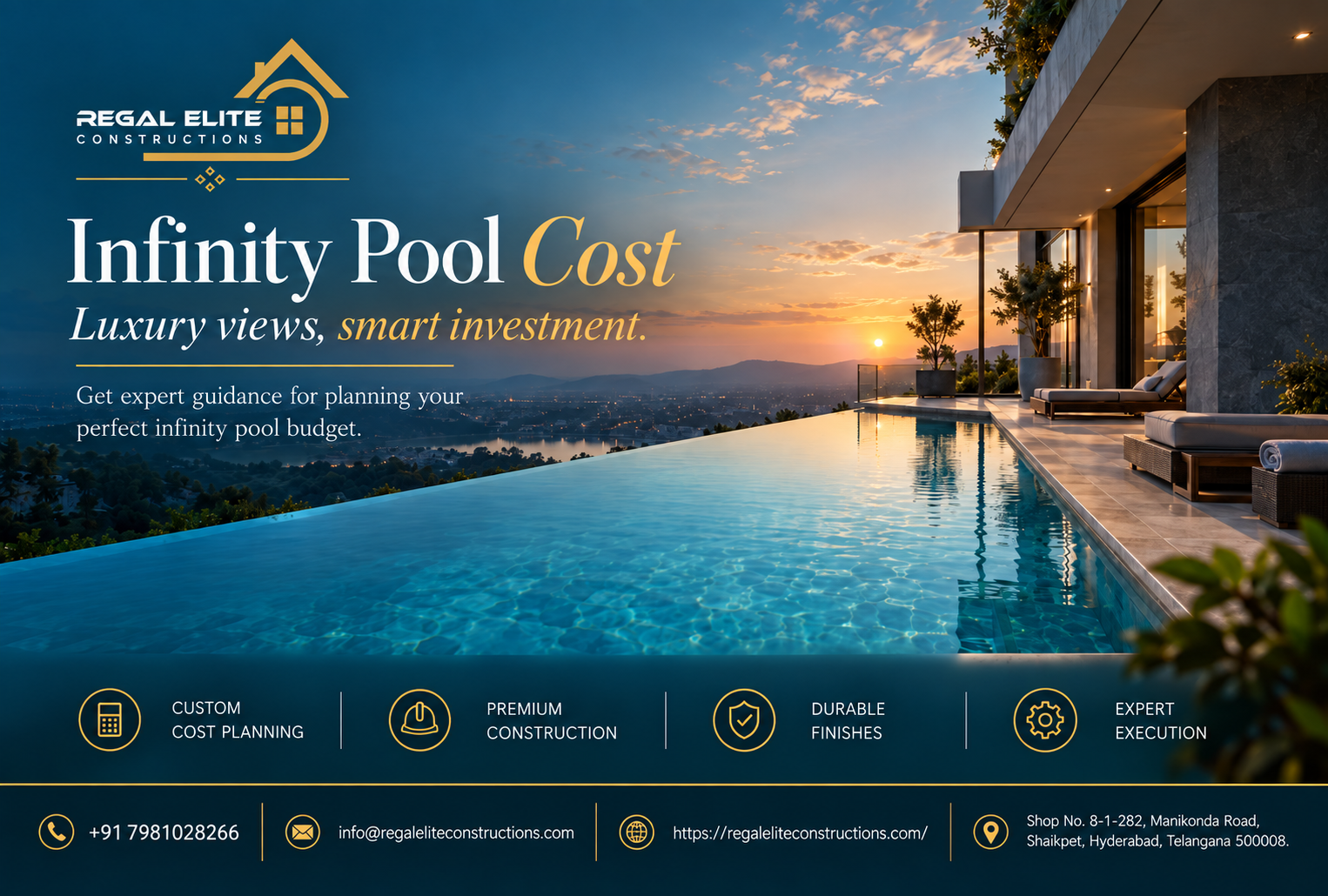
An infinity pool can transform an ordinary terrace, villa garden, farmhouse, resort, or premium residence into an architectural focal point. Unlike a conventional swimming pool, the water appears to disappear over one or more edges, creating a continuous visual connection with the horizon, landscape, skyline, or surrounding architecture. That visual simplicity, however, depends on complex structural, hydraulic, waterproofing, and finishing work. For that reason, understanding Infinity Pool Cost requires much more than calculating the length and width of the swimming area.
For property owners in Hyderabad and surrounding areas, Infinity Pool Cost is influenced by site elevation, soil conditions, access for excavation, structural engineering, the number of overflow edges, balancing-tank capacity, filtration equipment, waterproofing, finishes, lighting, deck construction, landscaping, and the level of customization. A realistic budget should therefore begin with design and engineering rather than a generic square-foot rate.
1. Why Infinity Pools Cost More Than Conventional Pools
The first reason Infinity Pool Cost is normally higher than the budget for a conventional pool is the additional engineering required to create the vanishing-edge effect. A standard swimming pool keeps water within a single structural shell. A vanishing-edge design intentionally allows water to flow over a precisely formed edge into a lower collection channel or catch basin. The water must then be transferred through the circulation system and returned to the main pool.
This arrangement means there may effectively be two water-retaining structures: the primary pool and the overflow or balancing system. Both must be structurally stable and carefully waterproofed. Additional plumbing, drainage, pumps, control valves, level sensors, overflow channels and finishing work can also increase Infinity Pool Cost.
The visual edge itself demands unusually accurate construction. Even a relatively small difference in level can cause water to overflow heavily at one point while appearing dry at another. Achieving a uniform sheet of water requires accurate surveying, shuttering, concrete finishing and final edge adjustment. These elements explain why Infinity Pool Cost should be evaluated on engineering quality rather than simply comparing the lowest contractor quotation.
2. Pool Size, Depth and Water Volume
Pool dimensions have a direct effect on Infinity Pool Cost. Increasing length or width means additional excavation, reinforcement, concrete, waterproofing, tiles, coping, plumbing and water volume. Larger pools may also need higher-capacity pumps and filtration systems to maintain effective circulation.
Depth matters as well. A shallow leisure pool can have very different structural and excavation requirements from a deeper pool. Deeper walls hold greater volumes of water and may require more reinforcement depending on structural calculations, soil pressure, groundwater conditions and whether the structure is fully buried, partially exposed or elevated. Consequently, Infinity Pool Cost should be calculated from actual engineering drawings rather than external dimensions alone.
Owners can sometimes control Infinity Pool Cost by selecting dimensions that match the way the pool will actually be used. A private villa may not require resort-scale depth throughout the pool. Creating a comfortable shallow relaxation zone combined with a suitable swimming section can improve usability while limiting unnecessary excavation and structural volume.
| Design Decision | Potential Budget Effect | Planning Advice |
|---|---|---|
| Longer pool | More structure, waterproofing and finishing | Match length to actual swimming requirements |
| Greater width | Increased water area and deck interface | Allow comfortable circulation without oversizing |
| Greater depth | More excavation and structural demand | Select depth according to intended use |
| Multiple depth zones | More complex forming and finishing | Use where it adds meaningful functionality |
3. Number and Length of Vanishing Edges
One of the biggest architectural decisions affecting Infinity Pool Cost is whether the pool has one disappearing edge, two adjacent overflow edges, or a more elaborate perimeter-overflow concept. A single carefully positioned edge facing the strongest view is usually more straightforward than extending the effect around multiple sides.
Every additional overflow edge increases the length that must be constructed to tight tolerances. It can also increase the size of the catch channel and the amount of water that moves out of the main pool when swimmers enter. Hydraulic calculations become more important as overflow length increases. For this reason, Infinity Pool Cost can rise significantly when the design moves from a simple single-edge arrangement to a multi-edge architectural pool.
The most expensive design is not automatically the most attractive. A well-positioned single edge overlooking a garden, valley, city skyline or open landscape can create a stronger visual effect than multiple edges that do not align with a meaningful view. A professional designer can therefore help reduce Infinity Pool Cost while preserving the visual impact by concentrating the infinity treatment where it contributes most.
4. Site Elevation, Slope and Existing Ground Conditions
Site conditions can change Infinity Pool Cost before construction even begins. Infinity pools often work beautifully on sloped sites because the lower side naturally accommodates the catch basin and creates an uninterrupted horizon. However, steep or unstable land may require retaining structures, deeper foundations or additional soil stabilization.
A level residential plot presents different challenges. The design may need to create artificial elevation so the disappearing edge can be seen effectively. This can mean constructing raised walls or altering surrounding landscaping. Rock excavation, loose fill, groundwater and restricted machinery access can further increase Infinity Pool Cost.
Before fixing the pool location, the contractor and structural team should study existing levels, drainage routes, nearby foundations, trees, underground utilities and vehicle access. Spending time on site assessment can make Infinity Pool Cost much more predictable because major civil challenges are identified before excavation begins.
5. Structural Engineering and RCC Construction
A reinforced-concrete pool shell is one of the most important contributors to Infinity Pool Cost. The structure must resist the pressure created by the water inside the pool as well as soil, groundwater and other loads outside it. Elevated pools and pools integrated with buildings require even more careful engineering.
Reinforcement diameter, spacing, concrete grade, wall thickness and foundation design should be determined according to project conditions. The infinity wall may also have a different structural configuration because water flows across its top and the outside face can be visible. Cutting structural quality to reduce Infinity Pool Cost can result in cracks, leakage and expensive repairs later.
The shell should also be coordinated with pipe penetrations, drains, lights, skimmers where applicable, inlets and other embedded components before concrete placement. Breaking completed RCC later to add forgotten services introduces unnecessary risk. A detailed coordinated drawing package helps keep Infinity Pool Cost under control by reducing rework during construction.
6. Catch Basin and Balance Tank Requirements
The catch basin is fundamental to the infinity effect and has a noticeable influence on Infinity Pool Cost. Its job is to collect water flowing over the disappearing edge and provide sufficient reserve volume for displacement caused by swimmers, wind and operating conditions.
If the basin is undersized, the system may struggle to maintain a consistent water level and water can be wasted through uncontrolled overflow. An oversized tank, on the other hand, adds unnecessary excavation, structure and waterproofing. Correct sizing therefore protects both performance and Infinity Pool Cost.
Depending on the architectural layout, the balancing system may be positioned immediately behind the edge, beneath the deck, below the pool level or in another accessible service location. Maintenance access should be considered from the beginning. Designing a tank that technicians cannot easily inspect may reduce convenience for years. Good planning ensures that Infinity Pool Cost includes a practical hydraulic system rather than only the visible elements of the pool.
7. Hydraulic Design, Pumps and Circulation
Hydraulic engineering has a major influence on Infinity Pool Cost. Water must circulate through the main pool, overflow edge, catch basin, filtration equipment and return lines at a rate that supports both appearance and water quality. The overflow system may also require dedicated pumping depending on the design.
Pipe diameter, pump selection, suction arrangements, return locations and filtration capacity should work as one coordinated system. Poorly sized pipes can increase resistance and force pumps to work harder. Incorrect return placement may create areas of weak circulation. These problems can increase operating expenses even if the initial Infinity Pool Cost appeared attractive.
A professional equipment schedule should identify pump duty, filter size, valves, strainers, control components and electrical requirements before purchasing equipment. Choosing equipment simply because it has the lowest purchase price can create higher running costs or poor water movement. Efficient hydraulic planning improves performance and allows the owner to understand both construction expenditure and long-term Infinity Pool Cost.
8. Waterproofing and Leakage Prevention
Waterproofing deserves a protected portion of Infinity Pool Cost because the entire structure remains exposed to continuous water pressure. Infinity designs introduce additional joints, overflow channels and external faces that must remain watertight.
Surface preparation is just as important as the waterproofing material. Honeycombs, cracks, tie holes, construction joints and pipe penetrations need careful treatment before the final system is applied. Waterproofing should also be compatible with the tile adhesive or internal finish selected for the project. Attempting to reduce Infinity Pool Cost by applying a thin decorative coating over an inadequately prepared shell can create problems that are difficult to repair after tiling.
Water testing at appropriate stages helps identify leakage before expensive finishes are installed. Contractors should also document the products, application sequence and curing requirements used on the project. When properly planned, Infinity Pool Cost includes not merely a waterproofing product but a complete method for protecting the structure.
9. Tiles, Mosaics and Interior Finishes
Finishing materials can move Infinity Pool Cost from a practical budget to a premium one. Ceramic pool tiles, porcelain products, glass mosaics, natural-stone details and specialty finishes all have different material and installation costs.
Dark blue, turquoise and grey finishes influence the perceived colour of the water differently. In an infinity pool, the internal finish should also complement the surrounding landscape because the water surface visually merges with the background. Premium mosaics may create an impressive result, but the labour required for detailed installation can increase Infinity Pool Cost.
Slip resistance, chemical compatibility, submerged use and ease of cleaning should be considered along with appearance. The overflow edge requires particular care because it is constantly wet and highly visible. A combination of high-quality materials in prominent zones and more economical finishes in less visible areas can sometimes control Infinity Pool Cost without sacrificing the overall character of the project.
10. Decking, Coping and Surrounding Landscape
Homeowners frequently concentrate on the swimming pool shell when estimating Infinity Pool Cost, but the surrounding deck can represent a significant additional investment. Natural stone, porcelain outdoor tiles, composite decking, drainage channels, steps, seating and landscaping all influence the completed space.
The deck should slope appropriately so rainwater and wash water do not run directly into the pool. Surface materials should be selected for wet-area suitability, comfortable barefoot use and maintenance requirements. If large-format stone or custom coping is selected, fabrication and installation can increase Infinity Pool Cost.
Landscape design also determines how successfully the pool integrates with the property. Thoughtful planting, lighting and seating can make a modestly sized pool feel more luxurious than a larger pool surrounded by unfinished paving. Owners should therefore evaluate Infinity Pool Cost as the cost of a complete outdoor environment rather than budgeting for the water body in isolation.
11. Lighting and Electrical Systems
Underwater lighting changes how an infinity pool performs after sunset and is another factor in Infinity Pool Cost. LED fixtures can highlight the disappearing edge, steps, benches and architectural geometry while also improving visibility around the water.
The number and placement of fixtures should be determined before structural and waterproofing work is completed so conduits, niches and junction arrangements can be coordinated. Landscape lighting, deck lighting, equipment-room circuits and automation panels may also form part of the electrical scope. If these elements are added late, modifications can increase Infinity Pool Cost.
Electrical installation around water should always follow applicable safety requirements and be completed by qualified professionals. Owners should ask the contractor to define whether transformers, control panels, cabling, earthing, fixtures and automation are included in the quotation. A transparent specification prevents disagreement about Infinity Pool Cost when the project reaches the electrical-finishing stage.
12. Automation and Smart Pool Controls
Automation can increase initial Infinity Pool Cost but can make daily operation easier. Depending on the equipment selected, owners may be able to schedule circulation, control lighting, manage water features, monitor certain operating conditions and integrate pool systems with broader home automation.
The value of automation depends on how the property is used. A full-time residence may need a different solution from a weekend farmhouse or resort. Sophisticated controls are not useful if replacement parts and technical support are difficult to obtain locally. Selecting dependable components can therefore be more important than maximizing the number of functions included in Infinity Pool Cost.
Even when advanced automation is not included during initial construction, it can be sensible to plan spare conduits and electrical capacity for future upgrades. This relatively small preparation can reduce later disruption and keeps future Infinity Pool Cost more manageable if additional equipment is installed.
13. Infinity Pool Construction on Rooftops and Elevated Structures
A rooftop installation can substantially change Infinity Pool Cost because the pool becomes part of the building structure rather than a structure supported directly on the ground. Water is extremely heavy, and the pool shell, finishes, equipment and occupants all add to the load.
Structural engineers must verify that the building can safely accommodate the proposed loads. New buildings can be designed around the pool from the beginning, while existing buildings may require strengthening or may not be suitable for the desired size. Additional waterproofing, drainage and access challenges can further increase Infinity Pool Cost.
Elevated aquatic venues also deserve careful attention to overflow management. Water should not be allowed to damage façades, occupied spaces or services below. Industry organizations such as the Pool & Hot Tub Alliance publish standards addressing elevated pools integrated into structures. Considering such guidance during design creates a more responsible approach to Infinity Pool Cost and long-term building protection.
14. Labour, Craftsmanship and Precision
Skilled labour represents an important part of Infinity Pool Cost. Vanishing-edge construction requires several trades to work accurately together: surveyors, steel workers, formwork teams, concrete crews, waterproofing specialists, plumbers, electricians and tile installers.
A small error in the overflow level can become obvious once water begins moving across the edge. Similarly, poorly aligned tiles or an uneven channel can reduce the premium appearance even when expensive materials are used. Choosing skilled labour can therefore increase initial Infinity Pool Cost but improve the finished result considerably.
The contractor's coordination ability is equally important. Pool construction involves many hidden stages, and later work can cover the quality of earlier work. Stage inspections, photographic documentation and clear checklists help ensure each element is completed before it becomes inaccessible. Owners comparing Infinity Pool Cost quotations should examine workmanship standards and supervision rather than focusing only on the final price.
15. Hyderabad Climate and Seasonal Conditions
Local climate should be included when planning Infinity Pool Cost. Hyderabad experiences strong summer heat as well as seasonal rainfall, so outdoor pools need adequate deck drainage, equipment protection and landscaping that performs in both dry and wet conditions.
Evaporation can become important during hot, dry periods. The U.S. Environmental Protection Agency's WaterSense guidance notes that pool covers can substantially reduce evaporation when properly used. While an infinity edge creates a beautiful appearance, moving water can increase exposure to air. Practical water-management decisions can therefore influence the lifetime Infinity Pool Cost.
Equipment areas should also be planned so they remain accessible during heavy rain and protected against water accumulation. The landscape should direct stormwater away from the pool rather than allowing soil, leaves and contaminants to wash into the water. Considering local weather at design stage makes Infinity Pool Cost more realistic because drainage and protection are included before construction rather than added after problems appear.
16. Water Treatment and Filtration Quality
Filtration and water treatment form an essential part of Infinity Pool Cost. Clear water depends on effective circulation, filtration, cleaning and appropriate chemical management rather than appearance alone.
The U.S. Centers for Disease Control and Prevention recommends routine monitoring of disinfectant and pH levels in swimming pools, while the World Health Organization publishes guidance addressing health risks and management of swimming pools and similar recreational environments. India also has the Bureau of Indian Standards specification IS 3328:2026 covering quality requirements for swimming-pool water. Reliable treatment equipment should therefore be treated as a core component rather than an optional addition to Infinity Pool Cost.
The selected filtration system should suit pool volume, expected usage and operating requirements. Pumps, filters, dosing equipment and plumbing should be accessible for servicing. A beautifully constructed pool can become difficult to own if routine maintenance is complicated. A complete Infinity Pool Cost assessment should therefore consider both construction and the practical operation of clean, comfortable water.
17. Pool Safety and Access Planning
Safety provisions contribute to responsible Infinity Pool Cost. The design should consider safe entry and exit, steps, ladders where appropriate, non-slip surfaces, lighting, deck circulation, depth transitions and access control.
Properties used by families with children may require barriers or additional protective measures according to applicable regulations and project conditions. Hospitality facilities need broader consideration because pools may be used by guests with different swimming abilities. Industry standards from organizations such as the Pool & Hot Tub Alliance can help project teams understand accepted approaches, while local requirements must always take priority. These provisions should be considered when establishing Infinity Pool Cost.
The vanishing edge itself should not be treated as an ordinary seating or walking edge unless specifically designed for that purpose. The lower catch area should also be protected appropriately. Incorporating safety into drawings before construction is normally more economical than modifying completed work, making early safety planning an important part of responsible Infinity Pool Cost.
18. How Design Complexity Changes the Budget
Architectural complexity is one of the easiest ways for Infinity Pool Cost to expand. Curved walls, unusual geometry, integrated spas, sunken seating, acrylic viewing panels, bridges, waterfalls, fountains and fire features can all add specialized construction requirements.
A simple rectangular pool can still look highly luxurious when proportions, finishes, views and landscaping are carefully coordinated. In many cases, simplifying geometry allows more of the budget to be invested in waterproofing, equipment and premium visible finishes. This approach can control Infinity Pool Cost without producing a basic-looking result.
Owners should separate "must-have" features from optional enhancements during concept design. Pricing the core pool first and then adding options makes financial decisions much easier. When everything is included in one initial design, it can be difficult to understand which features are driving Infinity Pool Cost beyond the target budget.
19. A Practical Cost Breakdown by Construction Stage
Instead of asking for one headline figure, property owners should divide Infinity Pool Cost into construction packages. This makes quotations easier to understand and allows competing proposals to be compared using the same scope.
| Project Stage | Typical Scope | Key Cost Driver |
|---|---|---|
| Design | Concept drawings, dimensions, engineering coordination | Complexity and number of revisions |
| Site preparation | Setting out, excavation, disposal and access | Ground conditions |
| RCC structure | Steel, shuttering and concrete | Structural design |
| Waterproofing | Surface treatment, joints and membranes/coatings | System specification |
| Hydraulics | Pipes, channels, balance system and circulation | Pool volume and overflow length |
| Equipment | Pumps, filters, valves and treatment systems | Brand and capacity |
| Finishes | Tiles, mosaics, coping and grout | Material selection |
| Electrical | Lighting, controls and power connections | Automation level |
| External works | Deck, drainage and landscaping | Finish area and landscape scope |
A detailed bill of quantities or scope schedule makes Infinity Pool Cost easier to monitor during construction. It also identifies items that have been excluded from a quotation.
Owners should particularly check whether excavation disposal, waterproofing, electrical cabling, equipment-room construction, deck drainage, pool filling, testing and commissioning are included. Transparent scope definition reduces the chance that Infinity Pool Cost will increase unexpectedly through variations.
20. How to Control the Budget Without Reducing Quality
Controlling Infinity Pool Cost does not require compromising structural integrity or waterproofing. The best savings normally come from simplifying architecture, choosing practical dimensions and limiting unnecessary features.
A single vanishing edge can be prioritized toward the property's best view rather than extending overflow around several sides. Standardized tile sizes may reduce installation labour compared with intricate custom patterns. Equipment can be selected for dependable performance rather than unnecessary capacity. These decisions help reduce Infinity Pool Cost while maintaining the features that users notice most.
Owners should avoid cutting budgets in critical areas such as structural engineering, reinforcement, waterproofing, electrical safety and hydraulic sizing. Saving money on hidden systems can result in repairs that cost considerably more later. The goal should be value engineering: spending intelligently where performance matters and simplifying decorative elements where they offer limited benefit. This creates a more balanced Infinity Pool Cost strategy.
21. Professional Planning, Local Permissions and Trusted Resources
A responsible Infinity Pool Cost estimate should be prepared only after checking the property, confirming dimensions and understanding structural requirements. Projects integrated with buildings, rooftops, retaining walls or major external works may also interact with local building-permission requirements.
For Hyderabad properties, owners can consult the official Greater Hyderabad Municipal Corporation building-permission information and work with qualified architects or consultants to determine what approvals apply to the specific project. Regulatory requirements vary according to property and project type, so assumptions should not be used when establishing Infinity Pool Cost.
Authoritative Resources for Pool Design, Water Quality and Construction Planning
- World Health Organization – Guidelines for Safe Recreational Water Environments: Swimming Pools
- CDC – Home Pool and Hot Tub Water Treatment and Testing
- CDC – Operating and Managing Public Pools
- Pool & Hot Tub Alliance – ANSI/PHTA Pool Standards
- Bureau of Indian Standards – Indian Standards Portal
- U.S. EPA WaterSense – Pool Water Efficiency
- Greater Hyderabad Municipal Corporation – Building Permission
Engineering, water quality, safety and approval requirements should be treated as essential parts of the project. When these factors are considered before construction starts, Infinity Pool Cost becomes much more predictable and the completed pool is easier to operate responsibly.
22. Choosing the Right Infinity Pool Contractor in Hyderabad
Selecting a contractor solely according to Infinity Pool Cost can be risky because two quotations may represent very different scopes. One contractor may include a complete RCC shell, waterproofing, filtration, lighting and commissioning, while another quotation may exclude several of those items.
Ask potential contractors to explain their construction sequence, reinforcement approach, waterproofing system, overflow design, equipment specification, testing method and after-sales support. Review completed projects where possible and request drawings or specifications that clearly define what is being built. A detailed quotation makes Infinity Pool Cost easier to compare objectively.
For additional planning information, read Regal Elite Constructions' guide to swimming pool construction in Hyderabad for homes, villas and resorts. You can also explore Regal Elite Constructions for professional construction solutions. A contractor who combines architecture, civil construction, hydraulics, waterproofing and finishing under coordinated supervision can provide far greater long-term value than choosing the lowest initial Infinity Pool Cost.
Frequently Asked Questions
1. What is the average Infinity Pool Cost in Hyderabad?
There is no universal rate because Infinity Pool Cost depends on size, depth, site conditions, RCC requirements, overflow-edge length, catch-basin design, waterproofing, equipment and finishes. A compact residential design on an accessible plot can have a very different budget from an elevated villa pool or resort installation.
The most reliable way to determine Infinity Pool Cost is to prepare dimensions and a preliminary design, inspect the site and obtain a detailed scope-based quotation. Ask for separate values for civil construction, waterproofing, plumbing, filtration, electrical work, finishes, deck work and optional features so you can understand where the budget is being spent.
2. Why is Infinity Pool Cost higher than a normal swimming pool?
Infinity Pool Cost is generally higher because a vanishing-edge pool requires an overflow wall, collection channel or catch basin, additional plumbing and more precise construction. The edge must be extremely level so water flows uniformly across its full length.
There may also be additional structural, waterproofing and hydraulic requirements compared with a conventional pool. The design can involve more exposed surfaces, balance-volume calculations and additional equipment. These elements add construction complexity, which is why comparing Infinity Pool Cost directly with a standard pool price can be misleading unless both quotations include the same scope.
3. What factors have the biggest effect on Infinity Pool Cost?
The largest contributors to Infinity Pool Cost usually include pool dimensions, structural design, site excavation, number of disappearing edges, catch-basin size, waterproofing, pumps, filtration equipment, tile selection, deck finishes and landscaping.
Site conditions can sometimes have an even greater impact than finishes. Rock excavation, steep land, restricted access, rooftop construction and retaining walls may significantly change project requirements. For this reason, a professional site inspection should be completed before treating any preliminary Infinity Pool Cost figure as a final quotation.
4. Can Infinity Pool Cost be reduced without compromising quality?
Yes. Infinity Pool Cost can often be reduced by simplifying pool geometry, limiting the vanishing effect to the side with the best view, selecting practical dimensions and avoiding decorative features that do not improve everyday use.
Owners can also choose durable mid-range tiles rather than highly customized mosaics, optimize deck area and select appropriately sized equipment instead of oversizing. However, structural design, RCC quality, waterproofing, hydraulic engineering and electrical safety should not be reduced simply to achieve a lower Infinity Pool Cost. Those systems protect the pool's long-term performance.
5. Does a rooftop location increase Infinity Pool Cost?
In many situations, rooftop installation increases Infinity Pool Cost because structural loading, access, waterproofing, drainage and equipment placement require additional engineering. The existing building must be assessed to confirm whether it can safely support the proposed pool.
Construction materials may also be more difficult to move to the roof, and there may be limitations on excavation, equipment-room location and plumbing routes. New buildings can often incorporate these requirements more efficiently because the structure is designed around the pool from the beginning. For existing buildings, Infinity Pool Cost should not be estimated until structural feasibility has been reviewed by qualified professionals.
6. How does maintenance affect long-term Infinity Pool Cost?
Construction is only part of Infinity Pool Cost. Long-term expenses include electricity for pumps, water replacement, filtration maintenance, cleaning, water-treatment chemicals, equipment servicing and occasional repairs.
Efficient hydraulic design and correctly sized equipment can help control operating expenses. Pool covers, where practical for the specific design, can also reduce evaporation when the pool is not being used. Routine testing and preventive maintenance can identify small issues before they become major repairs. Owners comparing quotations should therefore examine expected operating requirements as well as the initial Infinity Pool Cost.
7. How can I get an accurate Infinity Pool Cost quotation?
To receive an accurate Infinity Pool Cost quotation, provide the contractor with the project location, approximate length, width and depth, preferred overflow-edge location, expected finishes and any special features. A physical site inspection should then identify access, levels, excavation conditions and structural constraints.
Request a written quotation that defines inclusions and exclusions for design, excavation, RCC, waterproofing, plumbing, filtration, electrical work, lighting, tiles, coping, deck work, landscaping, testing and commissioning. The clearer the project scope becomes before construction, the more reliable the final Infinity Pool Cost will be.
Final Thoughts
An infinity pool is an architectural and engineering feature rather than simply a decorative swimming pool. Its quality depends on the coordination of structure, overflow geometry, water circulation, waterproofing, filtration, electrical systems, finishing and landscaping. Property owners should therefore evaluate quotations according to the complete construction system instead of choosing a contractor only because the headline price appears low.
A well-planned pool can become one of the most memorable features of a villa, farmhouse, luxury residence or hospitality property. Investing in detailed planning before excavation allows the design team to identify expensive complications early, refine the architecture and allocate the budget toward features that contribute meaningful visual and functional value.
For a project-specific assessment, site inspection and professional swimming-pool construction guidance in Hyderabad, contact Regal Elite Constructions and discuss your property layout, preferred dimensions, design expectations and construction requirements.
Contact Regal Elite Constructions:
+91 79810 28266
regaleliteconstructions.com
Shop No. 8-1-282, Manikonda Road, Shaikpet, Hyderabad, Telangana 500008.