
Concrete Swimming Pool Cost vs Fiberglass Pool Cost: Complete Guide for Homeowners
1. Understanding the Real Cost Difference
When homeowners begin researching Concrete vs Fiberglass Pool Cost, they often expect one pool type to have a universally lower price. In reality, the answer depends on much more than the shell itself. A concrete swimming pool is constructed on the property and normally involves excavation, structural reinforcement, concrete or shotcrete work, waterproofing, finishing, plumbing and equipment installation. A fiberglass pool arrives as a manufactured shell and therefore shifts a larger portion of the budget toward shell manufacturing, transportation, crane handling, base preparation and backfilling. The correct comparison should include the complete pool environment rather than one advertised component. For Hyderabad homeowners, access roads, soil conditions, pool depth, filtration specifications and surrounding deck work can be especially influential. A detailed Concrete vs Fiberglass Pool Cost review therefore begins with the property, intended use and finished design rather than an online headline price.
A useful Concrete vs Fiberglass Pool Cost assessment should separate the project into construction cost, equipment cost, finishing cost, installation logistics and long-term maintenance. Concrete pools can require more on-site labour because the structure is created specifically for the property. Fiberglass pools reduce some stages of shell construction, but they introduce transportation limitations and may require a crane with safe access to the installation area. The final price also depends on whether the quotation includes excavation disposal, electrical connections, filtration equipment, pool lights, coping, deck drainage, landscaping and commissioning. Homeowners sometimes compare one complete turnkey quote with another quote that covers only a shell, creating a misleading difference. Requesting identical scopes from contractors is essential when studying Concrete vs Fiberglass Pool Cost for a villa, farmhouse or premium residence.
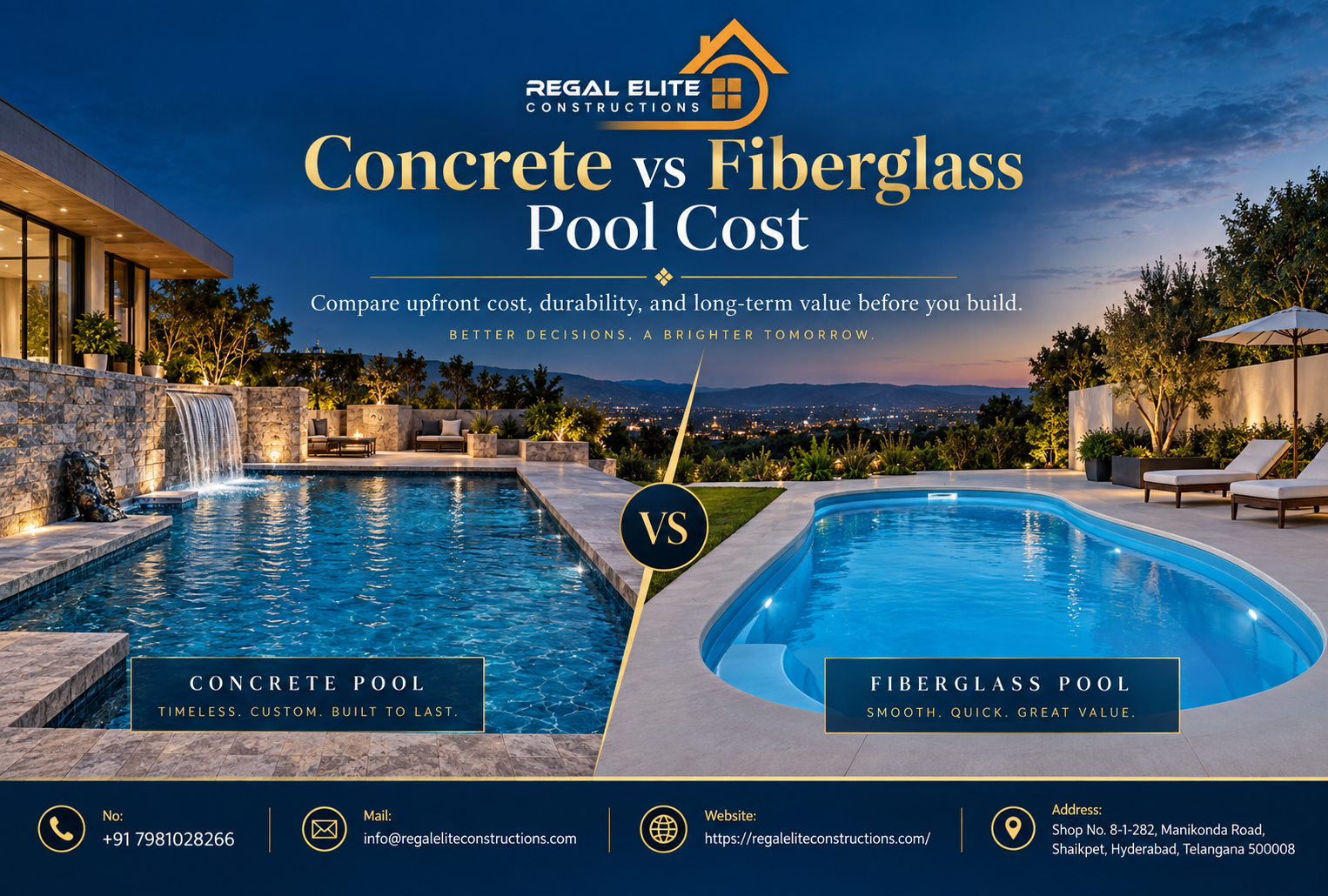
For many properties, Concrete vs Fiberglass Pool Cost becomes a question of customization versus predictability. Concrete allows the designer to create dimensions that suit the available plot, architectural lines, landscape plan and swimming requirements. Fiberglass shells are manufactured in predefined molds, so their sizes, depths and configurations depend on available models. That standardization can simplify planning, yet it may also force the homeowner to adapt the landscape to the shell. If a property requires an infinity edge, unusual geometry, a long lap lane, integrated seating or a highly specific depth profile, a concrete structure may provide considerably more design freedom. If the priority is a conventional family pool with a suitable premanufactured model, fiberglass may be attractive. This is why Concrete vs Fiberglass Pool Cost should always be interpreted together with the design brief rather than as a price-only decision.
Before making a final decision about Concrete vs Fiberglass Pool Cost, homeowners should also examine who will design, install and support the pool after handover. Pool construction integrates structural engineering, hydraulics, waterproofing or shell installation, plumbing, electrical work and water treatment. A quotation that appears economical but excludes important work can become expensive once construction has started. At Regal Elite Constructions, the planning process can begin by defining dimensions, usage, site conditions, desired finishes and the surrounding outdoor space before establishing a project-specific budget. This method provides a clearer basis for comparing complete solutions. The most useful Concrete vs Fiberglass Pool Cost calculation is therefore the one that reflects the actual site and completed pool instead of a generic market estimate.
2. What Should Be Included in a Pool Cost Comparison?
A professional Concrete vs Fiberglass Pool Cost comparison begins before excavation. Design consultation, property measurement, soil assessment, pool positioning, structural requirements and access planning can all influence the budget. A backyard with easy machinery access is fundamentally different from an enclosed villa plot where soil must be removed manually or transported through a narrow passage. Similarly, a level property may require less additional civil work than a sloping property that needs retaining structures or substantial ground preparation. Pool owners should also budget for drainage around the pool because water should be directed away from structures and entertainment areas. The estimate should clearly identify what happens before the pool shell is created or delivered. Ignoring preliminary work is one of the quickest ways to underestimate Concrete vs Fiberglass Pool Cost and create unexpected additions during construction.
Equipment is another major part of Concrete vs Fiberglass Pool Cost. Pumps, filters, circulation plumbing, valves, skimmers, drains, lights, control panels and optional automation can represent a meaningful portion of the investment regardless of shell type. Two pools with identical dimensions may have very different quotations if one includes basic equipment and the other includes premium filtration, variable-speed pumping, automated sanitation and intelligent controls. Owners should compare equipment model numbers, capacities and warranties rather than accepting descriptions such as “premium filter” without specifications. The filtration system should be designed around pool volume, intended usage and hydraulic requirements instead of being selected purely to reduce the initial quotation. Because both shell types require effective circulation and treatment, equipment quality can narrow or widen the apparent Concrete vs Fiberglass Pool Cost difference.
The surrounding environment must also be considered when calculating Concrete vs Fiberglass Pool Cost. Coping stones, anti-slip decking, drainage channels, landscape work, outdoor showers, fencing, lighting and seating can sometimes equal a significant portion of the overall project. A homeowner comparing two shell quotations may think one option costs substantially less, only to discover that neither quote includes the finished poolside area. Premium residences frequently integrate the swimming pool with a garden, gazebo, outdoor kitchen or entertainment zone, so the shell cannot be treated as a completely independent project. Planning these elements together also reduces the possibility of later demolition or rework. A realistic Concrete vs Fiberglass Pool Cost budget should therefore describe what the homeowner will actually receive when the entire swimming area is ready for use.
3. Where Concrete Pool Expenses Come From
The concrete side of a Concrete vs Fiberglass Pool Cost study usually contains more individual construction activities because the pool is formed on site. After excavation, the project can involve a prepared base, steel reinforcement, embedded plumbing, formwork where required and structural concrete or shotcrete. Construction quality at these stages is particularly important because the shell must resist soil pressure, water pressure and site-specific structural conditions. Cutting structural specifications simply to reduce the initial quotation can create far greater repair costs later. A qualified team should coordinate structural detailing with plumbing penetrations and construction joints so that the finished system works as one assembly. The civil and structural components explain why the Concrete vs Fiberglass Pool Cost discussion should look beyond the visible tiles and water.
Waterproofing is another important component within Concrete vs Fiberglass Pool Cost planning for a concrete structure. A swimming pool permanently contains water, so junctions, pipe penetrations, construction joints and surface preparation deserve careful attention. The selected waterproofing approach must also be compatible with the final interior finish. Correct application is as important as the product because poor workmanship can create pathways for leakage even when high-quality materials are purchased. Testing the structure at the appropriate stage can help identify issues before expensive tiles and coping are completed. Some low quotations reduce or simplify waterproofing scope to improve headline pricing, but that approach can increase future repair risk. A responsible Concrete vs Fiberglass Pool Cost comparison should therefore ask exactly what waterproofing preparation, products, testing and workmanship are included.
Interior finishes strongly influence Concrete vs Fiberglass Pool Cost for a custom-built pool. Options may include conventional pool tiles, glass mosaics, specialist plaster systems, stone accents or combinations selected to match the architecture. Material price is only one factor because intricate patterns, curved walls, steps and complex edges increase installation labour. Dark finishes may create a dramatic appearance, while lighter finishes can produce a brighter visual effect; however, aesthetics should always be balanced with suitability for submerged conditions and maintenance requirements. Coping materials around the perimeter can also vary significantly in price. Homeowners should define the finish level before requesting final quotations so contractors are pricing comparable specifications. Otherwise, two estimates can appear different even though the real cause is finish selection rather than Concrete vs Fiberglass Pool Cost itself.
Customization is one reason some homeowners accept a higher or more variable Concrete vs Fiberglass Pool Cost. Concrete construction can be adapted to unusual plot dimensions, landscape features and architectural concepts. A pool may include an infinity edge, beach-style entry, submerged seating, separate children’s zone, spa integration, long lap section or carefully positioned steps. Each custom feature introduces design, structural, hydraulic and finishing considerations. That does not mean every feature dramatically increases cost, but multiple bespoke elements can change labour, material quantities and equipment requirements. The advantage is that the finished pool can be developed around the property rather than selecting from a fixed mold. When architectural individuality is a priority, the flexibility associated with Concrete vs Fiberglass Pool Cost may justify a more detailed construction process for the homeowner.
4. Where Fiberglass Pool Expenses Come From
The fiberglass side of Concrete vs Fiberglass Pool Cost begins with the manufactured shell. Because the pool body is produced away from the site, the shell price can be easier to identify than a structure assembled through many separate civil activities. Nevertheless, the shell is only one portion of the completed swimming pool. Transportation from the manufacturing facility, loading and unloading, insurance where applicable, crane handling and safe access to the property can all affect the installed price. Large shells require careful route planning because road width, gates, overhead cables, trees and neighbouring structures may limit delivery. A shell that appears economical at the factory can become more expensive when unusual transport or lifting arrangements are necessary. Consequently, an accurate Concrete vs Fiberglass Pool Cost assessment should calculate the delivered and installed cost rather than the shell purchase price.
Excavation and base preparation still matter when studying Concrete vs Fiberglass Pool Cost for fiberglass installation. The excavation needs to match the shell geometry and provide the installation clearances required by the selected system. The prepared base must provide consistent support, and the backfilling procedure around the shell needs to follow the installation method recommended for that product. Poor support or careless backfilling can affect alignment and long-term performance. Groundwater conditions can also change the installation strategy, particularly when an empty shell could be exposed to external hydrostatic forces. These considerations demonstrate why fiberglass should not be treated as simply lowering a molded product into a hole. Professional installation remains central to the value represented by Concrete vs Fiberglass Pool Cost.
The standardized nature of fiberglass influences Concrete vs Fiberglass Pool Cost in both positive and limiting ways. Manufacturing in controlled conditions can reduce some on-site construction stages and make the shell configuration predictable. At the same time, the homeowner normally selects from available shapes and dimensions rather than designing every curve, step or depth from scratch. This can be highly practical for families who find a model that suits their property and swimming requirements. It may be less suitable for an architect who has designed a pool to align precisely with a narrow courtyard, complex landscape axis or infinity-edge concept. Before assuming fiberglass is cheaper, verify that the desired shell actually fits the site without expensive landscape alterations. The best Concrete vs Fiberglass Pool Cost result is achieved when the chosen construction method naturally suits the property.
Finishing around a fiberglass shell also needs to be included in Concrete vs Fiberglass Pool Cost. Although the internal shell surface generally arrives finished, the installation still requires coping, deck integration, drainage, equipment connections and landscaping. Some owners focus heavily on the smooth interior surface and installation speed but forget that the pool must visually connect with the home and garden. A high-quality deck with proper levels and drainage can significantly improve everyday usability. Similarly, access panels and equipment locations should be planned before paving is completed so future maintenance remains practical. When all exterior completion work is added, the difference between shell types may be smaller or larger than expected. A complete Concrete vs Fiberglass Pool Cost quotation should therefore continue beyond the shell installation and describe the finished pool area.
5. Side-by-Side Cost and Construction Comparison
| Comparison Factor | Concrete Swimming Pool | Fiberglass Swimming Pool |
|---|---|---|
| Shell Construction | Built on site using structural concrete or shotcrete and reinforcement | Factory-manufactured shell delivered to site |
| Design Flexibility | Very high; dimensions, depths and geometry can be customized | Limited to available manufactured molds and sizes |
| Initial Cost Predictability | Can vary considerably with structure, finish and complexity | Shell pricing may be more predictable, but installation logistics can vary |
| Excavation | Designed around custom pool dimensions | Must closely accommodate manufactured shell |
| Interior Finish | Tiles, mosaics, specialist plaster and other selected finishes | Integrated manufactured surface |
| Transport Requirement | Raw materials transported normally | Large complete shell may require specialist transportation |
| Crane Requirement | Depends on site and construction method | Frequently required for shell placement |
| Installation Programme | Generally involves more site construction stages | Shell installation can be quicker when access is straightforward |
| Custom Luxury Features | Excellent flexibility for bespoke features | Dependent on shell design and manufacturer options |
| Future Surface Work | Interior finish may eventually require renovation depending on material and use | Surface care depends on shell condition and manufacturer guidance |
The table demonstrates why Concrete vs Fiberglass Pool Cost cannot be reduced to the assumption that one material is always inexpensive and the other is always premium. A basic custom concrete pool with restrained finishes can sometimes compete closely with a fiberglass installation that requires complicated transportation and crane access. Conversely, a highly customized concrete infinity pool with expensive mosaics, extensive decking and advanced automation may cost considerably more than a standard fiberglass family pool. The difference comes from scope rather than a single material. Homeowners should prepare a written specification containing dimensions, depth, filtration, lighting, sanitation, coping and deck requirements before asking contractors to quote. This creates a meaningful Concrete vs Fiberglass Pool Cost comparison in which each proposal is evaluated against approximately the same finished result.
Another important point in Concrete vs Fiberglass Pool Cost is contingency planning. Excavation can expose unexpected soil, rock, underground services or water conditions that were not obvious from the surface. Access constraints may also require smaller equipment or additional labour. A project budget should therefore contain a reasonable allowance for site-specific discoveries instead of using every available rupee for visible finishes. This is especially important when pool construction forms part of a larger villa or farmhouse development because delays can influence landscape, paving and external works. Proper investigation reduces uncertainty, but construction projects can still contain variables. Evaluating contingency alongside the main Concrete vs Fiberglass Pool Cost helps the owner make a financially safer decision without compromising structural or hydraulic essentials.
The payment schedule also affects how owners experience Concrete vs Fiberglass Pool Cost. Concrete work is usually completed through sequential site stages, which may allow payments to follow measurable milestones such as excavation, structure, waterproofing, finishing and equipment installation. Fiberglass projects may require a larger early payment connected with manufacturing or ordering the shell, followed by transport and installation costs. Neither approach is automatically better, but owners should understand when funds will be required and what each payment represents. Contracts should define materials, equipment, changes, delays, warranties and exclusions clearly. Avoid selecting a contractor solely because the initial deposit is lower or because a headline price appears attractive. Financial clarity is an important part of responsible Concrete vs Fiberglass Pool Cost planning.
6. Hyderabad Conditions That Can Change the Final Budget
For Hyderabad properties, Concrete vs Fiberglass Pool Cost can change substantially according to plot accessibility. Many villas and independent homes have finished compound walls, gardens, neighbouring buildings and narrow approach roads. Concrete construction allows materials to enter the property in smaller loads, although excavation equipment and concrete placement still require planning. A fiberglass shell, on the other hand, must reach the installation location as one large component. A wide open farmhouse can make this simple, while a dense residential plot may require a large crane or may make a particular shell impossible to install economically. Access should therefore be investigated before the homeowner becomes committed to a product. Site logistics are often one of the most overlooked influences on Concrete vs Fiberglass Pool Cost in developed neighbourhoods.
Ground conditions also influence Concrete vs Fiberglass Pool Cost. Excavating ordinary workable soil is different from encountering hard rock, loose fill, buried debris or groundwater. Rock removal can increase labour and equipment time regardless of pool type. Unstable fill may require additional preparation to create reliable support. Drainage and groundwater management must also be considered when the pool is empty for construction or future maintenance. Structural and geotechnical requirements should be determined according to actual site conditions instead of relying on assumptions from another property. Two neighbouring developments can even experience different excavation conditions if one plot has previously been filled or modified. This is why site inspection is necessary before turning an indicative Concrete vs Fiberglass Pool Cost discussion into a committed construction quotation.
Hyderabad's periods of high temperatures and seasonal rain should also be considered in Concrete vs Fiberglass Pool Cost planning. Pool construction needs appropriate sequencing and protection so that structural work, waterproofing, adhesives and exterior finishes are installed under suitable conditions. Drainage around the deck is particularly important because rainfall should not carry soil, garden debris or contaminated runoff into the pool. In dry periods, dust from surrounding development or roads may increase cleaning requirements, making filtration design and practical maintenance access valuable. Climate should therefore influence material and equipment decisions rather than simply changing the visual design. A balanced Concrete vs Fiberglass Pool Cost assessment considers not just the day of installation but how easily the swimming pool can be operated throughout changing seasonal conditions.
Local planning requirements should form part of Concrete vs Fiberglass Pool Cost because approvals, sanctioned plans and property conditions can affect project sequencing. Requirements can differ according to location, development type, plot configuration and whether the pool is associated with an existing building or a new development. Homeowners should verify applicable requirements with the relevant authority and qualified professionals before starting physical work. Altering a pool after construction because of an overlooked planning or safety condition can be significantly more expensive than resolving the issue during design. For Hyderabad projects, official resources such as GHMC and applicable Telangana building regulations can provide useful starting points. Compliance planning is therefore part of a responsible Concrete vs Fiberglass Pool Cost study rather than a separate issue to consider after construction begins.
7. Design Freedom, Size and Luxury Features
Pool geometry can have a major influence on Concrete vs Fiberglass Pool Cost. Rectangular pools are generally efficient because structural setting-out, circulation planning and surrounding paving can be straightforward. Curved edges, multiple levels, unusual angles and freeform layouts introduce additional detailing. Concrete construction can accommodate these choices because the shell is created for the design, while fiberglass requires a manufactured mold that already contains the required geometry. This distinction becomes important when the pool is part of a highly coordinated landscape where edges must align with the villa, patio, garden or view. Owners should avoid paying for complex customization unless it creates meaningful value for the way the property will be used. Design discipline can often control Concrete vs Fiberglass Pool Cost without making the finished pool look basic.
Depth selection is equally relevant to Concrete vs Fiberglass Pool Cost. Many residential owners initially assume a deeper pool automatically feels more luxurious, but depth should follow intended activities. A family recreation pool, lap pool, children’s area and diving-oriented facility have different design requirements. Greater depth increases excavation volume and can influence structural quantities, water volume, circulation and operating requirements. Fiberglass buyers are restricted to depths available within the chosen shell, while concrete construction can develop a custom floor profile subject to engineering and safety considerations. A well-planned moderate-depth pool may provide better everyday usability for many households than an unnecessarily deep design. Matching depth to genuine requirements helps keep Concrete vs Fiberglass Pool Cost focused on useful features rather than spending on dimensions that deliver little practical benefit.
Premium features can quickly alter Concrete vs Fiberglass Pool Cost. Infinity edges require additional hydraulic and structural planning, water features introduce pumps and plumbing, heating systems add equipment and energy requirements, and integrated spas can create another operating zone. Automation, underwater lighting, counter-current systems, fountains and high-end finishes may each be desirable, but owners should prioritise them before construction begins. Concrete is often selected where these elements are deeply integrated into a custom architectural concept, whereas fiberglass projects usually work best when options are compatible with the chosen shell. Creating a ranked feature list makes budgeting easier: essentials can be separated from enhancements that may be added later. This approach prevents optional extras from obscuring the core Concrete vs Fiberglass Pool Cost decision.
8. Construction Timeline and Installation Logistics
Time is an indirect but important element of Concrete vs Fiberglass Pool Cost. Concrete pools normally involve more sequential site activities, including structural work, curing, waterproofing preparation, finishing and testing. Each activity depends on successful completion of the previous stage. Fiberglass shells can reduce the number of on-site shell construction stages because the body arrives manufactured, although excavation, base preparation, plumbing, backfilling, equipment installation and deck completion are still required. Homeowners should avoid assuming that the quickest shell installation means the entire outdoor area will immediately be finished. Landscaping and hardscape work can continue after either pool type is structurally installed. When a fixed opening date matters, programme reliability should be considered together with Concrete vs Fiberglass Pool Cost instead of focusing only on the theoretical speed of the shell.
Weather and contractor coordination also influence Concrete vs Fiberglass Pool Cost during construction. Rain can affect excavation, site access and some finishing processes, while multiple subcontractors may need to coordinate structural, plumbing, electrical and landscape work. Concrete projects may have greater exposure to sequencing because more work takes place directly on site. Fiberglass projects concentrate risk around manufacturing, delivery and successful shell placement. A delayed shell shipment or unavailable crane can affect later work just as easily as delayed civil construction can affect a concrete pool. A realistic schedule should include procurement lead times and should not rely on every activity occurring under perfect conditions. Strong project management therefore protects both the completion date and the planned Concrete vs Fiberglass Pool Cost.
Transport deserves special attention when evaluating Concrete vs Fiberglass Pool Cost. A fiberglass shell is physically large even before it contains water, so route surveys, gate widths, turning areas, overhead restrictions and lifting distances may need to be reviewed. The crane must have an appropriate setup area and safe lifting path. Concrete pool materials are generally transported as smaller components or delivered through standard construction methods, which can make difficult-access plots more manageable, though concrete pumping and excavation removal may still require specialist equipment. Homeowners should obtain installation logistics in writing rather than assuming delivery is included in the displayed shell price. Unexpected crane or road-access arrangements can significantly change Concrete vs Fiberglass Pool Cost after a product has already been ordered.
9. Maintenance and Long-Term Ownership
Long-term Concrete vs Fiberglass Pool Cost should include routine maintenance rather than focusing only on construction. Both pools require water testing, filtration, cleaning and equipment care. The amount of work depends on pool usage, surrounding vegetation, dust, water chemistry, circulation design and owner habits. Concrete pools may use tile, plaster or other interior systems that have their own cleaning and lifecycle requirements. Fiberglass shells have a manufactured surface that also requires appropriate water balance and care. No pool should be treated as maintenance-free. A good circulation layout, correctly sized equipment and regular testing can help reduce unnecessary chemical consumption and protect pool components. When operating practices are included in the calculation, Concrete vs Fiberglass Pool Cost becomes a more realistic representation of years of ownership.
Surface renovation is another long-term consideration in Concrete vs Fiberglass Pool Cost. Concrete pools offer substantial flexibility because owners can potentially update tiles, coping and selected finishes during future renovation. However, certain interior finishes may require resurfacing over the life of the pool depending on material, installation quality, water chemistry and usage. Fiberglass owners should consider the manufacturer's recommendations for protecting the shell finish and understand repair procedures should surface damage occur. Predicting an exact renovation year is unrealistic because two pools can age differently under different maintenance conditions. Instead, homeowners should ask about expected care, warranties and available repair methods before purchase. The future serviceability of the selected system is an important part of Concrete vs Fiberglass Pool Cost, especially for a property intended for long-term ownership.
Equipment replacement should also be included when considering Concrete vs Fiberglass Pool Cost. Pumps, lights, sensors and control equipment are mechanical or electrical components and therefore do not last indefinitely. Their future replacement cost is largely independent of whether the shell is concrete or fiberglass. This is another reason an inexpensive pool shell does not automatically produce the lowest lifetime ownership cost. Selecting commonly supported equipment, providing easy access to the plant area and keeping plumbing layouts organized can make future servicing more efficient. Owners should request documentation showing valve locations, equipment models and operating instructions at handover. Good design improves maintainability and can reduce unnecessary service labour. A complete Concrete vs Fiberglass Pool Cost assessment therefore looks at the pool as a working system rather than only a permanent shell.
10. Water, Filtration and Energy Expenses
Operating efficiency can influence lifetime Concrete vs Fiberglass Pool Cost far more than many owners expect. Pumps circulate water through filtration and treatment equipment, so choosing an appropriately designed system matters. Larger pumps are not automatically better because circulation should be engineered according to hydraulic requirements. Variable-speed technology can provide operational flexibility, while timers and automation can help control unnecessary runtime where suitable. The same principles apply to both concrete and fiberglass pools because water circulation is determined by pool volume, plumbing configuration and features rather than shell material alone. A well-designed hydraulic system can improve water clarity while avoiding needless energy use. This means equipment efficiency should be evaluated as part of Concrete vs Fiberglass Pool Cost even if the initial equipment upgrade increases the construction quotation.
Water conservation is another practical dimension of Concrete vs Fiberglass Pool Cost. Evaporation, splashing, cleaning and leaks all create water demand over time. Pool covers can reduce exposure to evaporation and debris when appropriate for the design, while prompt leak investigation prevents ongoing water loss. Surrounding drainage should be designed to keep dirty runoff outside the pool, reducing unnecessary treatment and cleaning. Maintaining balanced water also protects finishes and equipment from avoidable deterioration. These practices matter regardless of shell material and should be discussed during design rather than after the pool is filled. A homeowner who considers water management when reviewing Concrete vs Fiberglass Pool Cost is more likely to understand the true operating budget instead of seeing the investment only as an initial construction expense.
Water chemistry is essential to responsible Concrete vs Fiberglass Pool Cost planning because incorrect chemistry can damage pool surfaces, plumbing and equipment. The exact treatment programme depends on the sanitation system, water source, climate, usage and manufacturer recommendations. Regular testing allows the owner or maintenance provider to make controlled adjustments instead of adding chemicals reactively when the water already appears problematic. Concrete finishes and fiberglass surfaces have different care considerations, but neither benefits from neglected water balance. Professional commissioning at handover is therefore valuable because it establishes a baseline and teaches the owner how the installed system should operate. When proper maintenance is built into the ownership plan, Concrete vs Fiberglass Pool Cost becomes easier to control over many seasons.
11. How to Request and Compare Pool Quotations
The most effective way to compare Concrete vs Fiberglass Pool Cost is to issue a clear project brief. Record the preferred pool length, width, depth, location, intended use and design style. Decide whether the quotation should include excavation disposal, structural work, waterproofing or shell installation, plumbing, filtration, sanitation, lights, coping, deck, drainage, filling, testing and commissioning. Ask each contractor to identify exclusions rather than relying only on what is included. A low quote can become expensive when important activities appear later as variations. Equipment specifications should include brands or measurable performance details wherever possible. By standardising the requested scope, homeowners transform Concrete vs Fiberglass Pool Cost from a vague conversation into a transparent comparison that can support a confident decision.
For homeowners who want to understand the complete pool construction process before comparing Concrete vs Fiberglass Pool Cost, Regal Elite Constructions has also prepared a detailed guide to swimming pool construction in Hyderabad for homes, villas and resorts. Reviewing the construction sequence can help owners understand why excavation, structural work, waterproofing, filtration, finishing and testing should be treated as coordinated elements instead of unrelated expenses. It also makes discussions with designers and contractors more productive because the owner understands what happens between concept and first fill. The more clearly the complete scope is understood, the easier it becomes to evaluate Concrete vs Fiberglass Pool Cost without being distracted by incomplete promotional prices.
Warranty terms deserve attention in every Concrete vs Fiberglass Pool Cost comparison. Owners should know which party is responsible for the structure or shell, waterproofing, plumbing, equipment, electrical installation and finishes. A long headline warranty can sound impressive but may contain exclusions or maintenance requirements, so the actual written terms matter. Fiberglass warranties may involve the shell manufacturer and installer, while concrete projects may divide responsibilities between construction systems and equipment manufacturers. Clarify who should be contacted if a problem appears and whether routine inspections or water chemistry records are required to preserve coverage. Reliable after-sales support can be worth more than a small saving during construction. Warranty clarity therefore adds practical value to Concrete vs Fiberglass Pool Cost over the life of the project.
Finally, evaluate Concrete vs Fiberglass Pool Cost in the context of how long you expect to own and use the property. A homeowner creating a signature pool for a permanent luxury villa may value customized dimensions and architectural integration more highly than rapid installation. A family preparing a practical recreational pool may prefer a standardized shell that matches the available space. A resort or commercial property may have different priorities again, including guest capacity, operational reliability and architectural identity. There is no universally correct material for every situation. The strongest decision balances construction budget, design requirements, access, maintenance expectations and long-term plans. When these factors are documented before construction, Concrete vs Fiberglass Pool Cost becomes a strategic design decision rather than a simple competition between two headline prices.
Authoritative Resources for Pool Planning, Safety and Efficiency
Frequently Asked Questions
1. Is a concrete swimming pool more expensive than a fiberglass swimming pool?
The answer to Concrete vs Fiberglass Pool Cost depends on the design and installation conditions rather than shell material alone. Concrete pools can become more expensive when they include complex structural geometry, premium mosaics, infinity edges, extensive steps or highly customised depths. Fiberglass can offer more predictable shell pricing, but transportation, crane hire, restricted access and site preparation may reduce the apparent saving. A standard fiberglass pool on an accessible open plot may have a very different budget from the same shell installed behind a completed villa. Similarly, a simple rectangular concrete pool may cost far less than an elaborate custom design. The most reliable Concrete vs Fiberglass Pool Cost comparison comes from obtaining complete site-specific quotations covering the same equipment and surrounding work.
2. Which type of swimming pool is better for Hyderabad homes?
Choosing between the two systems after reviewing Concrete vs Fiberglass Pool Cost depends on the property. Concrete can be particularly useful where the pool must fit a specific courtyard, villa layout, farmhouse landscape or architectural concept. Fiberglass can work well where the property has sufficient installation access and an available shell design matches the required size and depth. Hyderabad homeowners should consider excavation conditions, vehicle and crane access, outdoor drainage, surrounding construction and long-term maintenance arrangements. There is no single material that automatically suits every Hyderabad site. A professional inspection can reveal constraints that are impossible to identify from a photograph or price list. For that reason, the final Concrete vs Fiberglass Pool Cost decision should be made after evaluating the actual plot rather than selecting a pool solely from online examples.
3. Which swimming pool can be installed faster?
Installation speed is frequently discussed alongside Concrete vs Fiberglass Pool Cost. A fiberglass shell can reduce several on-site shell-building stages because the body arrives manufactured and can be positioned after suitable excavation and base preparation. Concrete requires construction, reinforcement, structural work, waterproofing and finishing to occur on site, which typically produces a longer sequence. However, total completion time also includes design approval, excavation, plumbing, filtration, electrical work, coping, decking, landscaping and commissioning. Difficult transport or unavailable crane access can delay fiberglass just as weather or finishing complexity can delay concrete. Homeowners should compare complete project programmes rather than shell-placement time. The relationship between programme and Concrete vs Fiberglass Pool Cost is strongest when a reliable completion date has financial or operational importance.
4. Which pool type offers more customization?
Customization is one of the clearest differences affecting Concrete vs Fiberglass Pool Cost. Concrete construction allows designers to create pool dimensions and geometry around the specific property, subject to structural and safety requirements. Owners can plan distinctive curves, long lap pools, custom steps, submerged seating, integrated spas and architectural edges. Fiberglass offers choices within the manufacturer's available molds, which can still include attractive family-friendly layouts but does not provide unlimited geometry. If an existing shell matches the owner's requirements, this limitation may have little practical importance. If the pool is intended to become a signature feature of a luxury villa or resort, custom concrete design may offer greater freedom. Therefore, Concrete vs Fiberglass Pool Cost should always be compared against the required design rather than assuming both systems will create an identical result.
5. Which pool requires less maintenance?
Maintenance is an important part of Concrete vs Fiberglass Pool Cost, but neither option eliminates the need for regular care. Every swimming pool needs filtration, water testing, cleaning, equipment checks and responsible chemical management. Fiberglass surfaces can be straightforward to clean when maintained correctly, while concrete pools may have tile, plaster or specialist finishes with their own care requirements. Surrounding trees, dust, swimmer load and circulation design often influence maintenance as much as the shell material. Poor water balance can also reduce the life of finishes and equipment in either system. Owners should request a written maintenance programme during handover and understand ongoing equipment and chemical requirements. A realistic lifetime Concrete vs Fiberglass Pool Cost comparison therefore includes routine maintenance instead of looking only at construction.
6. Can a fiberglass pool be installed on every property?
Property access can significantly influence Concrete vs Fiberglass Pool Cost for a fiberglass installation. Because the shell arrives as a large manufactured component, the transport vehicle must reach the property and the shell must then move safely to the excavation. Compound walls, trees, buildings, overhead wires and narrow roads can complicate installation. In some situations, a sufficiently large crane can lift the shell over obstacles, but the crane itself needs a safe setup location and adequate reach. Other sites may make a specific shell impractical. Concrete materials can generally enter the site in smaller quantities, although excavation and concrete placement still need access planning. Consequently, a site inspection is essential before confirming Concrete vs Fiberglass Pool Cost for a property with restricted access.
7. How can homeowners reduce pool construction costs without reducing quality?
A sensible approach to controlling Concrete vs Fiberglass Pool Cost is to simplify decisions that do not add meaningful value while protecting structural, waterproofing, hydraulic and safety essentials. A clean rectangular layout can reduce unnecessary complexity. Standardising depth according to actual family requirements can reduce excavation and water volume. Selecting durable finishes instead of purely decorative premium materials can also control the budget. Owners can plan optional automation, decorative fountains or extensive landscape elements as later upgrades if necessary. However, structural engineering, appropriate waterproofing or shell installation, filtration, electrical safety and drainage should not be weakened simply to achieve a lower quotation. The best savings come from efficient design and transparent procurement. Carefully managing Concrete vs Fiberglass Pool Cost means removing unnecessary complexity rather than compromising fundamental construction quality.
Conclusion: Which Pool Provides Better Value?
Contact Regal Elite Constructions:
Shaikpet, Hyderabad, Telangana 500008.