
Infinity Pool Design: Features, Cost and Planning
A practical guide for homeowners, villa owners and developers who want to understand the design, engineering, budget and long-term planning behind a premium vanishing-edge swimming pool.
Infinity Pool Design has become one of the most requested luxury pool concepts for villas, resorts and high-end homes because it combines water, architecture and the surrounding view into one visual experience. The effect looks effortless, but the construction is more demanding than a conventional swimming pool. Levels, structural engineering, waterproofing, water circulation, drainage, balance-tank sizing, finishes and sightlines all need to work together.
At Regal Elite Constructions, pool planning is best approached as part of the total property rather than as a separate outdoor feature. A successful Infinity Pool Design should fit the building lines, landscape, movement paths and intended lifestyle of the owner. This guide explains the major decisions from early concept through construction, commissioning and maintenance.
1. What Makes an Infinity Pool Different?
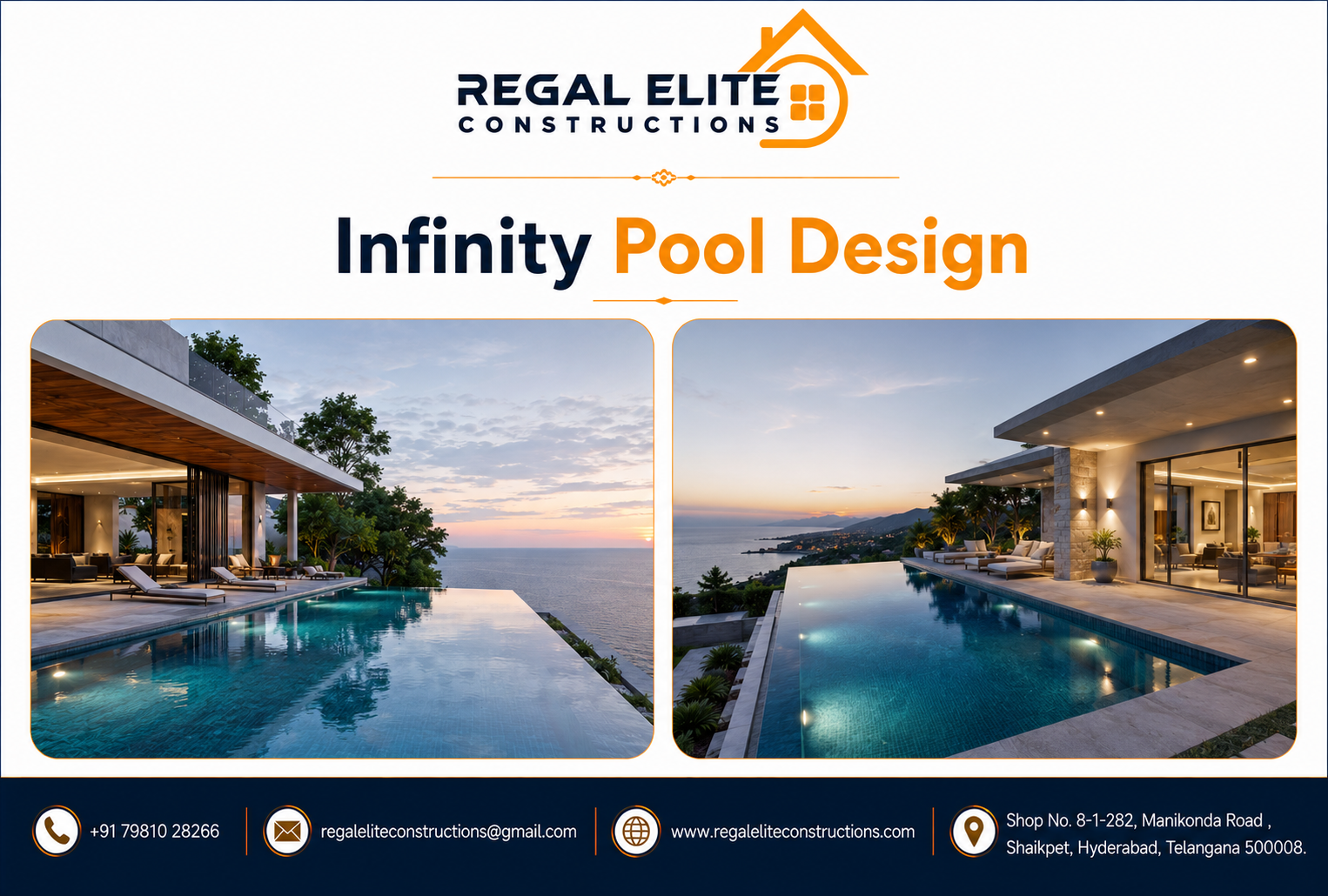
In a well-resolved Infinity Pool Design, an infinity pool is defined by a carefully engineered overflow edge that allows water to pass over one or more sides into a concealed catch basin. From the primary viewing angle, the water surface appears to continue into the horizon, a garden, a valley, or another visual feature.
The visual effect depends as much on levels, sightlines, structural accuracy, and water movement as it does on finishing materials. A good concept therefore begins with the property itself rather than with a catalogue image. This is one reason Infinity Pool Design requires closer coordination than a basic rectangular pool.
For villas in Hyderabad, the strongest opportunities are often plots with a garden drop, terrace edge, open skyline, lake-facing outlook, or elevated rear yard. Even on flatter sites, the effect can be created by raising the pool and controlling what the user sees beyond the overflow.
When planning this part of the project, owners should compare visual goals with technical consequences. A choice that looks minor on a concept drawing can affect excavation, reinforcement, pipe routing, service access, waterproofing or equipment. The architect, structural engineer, pool specialist and site team should review key interfaces before construction reaches a stage where changes become expensive. Drawings should show dimensions, levels and interfaces clearly, and the site team should verify them against actual conditions.
For this stage, the Infinity Pool Design decision should be tested against the actual site, intended user experience and maintenance plan—not just a reference photo.
2. Core Features That Create the Infinity Effect
In a well-resolved Infinity Pool Design, the signature feature is the vanishing edge, but the system is larger than the visible pool shell. It normally includes an overflow weir, balance tank or catch basin, recirculation plumbing, filtration, pump controls, waterproofing, drainage, and carefully coordinated finishes.
The edge must remain level across its full length so the water sheet looks continuous. Small construction tolerances that may be acceptable in an ordinary pool become noticeable here because inconsistent overflow can break the illusion. This is one reason Infinity Pool Design requires closer coordination than a basic rectangular pool.
Lighting, coping, deck levels, seating, landscaping, and the direction of approach also influence the final appearance. A premium result feels simple because the engineering is hidden.
When planning this part of the project, owners should compare visual goals with technical consequences. A choice that looks minor on a concept drawing can affect excavation, reinforcement, pipe routing, service access, waterproofing or equipment. The architect, structural engineer, pool specialist and site team should review key interfaces before construction reaches a stage where changes become expensive. Drawings should show dimensions, levels and interfaces clearly, and the site team should verify them against actual conditions.
For this stage, the Infinity Pool Design decision should be tested against the actual site, intended user experience and maintenance plan—not just a reference photo.
3. Single-Edge, Double-Edge and Multi-Edge Options
In a well-resolved Infinity Pool Design, a single-edge pool is usually the most efficient choice when there is one dominant view. It concentrates the visual drama in the direction that matters and keeps structural and hydraulic complexity under control.
Double-edge arrangements can work beautifully on corner plots, rooftop settings, or terraces with two attractive sightlines. Multi-edge pools create a stronger floating-water effect but demand more precise structure, more overflow collection capacity, and more detailed coordination. This is one reason Infinity Pool Design requires closer coordination than a basic rectangular pool.
The right choice should follow the site, not fashion. Adding an extra disappearing edge that does not improve the view can raise cost and maintenance without adding meaningful value.
When planning this part of the project, owners should compare visual goals with technical consequences. A choice that looks minor on a concept drawing can affect excavation, reinforcement, pipe routing, service access, waterproofing or equipment. The architect, structural engineer, pool specialist and site team should review key interfaces before construction reaches a stage where changes become expensive. Drawings should show dimensions, levels and interfaces clearly, and the site team should verify them against actual conditions.
For this stage, the Infinity Pool Design decision should be tested against the actual site, intended user experience and maintenance plan—not just a reference photo.
4. Site Planning and View Alignment
In a well-resolved Infinity Pool Design, before drawings are finalized, stand at the future deck level and identify the views you want to preserve and the objects you want to hide. The eye line from seating areas, bedrooms, living rooms, and the pool itself should be considered.
A vanishing edge works best when it visually meets sky, distant terrain, greenery, or another clean horizontal plane. If the edge terminates against a busy neighboring wall, utility area, or parking zone, landscaping or architectural screening may be needed. This is one reason Infinity Pool Design requires closer coordination than a basic rectangular pool.
Sun direction matters as well. Glare, afternoon heat, shade from the building, and reflections on the water can affect both comfort and the quality of the view.
When planning this part of the project, owners should compare visual goals with technical consequences. A choice that looks minor on a concept drawing can affect excavation, reinforcement, pipe routing, service access, waterproofing or equipment. The architect, structural engineer, pool specialist and site team should review key interfaces before construction reaches a stage where changes become expensive. Drawings should show dimensions, levels and interfaces clearly, and the site team should verify them against actual conditions.
For this stage, the Infinity Pool Design decision should be tested against the actual site, intended user experience and maintenance plan—not just a reference photo.
5. Structural Engineering and Load Considerations
In a well-resolved Infinity Pool Design, an infinity pool is a water-retaining structure, and water is heavy. The shell, supporting soil or building structure, edge beam, overflow trough, and balance tank should be designed as one coordinated system.
For rooftop or elevated pools, structural verification is especially important because loads must be transferred safely through slabs, beams, columns, and foundations. Deflection also matters: even small movement can affect waterproofing and the level of the overflow edge. This is one reason Infinity Pool Design requires closer coordination than a basic rectangular pool.
Soil conditions, retaining walls, adjacent foundations, excavation depth, and groundwater can influence engineering on ground-level projects. A structural engineer should review the project before construction details are locked.
When planning this part of the project, owners should compare visual goals with technical consequences. A choice that looks minor on a concept drawing can affect excavation, reinforcement, pipe routing, service access, waterproofing or equipment. The architect, structural engineer, pool specialist and site team should review key interfaces before construction reaches a stage where changes become expensive. Drawings should show dimensions, levels and interfaces clearly, and the site team should verify them against actual conditions.
For this stage, the Infinity Pool Design decision should be tested against the actual site, intended user experience and maintenance plan—not just a reference photo.
6. Hydraulic Design, Overflow and Balance Tank
In a well-resolved Infinity Pool Design, the visual sheet of water over the edge is created by a hydraulic system that continuously recirculates overflow. Water leaves the main pool, enters a catch channel or lower basin, moves to the balance tank, and returns through the filtration and pumping system.
The system must accommodate normal circulation plus water displaced when swimmers enter the pool. If the balance tank is undersized, the system can overflow or run short; if the pump and plumbing are poorly matched, the edge may spill unevenly or waste energy. This is one reason Infinity Pool Design requires closer coordination than a basic rectangular pool.
Access for cleaning the trough, checking valves, and servicing pumps should be built into the layout instead of treated as an afterthought.
When planning this part of the project, owners should compare visual goals with technical consequences. A choice that looks minor on a concept drawing can affect excavation, reinforcement, pipe routing, service access, waterproofing or equipment. The architect, structural engineer, pool specialist and site team should review key interfaces before construction reaches a stage where changes become expensive. Drawings should show dimensions, levels and interfaces clearly, and the site team should verify them against actual conditions.
For this stage, the Infinity Pool Design decision should be tested against the actual site, intended user experience and maintenance plan—not just a reference photo.
7. Waterproofing and Movement Joints
In a well-resolved Infinity Pool Design, waterproofing is one of the most important hidden layers. The pool shell, overflow trough, penetrations, lighting niches, pipe entries, and balance tank all need compatible waterproofing details.
Construction joints and movement joints require particular attention. Decorative finishes alone do not make a pool watertight; the underlying system must handle water pressure and expected movement. This is one reason Infinity Pool Design requires closer coordination than a basic rectangular pool.
Before final finishes are installed, staged water testing can help identify leakage early. Repairing a defect after stone, tiles, landscaping, and equipment are complete is far more disruptive.
When planning this part of the project, owners should compare visual goals with technical consequences. A choice that looks minor on a concept drawing can affect excavation, reinforcement, pipe routing, service access, waterproofing or equipment. The architect, structural engineer, pool specialist and site team should review key interfaces before construction reaches a stage where changes become expensive. Drawings should show dimensions, levels and interfaces clearly, and the site team should verify them against actual conditions.
For this stage, the Infinity Pool Design decision should be tested against the actual site, intended user experience and maintenance plan—not just a reference photo.
8. Pool Finishes, Coping and Material Selection
In a well-resolved Infinity Pool Design, the interior finish influences both color and perceived depth. Blue glass mosaic, porcelain tile, natural-looking ceramic finishes, and specialist pool coatings can all work, depending on the aesthetic and maintenance plan.
Dark finishes can create a reflective, resort-like look, while lighter finishes often produce brighter turquoise water. The surrounding deck should have suitable slip resistance and should not become excessively hot under strong sun. This is one reason Infinity Pool Design requires closer coordination than a basic rectangular pool.
At the overflow edge, material thickness and alignment must be coordinated precisely. A beautiful finish cannot compensate for an uneven weir.
When planning this part of the project, owners should compare visual goals with technical consequences. A choice that looks minor on a concept drawing can affect excavation, reinforcement, pipe routing, service access, waterproofing or equipment. The architect, structural engineer, pool specialist and site team should review key interfaces before construction reaches a stage where changes become expensive. Drawings should show dimensions, levels and interfaces clearly, and the site team should verify them against actual conditions.
For this stage, the Infinity Pool Design decision should be tested against the actual site, intended user experience and maintenance plan—not just a reference photo.
9. Deck Planning and Outdoor Living
In a well-resolved Infinity Pool Design, the deck should be designed around how people will actually use the space. Consider circulation from the house, towel storage, showers, seating, shade, dining, loungers, planting, and access to equipment.
A narrow deck may look sleek in a rendering but feel inconvenient when people are walking around furniture. Conversely, oversized hardscape can make the pool area feel exposed and increase heat gain. This is one reason Infinity Pool Design requires closer coordination than a basic rectangular pool.
Integrating pergolas, landscape pockets, feature walls, and night lighting can make the pool useful beyond swimming hours while preserving the clean visual line of the water.
When planning this part of the project, owners should compare visual goals with technical consequences. A choice that looks minor on a concept drawing can affect excavation, reinforcement, pipe routing, service access, waterproofing or equipment. The architect, structural engineer, pool specialist and site team should review key interfaces before construction reaches a stage where changes become expensive. Drawings should show dimensions, levels and interfaces clearly, and the site team should verify them against actual conditions.
For this stage, the Infinity Pool Design decision should be tested against the actual site, intended user experience and maintenance plan—not just a reference photo.
10. Safety, Barriers and Family Use
In a well-resolved Infinity Pool Design, a luxury appearance should never come at the expense of safety. Barrier requirements, gates, supervision, anti-slip surfaces, depth transitions, safe access, drainage, and electrical protection must be addressed for the specific property and local rules.
Families with children should pay particular attention to restricting unsupervised access. The U.S. Consumer Product Safety Commission publishes residential pool barrier guidance, and the CDC also provides practical drowning-prevention guidance that is useful as a general safety reference. This is one reason Infinity Pool Design requires closer coordination than a basic rectangular pool.
Local approvals and code requirements can differ, so the final design and installation should follow applicable Indian and local authority requirements rather than relying only on overseas guidance.
When planning this part of the project, owners should compare visual goals with technical consequences. A choice that looks minor on a concept drawing can affect excavation, reinforcement, pipe routing, service access, waterproofing or equipment. The architect, structural engineer, pool specialist and site team should review key interfaces before construction reaches a stage where changes become expensive. Drawings should show dimensions, levels and interfaces clearly, and the site team should verify them against actual conditions.
For this stage, the Infinity Pool Design decision should be tested against the actual site, intended user experience and maintenance plan—not just a reference photo.
Related Reading: Swimming Pool Construction in Hyderabad
For a wider overview of pool planning, materials and construction for residential and hospitality projects, read our guide on best swimming pool construction in Hyderabad for homes, villas and resorts.
11. Filtration, Sanitation and Water Quality
In a well-resolved Infinity Pool Design, clear water depends on filtration, circulation, sanitation, and regular testing. The infinity edge increases the amount of water surface and movement exposed to the environment, so leaves, dust, rain, and evaporation should be considered.
Equipment should be sized for the actual pool volume, hydraulic resistance, overflow arrangement, and expected usage. Automatic dosing and monitoring can simplify operation, but they do not remove the need for inspection and maintenance. This is one reason Infinity Pool Design requires closer coordination than a basic rectangular pool.
The CDC notes that disinfectant level and pH are central to healthy pool water. Owners should follow the chemical manufacturer's directions and use trained service support where appropriate.
When planning this part of the project, owners should compare visual goals with technical consequences. A choice that looks minor on a concept drawing can affect excavation, reinforcement, pipe routing, service access, waterproofing or equipment. The architect, structural engineer, pool specialist and site team should review key interfaces before construction reaches a stage where changes become expensive. Drawings should show dimensions, levels and interfaces clearly, and the site team should verify them against actual conditions.
For this stage, the Infinity Pool Design decision should be tested against the actual site, intended user experience and maintenance plan—not just a reference photo.
12. Energy Efficiency and Operating Cost
In a well-resolved Infinity Pool Design, operating cost is influenced by pumps, filtration hours, lighting, heating or cooling, water replacement, and the overflow system. Because an infinity edge needs active circulation to maintain its appearance, efficient equipment selection matters.
Variable-speed pumps can be useful because different operations may require different flow rates. ENERGY STAR guidance explains how variable-speed pool pumps can match pumping speed to the task instead of running at one high speed continuously. This is one reason Infinity Pool Design requires closer coordination than a basic rectangular pool.
Timers, automation, efficient lighting, sensible filtration schedules, pool covers where practical, and well-designed hydraulics can reduce unnecessary energy and water use.
When planning this part of the project, owners should compare visual goals with technical consequences. A choice that looks minor on a concept drawing can affect excavation, reinforcement, pipe routing, service access, waterproofing or equipment. The architect, structural engineer, pool specialist and site team should review key interfaces before construction reaches a stage where changes become expensive. Drawings should show dimensions, levels and interfaces clearly, and the site team should verify them against actual conditions.
For this stage, the Infinity Pool Design decision should be tested against the actual site, intended user experience and maintenance plan—not just a reference photo.
13. Water Efficiency and Evaporation Control
In a well-resolved Infinity Pool Design, infinity pools can lose water through evaporation, splash-out, backwashing, and the overflow system if controls are poorly adjusted. Windy elevated sites may experience higher evaporation because the water surface and disappearing edge are more exposed.
The U.S. EPA WaterSense program provides useful guidance on pool water efficiency, including maintenance, leak control, and pool covers. These principles can inform residential pool management even where local products and conditions differ. This is one reason Infinity Pool Design requires closer coordination than a basic rectangular pool.
Good design includes make-up water control, drainage planning, leak detection, overflow management, and landscape choices that do not introduce excessive debris into the pool.
When planning this part of the project, owners should compare visual goals with technical consequences. A choice that looks minor on a concept drawing can affect excavation, reinforcement, pipe routing, service access, waterproofing or equipment. The architect, structural engineer, pool specialist and site team should review key interfaces before construction reaches a stage where changes become expensive. Drawings should show dimensions, levels and interfaces clearly, and the site team should verify them against actual conditions.
For this stage, the Infinity Pool Design decision should be tested against the actual site, intended user experience and maintenance plan—not just a reference photo.
14. Lighting Design for Day and Night
In a well-resolved Infinity Pool Design, lighting should reveal the architecture rather than flood the area with brightness. Underwater lights can emphasize water color and depth, while low-level deck and landscape lighting improves orientation and atmosphere.
Avoid placing bright fixtures where they create glare across the main view or reflect directly toward seating and interior rooms. Warm architectural lighting often works well with cooler pool light, but the combination should be tested visually. This is one reason Infinity Pool Design requires closer coordination than a basic rectangular pool.
Service access to underwater fixtures and electrical components should be planned early so maintenance does not require damaging finishes.
When planning this part of the project, owners should compare visual goals with technical consequences. A choice that looks minor on a concept drawing can affect excavation, reinforcement, pipe routing, service access, waterproofing or equipment. The architect, structural engineer, pool specialist and site team should review key interfaces before construction reaches a stage where changes become expensive. Drawings should show dimensions, levels and interfaces clearly, and the site team should verify them against actual conditions.
For this stage, the Infinity Pool Design decision should be tested against the actual site, intended user experience and maintenance plan—not just a reference photo.
15. Infinity Pool Cost: What Determines the Budget?
In a well-resolved Infinity Pool Design, there is no reliable one-price-fits-all figure because cost depends on size, site access, excavation, structure, overflow length, balance tank, waterproofing, finishes, equipment, lighting, landscaping, automation, and surrounding civil work.
An infinity pool generally costs more than a comparable conventional pool because of the extra structural edge, catchment system, hydraulic components, precision construction, and finishing. Rooftop or steep-site projects can add further engineering and logistics. This is one reason Infinity Pool Design requires closer coordination than a basic rectangular pool.
A useful estimate should separate the pool shell, hydraulic equipment, waterproofing, finishes, deck, electrical work, landscape work, optional heating, automation, and taxes so the owner understands what is included.
When planning this part of the project, owners should compare visual goals with technical consequences. A choice that looks minor on a concept drawing can affect excavation, reinforcement, pipe routing, service access, waterproofing or equipment. The architect, structural engineer, pool specialist and site team should review key interfaces before construction reaches a stage where changes become expensive. Drawings should show dimensions, levels and interfaces clearly, and the site team should verify them against actual conditions.
For this stage, the Infinity Pool Design decision should be tested against the actual site, intended user experience and maintenance plan—not just a reference photo.
16. Planning a Realistic Project Budget
In a well-resolved Infinity Pool Design, start with the outcome you value most: a dramatic view, family recreation, lap swimming, entertaining, wellness, or a resort-style centerpiece. Allocate the highest budget to structure, waterproofing, hydraulics, safety, and durable finishes before adding decorative extras.
Create a contingency for site surprises and design changes. Underground services, rock excavation, retaining requirements, drainage complications, and access restrictions can affect cost after work begins. This is one reason Infinity Pool Design requires closer coordination than a basic rectangular pool.
Ask contractors to state assumptions clearly. Two quotations may look similar at the bottom line but differ significantly in equipment specifications, tile allowance, overflow system, electrical scope, landscaping, and warranty coverage.
When planning this part of the project, owners should compare visual goals with technical consequences. A choice that looks minor on a concept drawing can affect excavation, reinforcement, pipe routing, service access, waterproofing or equipment. The architect, structural engineer, pool specialist and site team should review key interfaces before construction reaches a stage where changes become expensive. Drawings should show dimensions, levels and interfaces clearly, and the site team should verify them against actual conditions.
For this stage, the Infinity Pool Design decision should be tested against the actual site, intended user experience and maintenance plan—not just a reference photo.
17. Construction Timeline and Major Stages
In a well-resolved Infinity Pool Design, a typical project moves through survey and concept design, engineering, approvals where required, excavation or structural preparation, reinforcement, plumbing, shell construction, waterproofing, testing, finishes, equipment installation, deck work, commissioning, and handover.
The sequence matters because later trades depend on accurate earlier work. Waterproofing cannot be treated as a cosmetic stage, and hydraulic testing should happen before expensive finishes conceal pipes and joints. This is one reason Infinity Pool Design requires closer coordination than a basic rectangular pool.
Weather, material lead times, access, custom fabrication, and design revisions can affect the programme. A realistic schedule should include inspection and curing periods rather than compressing every activity.
When planning this part of the project, owners should compare visual goals with technical consequences. A choice that looks minor on a concept drawing can affect excavation, reinforcement, pipe routing, service access, waterproofing or equipment. The architect, structural engineer, pool specialist and site team should review key interfaces before construction reaches a stage where changes become expensive. Drawings should show dimensions, levels and interfaces clearly, and the site team should verify them against actual conditions.
For this stage, the Infinity Pool Design decision should be tested against the actual site, intended user experience and maintenance plan—not just a reference photo.
18. Common Design Mistakes to Avoid
In a well-resolved Infinity Pool Design, one common mistake is choosing the vanishing edge before studying the view. Another is underestimating the equipment area, catchment capacity, drainage, or service access because those elements are hidden in presentation images.
Owners should also avoid selecting finishes only for appearance. Slipperiness, heat, chemical resistance, cleanability, and long-term availability matter. Excessive dark stone around a sunny pool may become uncomfortable, while poorly sealed porous materials can stain. This is one reason Infinity Pool Design requires closer coordination than a basic rectangular pool.
Finally, do not postpone landscape planning. Tree species, falling leaves, roots, irrigation overspray, and soil wash can all influence pool maintenance.
When planning this part of the project, owners should compare visual goals with technical consequences. A choice that looks minor on a concept drawing can affect excavation, reinforcement, pipe routing, service access, waterproofing or equipment. The architect, structural engineer, pool specialist and site team should review key interfaces before construction reaches a stage where changes become expensive. Drawings should show dimensions, levels and interfaces clearly, and the site team should verify them against actual conditions.
For this stage, the Infinity Pool Design decision should be tested against the actual site, intended user experience and maintenance plan—not just a reference photo.
19. Maintenance Planning from Day One
In a well-resolved Infinity Pool Design, maintenance becomes easier when access panels, equipment clearances, drains, valves, storage, cleaning points, and replacement routes are deliberately planned. The most elegant pools hide services without making them unreachable.
Routine care includes water testing, filtration checks, cleaning the overflow channel, inspecting the balance tank, checking pumps and valves, brushing surfaces, removing debris, and watching for unusual water loss. This is one reason Infinity Pool Design requires closer coordination than a basic rectangular pool.
A documented handover should explain equipment settings, shut-off procedures, cleaning routines, chemical handling, and service intervals. Owners should know whom to contact if the water level, overflow pattern, or equipment sound changes.
When planning this part of the project, owners should compare visual goals with technical consequences. A choice that looks minor on a concept drawing can affect excavation, reinforcement, pipe routing, service access, waterproofing or equipment. The architect, structural engineer, pool specialist and site team should review key interfaces before construction reaches a stage where changes become expensive. Drawings should show dimensions, levels and interfaces clearly, and the site team should verify them against actual conditions.
For this stage, the Infinity Pool Design decision should be tested against the actual site, intended user experience and maintenance plan—not just a reference photo.
20. Why Work With an Integrated Design-and-Construction Team?
In a well-resolved Infinity Pool Design, a pool touches architecture, structure, hydraulics, waterproofing, electrical systems, landscape design, and outdoor living. When these disciplines are coordinated early, the design can be cleaner and site conflicts are easier to avoid.
Regal Elite Constructions can approach the pool as part of the larger property rather than as an isolated rectangle. That means aligning the water edge with the building, views, deck, boundary treatment, lighting, and circulation. This is one reason Infinity Pool Design requires closer coordination than a basic rectangular pool.
For owners comparing contractors, ask to see how the team documents levels, reinforcement, waterproofing, plumbing, equipment, and finishes—not only the final visual.
When planning this part of the project, owners should compare visual goals with technical consequences. A choice that looks minor on a concept drawing can affect excavation, reinforcement, pipe routing, service access, waterproofing or equipment. The architect, structural engineer, pool specialist and site team should review key interfaces before construction reaches a stage where changes become expensive. Drawings should show dimensions, levels and interfaces clearly, and the site team should verify them against actual conditions.
For this stage, the Infinity Pool Design decision should be tested against the actual site, intended user experience and maintenance plan—not just a reference photo.
21. Conventional Pool vs Vanishing-Edge Pool
For homeowners comparing options, Infinity Pool Design adds a stronger visual relationship with the surrounding landscape but also introduces additional structural and hydraulic requirements.
| Planning Area | Conventional Pool | Vanishing-Edge Pool |
|---|---|---|
| Visual effect | Clearly defined pool perimeter | One or more edges visually merge with the horizon or landscape |
| Hydraulics | Standard skimmer or overflow arrangement | Requires overflow collection, balance capacity and controlled recirculation |
| Structural complexity | Generally simpler | Higher precision at edge, trough, supporting structure and levels |
| Site dependency | Works on a wide range of plots | Strongest results depend on view, elevation and sightline |
| Budget | Usually lower for similar size/finish | Typically higher because of additional structure, hydraulics and precision |
| Maintenance | Standard pool maintenance | Adds trough, balance-tank and overflow-system inspection |
22. A Practical Planning Checklist Before You Build
- Confirm the main viewing direction and the exact disappearing-edge alignment.
- Verify levels through a site survey before structural drawings are finalized.
- Obtain structural input for ground, terrace or rooftop conditions.
- Define the main pool, catchment system, balance tank and equipment-room locations.
- Plan overflow, stormwater and deck drainage separately and clearly.
- Choose slip-resistant, pool-compatible deck and coping materials.
- Allow safe access for cleaning the trough, valves, filters and pumps.
- Coordinate lighting niches, electrical conduits and equipment before waterproofing.
- Discuss child-safety barriers, gates and supervision requirements.
- Confirm the water-treatment system and the owner’s maintenance responsibilities.
- Review water and energy efficiency measures before equipment is purchased.
- Ask for staged inspections, pressure tests and water-tightness testing.
- Keep a contingency in the project budget for site-specific conditions.
- Request a detailed handover package with warranties and operating instructions.
Using this checklist during vanishing-edge pool planning makes it easier to compare contractor proposals on scope and performance rather than price alone. A disciplined design process also helps protect the visual simplicity that makes the finished pool feel luxurious.
23. Frequently Asked Questions
These common questions can help homeowners make better Infinity Pool Design decisions before finalizing drawings, equipment and construction scope.
Is an infinity pool suitable for every property?
Not every property needs a vanishing edge. The concept is most effective when there is a useful sightline, level difference, landscaped backdrop or architectural reason for water to appear to continue beyond the pool. Flat plots can still support the effect, but the pool may need to be raised or the surrounding landscape shaped deliberately. A site survey and visual study should be completed before deciding on the overflow direction.
How much does an infinity pool cost in Hyderabad?
The cost depends on pool dimensions, depth, structural conditions, excavation, the length and number of disappearing edges, waterproofing, tiles, deck finish, equipment brand, automation, lighting, landscaping and access to the site. Rooftop pools or pools on sloping land can require additional structural work. The most useful quotation is itemized so you can see what is included and compare specifications between contractors.
Does an infinity pool use much more water?
It can use more water than a protected conventional pool if evaporation, splash-out, wind exposure or overflow control are not managed carefully. However, good hydraulic design, leak monitoring, correct water levels and sensible operation can reduce unnecessary losses. The EPA WaterSense pool-efficiency guidance is a useful general reference for water-saving practices, including maintenance and pool-cover considerations.
Does the infinity edge need to run all the time?
The visual overflow effect depends on circulation, but the exact operating schedule should be designed around the hydraulic system, filtration requirements, usage pattern and equipment controls. It is not always necessary to operate every component at maximum speed continuously. A properly specified variable-speed pump and automation strategy can help match flow to different operating modes.
What is a balance tank and why is it required?
The balance tank stores water that moves out of the main pool through the overflow system and accommodates displacement when swimmers enter. It also helps maintain stable operating levels for the recirculation system. Its size and controls should be calculated for the specific pool rather than selected by guesswork. Easy access for inspection, cleaning and level-sensor maintenance is important.
Can an infinity pool be built on a rooftop?
Yes, but rooftop pools require careful structural engineering. Water weight, the pool shell, people, deck materials and equipment loads must be considered together. The engineer also needs to assess slab capacity, beams, columns, deflection, waterproofing interfaces and safe drainage. The pool should be coordinated with the building structure before construction, not inserted after the rooftop is complete.
Which tiles are best for an infinity pool?
There is no single best tile for every project. Suitable materials should be compatible with continuous water exposure and pool chemicals, and exterior walking surfaces should provide appropriate slip resistance. Glass mosaic, porcelain and specialist pool finishes are common options. Color, grout, edge detailing, maintenance, availability and installation quality are as important as the tile itself.
How long does construction take?
The programme varies with design complexity, approvals, site access, excavation, structural work, curing, waterproofing, testing, finishes, custom fabrication and landscaping. A simple ground-level project may move much faster than a rooftop or steep-site pool. The schedule should include time for inspections and testing instead of focusing only on the final finish date.
How do I choose a contractor?
Ask for a clear scope, structural and hydraulic coordination, equipment specifications, waterproofing methodology, testing sequence, finish allowances, electrical scope, drainage strategy, programme, warranty and handover process. Review relevant completed work where possible. A contractor should be able to explain the invisible systems behind the visual result, not only present attractive renderings.
What maintenance should I expect after handover?
Expect routine water testing, cleaning, filtration checks, debris removal, inspection of the overflow channel and balance tank, pump and valve checks, surface brushing and periodic equipment servicing. The exact schedule depends on usage, weather, nearby trees, dust and the sanitation system. A professional handover should include operating settings, chemical guidance, cleaning points and service contacts.
24. Authoritative Pool Safety, Water and Efficiency Resources
The following organizations publish useful technical and safety information. They are not substitutes for local design, engineering or statutory requirements, but they can help owners understand good operational practices when evaluating Infinity Pool Design choices.
25. Final Thoughts
A successful Infinity Pool Design should look calm, precise and effortless even though a great deal of engineering sits beneath the surface. The strongest projects begin by choosing the right view, then coordinating structure, hydraulics, waterproofing, equipment, safety, deck design and landscaping around that decision. Cost should be judged by scope and long-term performance, not simply by the lowest initial quotation.
If you are planning a villa, farmhouse, resort or premium residence, discuss the concept early enough for the pool to become part of the architecture. When Infinity Pool Design is integrated with the building and site from the start, the final result can deliver both visual impact and practical day-to-day use.
Contact Regal Elite Constructions
Discuss your Infinity Pool Design requirements, site conditions, budget and preferred style with the Regal Elite Constructions team.
Phone: +91 79810 28266
Email: regaleliteconstructions@gmail.com
Address: Shop No. 8-1-282, Manikonda Road , Shaikpet, Hyderabad, Telangana 500008.