
Swimming Pool Construction Gachibowli: Complete Planning, Design and Building Guide
Expert guidance for homeowners, villa owners, farmhouse developers, resorts and premium properties planning a durable, elegant and easy-to-maintain swimming pool in Gachibowli.
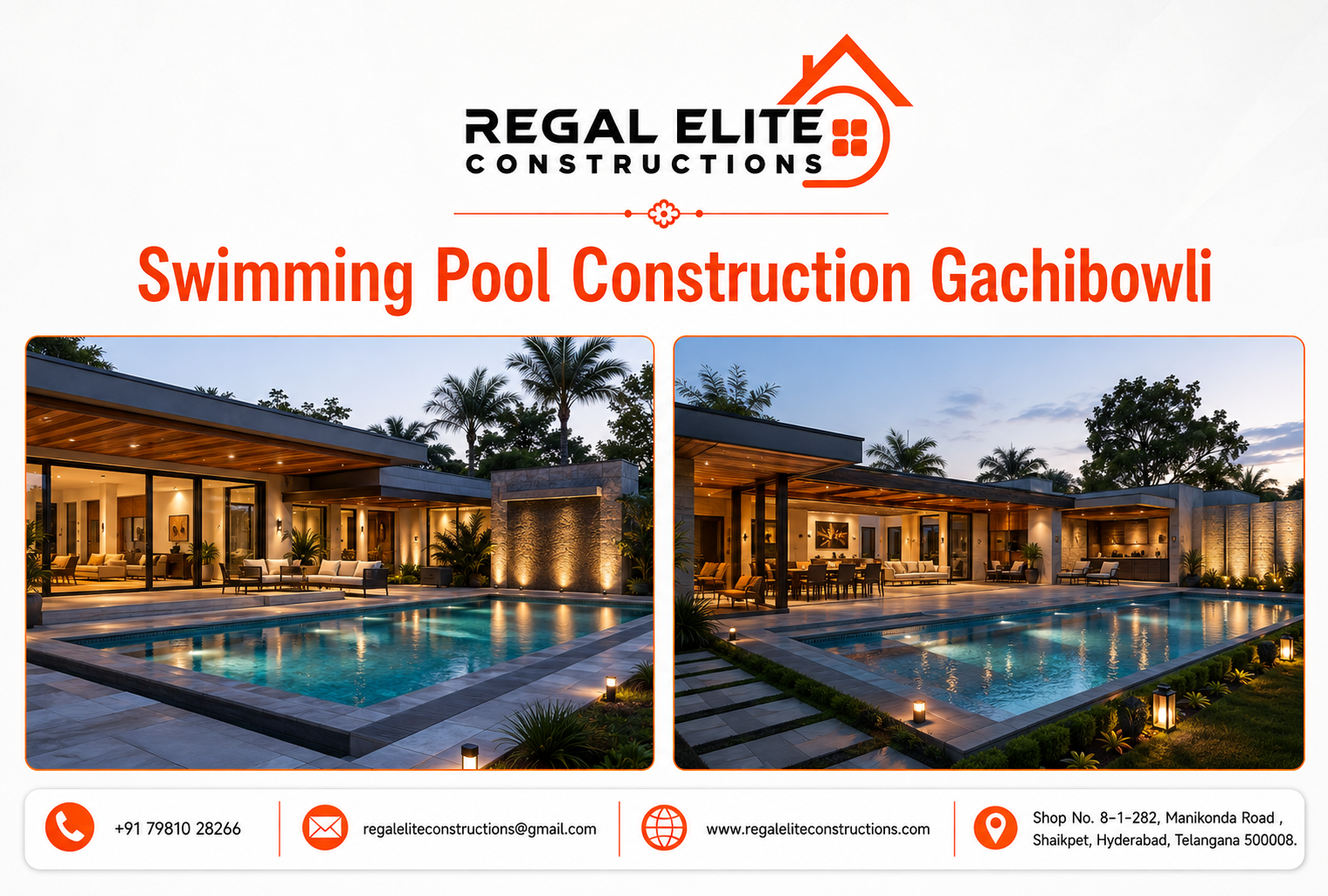
Gachibowli has grown into one of Hyderabad’s most desirable locations for premium residences, gated villa communities, farmhouses, hospitality projects, and lifestyle properties. A well-planned private pool can transform such a property into a comfortable retreat while adding visual appeal, recreational value, and a stronger connection between indoor and outdoor living. However, successful pool development requires much more than excavating a pit and filling it with water. It demands careful planning, structural engineering, waterproofing, hydraulic design, filtration, electrical safety, finishing, landscaping coordination, and a practical maintenance strategy.
Property owners searching for swimming pool Construction Gachibowli should begin with a clear understanding of their site, expected usage, preferred design, available budget, and long-term operating needs. A pool for a compact urban villa is different from a pool for a farmhouse, resort, apartment clubhouse, boutique hotel, or wellness facility. The shape, depth, circulation system, equipment capacity, deck finish, lighting, safety features, and water-treatment approach must be tailored to the project rather than copied from a generic plan.
Regal Elite Constructions approaches pool projects as integrated architectural and engineering assignments. The objective is to create a pool that looks refined, functions reliably, remains comfortable to use, and can be maintained without unnecessary complications. This detailed guide explains the complete process, from concept and site inspection to commissioning and maintenance, for clients considering swimming pool Construction Gachibowli.
Why a Professionally Built Pool Matters
Swimming pools are exposed to continuous hydrostatic pressure, changing temperatures, chemicals, sunlight, and frequent human use. Small mistakes in structural design or waterproofing can create cracks, leakage, tile failure, uneven settlement, corrosion, or expensive repairs. Professional planning reduces these risks by coordinating civil, plumbing, electrical, and finishing work from the beginning.
A quality pool should also support efficient circulation. Water must move through skimmers or overflow channels, reach the filtration system, receive appropriate treatment, and return evenly through correctly placed inlets. Poor circulation can create dead zones where debris and microorganisms collect. A well-designed hydraulic network improves water clarity and reduces the burden on chemicals and maintenance staff.
For homeowners, the value of professional execution is also visible in the final appearance. Accurate levels, clean tile lines, balanced proportions, concealed services, elegant lighting, and a well-finished deck make the pool feel like part of the property rather than an added structure. This is a central advantage of choosing experienced specialists for swimming pool Construction Gachibowli.
Understanding the Gachibowli Site Context
Gachibowli contains high-rise residences, villa communities, independent homes, commercial campuses, and properties extending toward Nanakramguda, Financial District, Kokapet, Narsingi, and surrounding growth corridors. Each site has different access conditions, soil characteristics, drainage patterns, neighbouring structures, and space limitations.
Before design begins, the contractor should study the proposed location, plot levels, existing foundations, underground utilities, access for excavation equipment, water availability, electrical load, and the route for removing excavated soil. In tightly developed plots, construction sequencing becomes especially important because machinery movement and material storage may be restricted.
Local climate also influences decisions. Hyderabad experiences intense summer heat, seasonal rain, dust, and strong sunlight. Pool finishes, deck materials, equipment enclosures, drainage, and landscaping must be selected to perform under these conditions. Thoughtful swimming pool Construction Gachibowli considers the full environment, not only the pool shell.
Step 1: Requirement Discussion and Design Brief
The first stage is a detailed consultation. The owner should explain who will use the pool, how often it will be used, whether children or elderly family members need special consideration, whether the pool is intended for exercise or relaxation, and whether features such as a jacuzzi, tanning ledge, waterfall, swim jet, or heating system are desired.
Design references are useful, but they should be adapted to the site. A photograph from an international resort may not suit the available plot, architecture, budget, or maintenance capacity. The designer should translate the preferred visual style into a practical plan with suitable dimensions, circulation, access, and equipment.
A written design brief helps control scope. It can list dimensions, depths, finish materials, filtration type, lighting, deck treatment, landscape interface, safety elements, automation, and provisional allowances. This keeps swimming pool Construction Gachibowli transparent and reduces late-stage changes.
Step 2: Site Survey and Technical Assessment
A proper survey records existing ground levels, boundaries, nearby walls, building foundations, drainage points, electrical sources, water lines, and access routes. The proposed pool should not interfere with critical structural elements or service lines. Where the pool is close to a building, structural coordination is essential.
Soil behaviour affects excavation support and foundation decisions. Loose fill, expansive soil, high groundwater, or waterlogged conditions may require additional engineering measures. The contractor may recommend soil investigation or structural consultation depending on the project scale and site history.
The survey should also identify where the plant room will be located. Pumps and filters need a dry, ventilated, accessible space with suitable drainage and safe electrical connections. Locating equipment too far away can increase pipe lengths and energy use, while placing it too close to living areas may create noise concerns. Efficient swimming pool Construction Gachibowli balances performance, access, and aesthetics.
Step 3: Pool Size, Shape, and Depth Planning
Pool dimensions should reflect actual use. A family recreation pool may prioritise a broad shallow zone, while a fitness-oriented pool may need a longer straight swimming lane. A farmhouse pool can support a larger leisure layout, whereas a villa pool may use a compact rectangle, courtyard pool, plunge pool, or lap pool.
Rectangular pools are popular because they are visually clean, easy to cover, and efficient for swimming. Freeform pools can blend with natural landscaping but may require more complex formwork and finishing. Infinity edges create dramatic views but demand accurate level control, a balancing tank, and additional hydraulic planning.
Depth should be planned responsibly. A gradual transition is often more comfortable for mixed users. Diving should never be assumed merely because a pool appears deep; safe diving design requires specialised dimensions and clearances. During swimming pool Construction Gachibowli, the depth profile must be documented before structural work begins.
Step 4: Budget Planning and Cost Transparency
Pool cost depends on size, structural system, excavation difficulty, waterproofing specification, tile selection, filtration type, deck material, water features, heating, automation, lighting, and landscape integration. Two pools with the same dimensions can have very different costs because their technical and finish specifications differ.
A reliable quotation should separate major work categories. These may include design, excavation, civil structure, waterproofing, plumbing, filtration equipment, electrical work, internal finishes, coping, deck work, lighting, testing, and commissioning. Clearly identified exclusions are equally important.
Owners should reserve a contingency for unexpected site conditions or approved changes. Choosing the lowest initial quote without comparing specifications can lead to omissions, inferior equipment, or expensive variations. Value-focused swimming pool Construction Gachibowli considers life-cycle performance, not only the opening price.
Structural Design and Reinforced Concrete Shell
The pool shell must resist water pressure from inside and soil or groundwater pressure from outside. Structural design considers pool dimensions, soil conditions, reinforcement, concrete grade, wall thickness, base slab, construction joints, and the relationship with nearby structures.
Reinforcement should be placed accurately with proper cover, spacing, laps, and supports. Plumbing sleeves, lights, drains, and inlet fittings must be coordinated before concrete placement to avoid uncontrolled cutting later. Construction joints require planned treatment because they are common leakage points.
Concrete placement and curing are critical. Honeycombing, segregation, poor vibration, or rapid drying can weaken the structure. Quality control during this stage is one of the most important parts of swimming pool Construction Gachibowli because later finishes cannot compensate for a defective shell.
Waterproofing: The Critical Protection Layer
Waterproofing should be treated as a complete system rather than a single coating. Surface preparation, crack treatment, joint detailing, pipe penetrations, corners, coves, and compatibility with tile adhesive all affect performance.
The concrete surface must be sound, clean, and properly prepared. Sharp internal corners may be treated with coves, while penetrations require careful sealing. The selected waterproofing product should be applied according to its technical requirements, including coat thickness, curing time, and protection before finishing.
Water-retention testing helps identify problems before expensive tiles and fittings are installed. A disciplined testing process is essential in swimming pool Construction Gachibowli because concealed leakage can damage surrounding soil, decks, plant rooms, and adjacent structures.
Hydraulic Circulation and Plumbing Design
A pool circulation system typically includes suction points, main drains, skimmers or overflow channels, pumps, filters, return inlets, valves, and treatment equipment. The system should circulate the full water volume within an appropriate turnover period based on pool type and usage.
Pipe sizing affects flow, pressure loss, energy consumption, and noise. Undersized pipes force pumps to work harder. Poorly arranged valves make maintenance difficult. Correct placement of inlets improves water distribution, while accessible unions and isolation valves simplify future servicing.
All suction fittings require safety-focused design. Entrapment risks must be addressed through suitable drain covers, configurations, and operating practices. For responsible swimming pool Construction Gachibowli, hydraulic efficiency and user safety must be considered together.
Skimmer Pools and Overflow Pools
In a skimmer pool, water is drawn through skimmer openings located near the waterline. This system is common for homes and villas because it is comparatively straightforward and requires less surrounding infrastructure. The water level normally sits below the deck.
An overflow pool allows water to spill into a perimeter channel or selected overflow edge before entering a balancing tank. It can create a visually seamless waterline and may offer strong surface cleaning when designed correctly. However, it requires more space, precise levels, a balancing tank, additional plumbing, and careful control.
The choice should be based on aesthetics, usage, site area, and budget. A knowledgeable swimming pool Construction Gachibowli team can explain the operational implications rather than recommending a system only for appearance.
Filtration Equipment Selection
The filter removes suspended particles from circulating water. Sand filters are widely used because they are robust and familiar to many operators. Cartridge filters can offer fine filtration and may reduce backwash water use, although cartridges require periodic cleaning and replacement. Other technologies may be considered for specialised projects.
Pump selection must match the hydraulic design rather than simply using a large motor. An oversized pump can increase energy consumption, turbulence, and equipment stress. A correctly selected pump delivers the required flow against the calculated system resistance.
Equipment quality, spare-part availability, warranty, and service support should influence procurement. Dependable swimming pool Construction Gachibowli includes an equipment schedule so the owner understands model capacities, materials, and maintenance requirements.
Water Treatment and Chemical Management
Clear water is not automatically safe water. Disinfection, pH control, circulation, filtration, and regular testing work together. The treatment approach may use chlorine-based systems, salt chlorination, automated dosing, ultraviolet support, or other approved technologies depending on the application.
The United States Centers for Disease Control and Prevention recommends regular monitoring of disinfectant concentration and pH for residential pools. Its home-pool guidance notes a pH range of 7.0 to 7.8 and at least 1 ppm chlorine in pools, while local requirements, equipment instructions, and professional advice should also be followed.
Chemical storage and dosing deserve caution. Products should be stored separately as directed, protected from heat and moisture, and handled by trained adults using appropriate protective equipment. Good swimming pool Construction Gachibowli includes a clear handover plan for water testing and treatment.
Electrical Safety and Pool Lighting
Pools combine water and electricity, making professional electrical design essential. Pumps, lights, automation panels, heaters, and accessories require suitable circuits, protective devices, grounding, bonding, weatherproof enclosures, and safe cable routing.
Underwater lights should be purpose-designed for pool use and installed with compatible niches, transformers, and seals. Lighting placement should avoid glare while improving visibility. Warm white light can create a calm atmosphere, while colour-changing systems offer flexibility for events.
Electrical work should be completed and tested by qualified professionals in accordance with applicable requirements. Premium swimming pool Construction Gachibowli never treats electrical safety as a decorative afterthought.
Pool Finishes, Tiles, and Coping
Internal finishes influence appearance, comfort, hygiene, and durability. Options may include glass mosaic, ceramic pool tile, porcelain systems, stone-look products, or specialised renders. Materials must be suitable for permanent immersion and compatible with the waterproofing and adhesive system.
Colour affects the visual tone of the water. Light blue finishes create a bright classic appearance, while grey or dark finishes can produce a reflective contemporary look. Very dark surfaces may show scale differently and can absorb more heat.
Coping forms the transition between the pool and deck. It should provide a comfortable edge, resist weather, and coordinate with the overall architecture. Accurate setting-out during swimming pool Construction Gachibowli ensures clean lines and consistent levels.
Pool Deck Design and Slip Resistance
The deck is one of the most frequently used parts of the pool environment. It should remain comfortable underfoot, drain efficiently, resist slipping, tolerate heat, and provide enough space for circulation, seating, and supervision.
Natural stone, textured porcelain, concrete finishes, and composite materials can be considered. Highly polished surfaces are generally unsuitable near water. Drainage falls must move water away without creating puddles or directing contaminated runoff into the pool.
Deck joints, edge details, and the interface with the pool shell require careful coordination. Attractive swimming pool Construction Gachibowli includes a practical deck plan rather than focusing only on the water body.
Landscape Integration and Outdoor Living
A pool becomes more valuable when it is connected to usable outdoor spaces. Shaded seating, pergolas, lawns, planting, outdoor showers, changing areas, and dining zones can make the environment comfortable throughout the day.
Plant selection matters. Trees that shed heavily can increase cleaning. Aggressive roots may threaten structures or pipes if planted too close. Thorny plants and species that attract excessive insects may be unsuitable around circulation areas.
Landscape lighting should guide movement without overpowering the pool. The best swimming pool Construction Gachibowli projects coordinate architecture, water, planting, furniture, and lighting as one composition.
Safety Features for Homes and Villas
Safety planning should begin during design. Non-slip surfaces, controlled access, clear depth markers, secure barriers where required, visible steps, handrails, adequate lighting, and properly designed suction fittings can reduce risk.
Children require constant active supervision around water. Physical barriers and covers can support safety but do not replace responsible supervision. Rescue equipment and basic emergency planning should be considered, especially for larger properties or frequently used pools.
The World Health Organization’s guidance for swimming pools addresses drowning, injury, microbial contamination, and chemical exposure. Responsible swimming pool Construction Gachibowli uses recognised safety principles while also following applicable local requirements.
Energy-Efficient Pool Planning
Operating cost is influenced by pump efficiency, pipe sizing, filtration resistance, lighting, heating, evaporation, and maintenance habits. Energy-efficient pumps or variable-speed systems can reduce consumption when correctly selected and programmed.
Pool covers can reduce evaporation, heat loss, and debris entry. Shading may lower heat gain but can also affect sunlight and landscape design. LED lighting generally consumes less energy than older lighting technologies.
Efficiency should not reduce water quality or safety. A balanced swimming pool Construction Gachibowli strategy optimises equipment schedules, circulation, and maintenance based on actual use.
Water Conservation Strategies
Hyderabad’s water conditions make conservation an important design consideration. Proper waterproofing prevents hidden loss. Accurate level control limits overflow waste. Efficient backwashing practices, cartridge filtration where suitable, covers, and leak monitoring can reduce consumption.
Deck drainage and rainwater management should be planned so stormwater does not carry soil or chemicals into the pool. Where permitted and technically appropriate, owners can explore responsible rainwater use for landscape needs rather than relying solely on treated water.
Conservation-focused swimming pool Construction Gachibowli also includes training the owner to identify unusual water loss, maintain correct levels, and respond early to leaks.
Construction Sequence from Excavation to Handover
A typical sequence includes survey, setting-out, excavation, sub-base preparation, structural work, embedded plumbing, concrete curing, surface preparation, waterproofing, water testing, equipment installation, tile work, coping, deck work, electrical completion, filling, balancing, and commissioning.
Some activities overlap, but coordination is important. Installing landscaping too early may create damage during equipment movement. Applying finishes before waterproof testing can conceal defects. Filling the pool before chemicals and filtration are ready can create staining or water-quality problems.
A documented programme helps clients understand milestones. Organised swimming pool Construction Gachibowli also includes site cleanliness, material protection, and regular progress review.
Quality Checks During Construction
Quality control should verify dimensions, levels, reinforcement, concrete condition, pipe pressure, waterproofing continuity, tile alignment, equipment installation, electrical protection, and final water performance.
Photographic records of concealed plumbing and reinforcement can be useful for future maintenance. Pressure testing lines before backfilling or covering reduces the risk of hidden leaks. Equipment labels and valve identification improve operation.
Before handover, swimming pool Construction Gachibowli should include trial operation, leak observation, water balancing, cleaning, and confirmation that all features work as intended.
Common Mistakes to Avoid
Frequent mistakes include choosing a contractor only by price, changing dimensions after structural work begins, ignoring plant-room access, using unsuitable tiles, omitting pressure tests, undersizing pipes, placing lights without glare review, and failing to plan deck drainage.
Another mistake is adding too many features without considering maintenance. Waterfalls, fountains, spas, automation, and heating can be valuable, but each adds equipment and operating requirements. Features should support the intended experience.
Good swimming pool Construction Gachibowli protects the project from these problems through detailed drawings, specifications, approvals, and staged inspections.
Maintenance After Completion
Routine maintenance includes skimming debris, brushing surfaces, vacuuming, cleaning baskets, checking filter pressure, testing water, adjusting chemicals, and inspecting equipment. Frequency depends on usage, weather, landscaping, and pool type.
Filters require periodic cleaning or backwashing. Pumps should not run dry. Unusual noise, bubbles, reduced flow, staining, or rapid water loss should be investigated promptly. Early attention prevents small problems from becoming major repairs.
A maintenance log is helpful for tracking readings, chemical additions, cleaning, and equipment service. Long-term success of swimming pool Construction Gachibowli depends on proper operation after the construction team leaves.
Renovation and Upgrade Options
Existing pools may be improved through retiling, waterproofing repairs, deck replacement, filtration upgrades, LED lighting, automation, salt chlorination, water-feature additions, or layout modifications.
Renovation should begin with diagnosis. Leakage may come from the shell, plumbing, fittings, or evaporation. Stains may result from water chemistry rather than tile failure. Replacing finishes without solving the root cause can waste money.
An experienced swimming pool Construction Gachibowli contractor can assess whether repair, partial renovation, or complete reconstruction offers the best value.
Choosing the Right Contractor
Review technical knowledge, completed work, clarity of quotation, equipment specifications, warranty terms, project management, communication, and after-sales support. Ask how the contractor handles waterproof testing, plumbing pressure tests, electrical safety, and commissioning.
Do not rely only on attractive renderings. Request practical information about circulation, plant-room layout, maintenance access, and operating cost. A contractor who explains trade-offs clearly is more valuable than one who promises every feature without qualification.
For clients evaluating swimming pool Construction Gachibowli, Regal Elite Constructions provides coordinated planning from concept to completion, with attention to structure, services, finishes, and usability.
Why Regal Elite Constructions
Regal Elite Constructions combines design coordination, civil execution, pool systems, finishing, and site management. This integrated approach helps maintain consistency between architectural intent and technical performance.
Clients receive guidance on dimensions, layouts, filtration options, finishes, lighting, decks, and maintenance considerations. The goal is to develop a solution suited to the property rather than force every project into the same package.
Whether the requirement is for a villa, farmhouse, home, resort, or commercial property, the team can develop a customised swimming pool Construction Gachibowli plan based on site conditions and client priorities.
Explore Our Detailed Hyderabad Pool Guide
For additional information about pool planning for homes, villas, farmhouses and resorts, read our in-depth guide: Best Swimming Pool Construction in Hyderabad for Homes, Villas & Resorts.
You can also visit the Regal Elite Constructions homepage to explore our construction services and discuss your project.
Comparison of Popular Pool Options
| Pool Type | Best For | Main Advantage | Planning Consideration |
|---|---|---|---|
| Skimmer Pool | Homes and villas | Practical and cost-efficient | Waterline remains below deck level |
| Overflow Pool | Premium villas and resorts | Elegant waterline and strong surface cleaning | Needs channel, balancing tank and precise levels |
| Infinity Pool | View-oriented properties | Dramatic visual edge | Requires catch basin and advanced hydraulic design |
| Lap Pool | Fitness-focused users | Efficient for exercise | Needs sufficient uninterrupted length |
| Plunge Pool | Compact plots | Fits limited spaces | Better for relaxation than long-distance swimming |
| Children’s Pool | Family and hospitality projects | Shallow supervised recreation | Requires controlled access and constant supervision |
Final Checklist Before Starting
Before appointing a contractor for swimming pool Construction Gachibowli, confirm the approved dimensions, depth profile, structural drawings, filtration capacity, waterproofing system, tile specification, lighting plan, deck levels, plant-room location, safety features, payment stages, completion schedule, testing process, warranties, and maintenance handover.
A pool is a long-term asset. Careful decisions made before excavation can prevent structural, operational, and financial problems later. The best outcome comes from balancing appearance, engineering, safety, maintenance, and site realities.
Frequently Asked Questions
How long does swimming pool construction usually take in Gachibowli?
The duration depends on dimensions, site access, structural complexity, weather, finishes, equipment availability, and landscape coordination. A clear schedule should be prepared after survey and design approval.
What is the best pool size for a villa?
There is no single ideal size. The pool should leave enough deck and circulation space while supporting the family’s intended use. Compact plunge pools, medium recreation pools, and lap pools can all work well in villas.
Is a skimmer pool or overflow pool better?
A skimmer pool is often practical for private homes, while an overflow pool can create a premium waterline and strong surface cleaning. The best choice depends on space, budget, appearance, and maintenance expectations.
How can pool leakage be prevented?
Leak prevention requires sound structural work, controlled joints, sealed penetrations, suitable waterproofing, pressure-tested plumbing, and water-retention testing before finishes are installed.
Which pool tiles are suitable?
Use products designed for permanent immersion along with compatible adhesives and grouts. Selection should consider slip resistance on steps, chemical exposure, colour, comfort, and maintenance.
How often should pool water be tested?
Testing frequency depends on use and treatment method. Residential owners should routinely check disinfectant and pH, with more frequent testing during heavy use, hot weather, or after rain.
Can a pool be built on a terrace?
Terrace or rooftop pools require specialised structural assessment, waterproofing, load analysis, access planning, and service coordination. They should never be added without qualified engineering input.
Can an existing pool be renovated?
Yes. Renovation can include leak repair, retiling, deck upgrades, lighting, filtration replacement, automation, or redesign. A technical inspection should identify the actual causes of existing problems.
Does a swimming pool increase property value?
A well-designed and maintained pool can improve lifestyle appeal and marketability for suitable premium properties, though value depends on location, buyer preferences, quality, and maintenance condition.
What maintenance support is required after handover?
Owners need routine cleaning, water testing, chemical management, filter servicing, and equipment inspection. A clear operating manual and service plan make ownership easier.
Authoritative Pool Planning and Safety Resources
For broader technical and safety awareness, property owners may review guidance from the following recognised organisations:
Additional Planning Notes
swimming pool Construction Gachibowli requires coordinated planning, quality materials, careful execution, testing, and a practical maintenance strategy suited to the property.
swimming pool Construction Gachibowli requires coordinated planning, quality materials, careful execution, testing, and a practical maintenance strategy suited to the property.
swimming pool Construction Gachibowli requires coordinated planning, quality materials, careful execution, testing, and a practical maintenance strategy suited to the property.
swimming pool Construction Gachibowli requires coordinated planning, quality materials, careful execution, testing, and a practical maintenance strategy suited to the property.
swimming pool Construction Gachibowli requires coordinated planning, quality materials, careful execution, testing, and a practical maintenance strategy suited to the property.
swimming pool Construction Gachibowli requires coordinated planning, quality materials, careful execution, testing, and a practical maintenance strategy suited to the property.
swimming pool Construction Gachibowli requires coordinated planning, quality materials, careful execution, testing, and a practical maintenance strategy suited to the property.
swimming pool Construction Gachibowli requires coordinated planning, quality materials, careful execution, testing, and a practical maintenance strategy suited to the property.
swimming pool Construction Gachibowli requires coordinated planning, quality materials, careful execution, testing, and a practical maintenance strategy suited to the property.
swimming pool Construction Gachibowli requires coordinated planning, quality materials, careful execution, testing, and a practical maintenance strategy suited to the property.
swimming pool Construction Gachibowli requires coordinated planning, quality materials, careful execution, testing, and a practical maintenance strategy suited to the property.
swimming pool Construction Gachibowli requires coordinated planning, quality materials, careful execution, testing, and a practical maintenance strategy suited to the property.
swimming pool Construction Gachibowli requires coordinated planning, quality materials, careful execution, testing, and a practical maintenance strategy suited to the property.
swimming pool Construction Gachibowli requires coordinated planning, quality materials, careful execution, testing, and a practical maintenance strategy suited to the property.
swimming pool Construction Gachibowli requires coordinated planning, quality materials, careful execution, testing, and a practical maintenance strategy suited to the property.
swimming pool Construction Gachibowli requires coordinated planning, quality materials, careful execution, testing, and a practical maintenance strategy suited to the property.
swimming pool Construction Gachibowli requires coordinated planning, quality materials, careful execution, testing, and a practical maintenance strategy suited to the property.
swimming pool Construction Gachibowli requires coordinated planning, quality materials, careful execution, testing, and a practical maintenance strategy suited to the property.
swimming pool Construction Gachibowli requires coordinated planning, quality materials, careful execution, testing, and a practical maintenance strategy suited to the property.
swimming pool Construction Gachibowli requires coordinated planning, quality materials, careful execution, testing, and a practical maintenance strategy suited to the property.
swimming pool Construction Gachibowli requires coordinated planning, quality materials, careful execution, testing, and a practical maintenance strategy suited to the property.
swimming pool Construction Gachibowli requires coordinated planning, quality materials, careful execution, testing, and a practical maintenance strategy suited to the property.
swimming pool Construction Gachibowli requires coordinated planning, quality materials, careful execution, testing, and a practical maintenance strategy suited to the property.
swimming pool Construction Gachibowli requires coordinated planning, quality materials, careful execution, testing, and a practical maintenance strategy suited to the property.
swimming pool Construction Gachibowli requires coordinated planning, quality materials, careful execution, testing, and a practical maintenance strategy suited to the property.
swimming pool Construction Gachibowli requires coordinated planning, quality materials, careful execution, testing, and a practical maintenance strategy suited to the property.
swimming pool Construction Gachibowli requires coordinated planning, quality materials, careful execution, testing, and a practical maintenance strategy suited to the property.
swimming pool Construction Gachibowli requires coordinated planning, quality materials, careful execution, testing, and a practical maintenance strategy suited to the property.
swimming pool Construction Gachibowli requires coordinated planning, quality materials, careful execution, testing, and a practical maintenance strategy suited to the property.
swimming pool Construction Gachibowli requires coordinated planning, quality materials, careful execution, testing, and a practical maintenance strategy suited to the property.
swimming pool Construction Gachibowli requires coordinated planning, quality materials, careful execution, testing, and a practical maintenance strategy suited to the property.
swimming pool Construction Gachibowli requires coordinated planning, quality materials, careful execution, testing, and a practical maintenance strategy suited to the property.
swimming pool Construction Gachibowli requires coordinated planning, quality materials, careful execution, testing, and a practical maintenance strategy suited to the property.
swimming pool Construction Gachibowli requires coordinated planning, quality materials, careful execution, testing, and a practical maintenance strategy suited to the property.
swimming pool Construction Gachibowli requires coordinated planning, quality materials, careful execution, testing, and a practical maintenance strategy suited to the property.
swimming pool Construction Gachibowli requires coordinated planning, quality materials, careful execution, testing, and a practical maintenance strategy suited to the property.
swimming pool Construction Gachibowli requires coordinated planning, quality materials, careful execution, testing, and a practical maintenance strategy suited to the property.
swimming pool Construction Gachibowli requires coordinated planning, quality materials, careful execution, testing, and a practical maintenance strategy suited to the property.
swimming pool Construction Gachibowli requires coordinated planning, quality materials, careful execution, testing, and a practical maintenance strategy suited to the property.
swimming pool Construction Gachibowli requires coordinated planning, quality materials, careful execution, testing, and a practical maintenance strategy suited to the property.
swimming pool Construction Gachibowli requires coordinated planning, quality materials, careful execution, testing, and a practical maintenance strategy suited to the property.
swimming pool Construction Gachibowli requires coordinated planning, quality materials, careful execution, testing, and a practical maintenance strategy suited to the property.
swimming pool Construction Gachibowli requires coordinated planning, quality materials, careful execution, testing, and a practical maintenance strategy suited to the property.
swimming pool Construction Gachibowli requires coordinated planning, quality materials, careful execution, testing, and a practical maintenance strategy suited to the property.
swimming pool Construction Gachibowli requires coordinated planning, quality materials, careful execution, testing, and a practical maintenance strategy suited to the property.
swimming pool Construction Gachibowli requires coordinated planning, quality materials, careful execution, testing, and a practical maintenance strategy suited to the property.
swimming pool Construction Gachibowli requires coordinated planning, quality materials, careful execution, testing, and a practical maintenance strategy suited to the property.
swimming pool Construction Gachibowli requires coordinated planning, quality materials, careful execution, testing, and a practical maintenance strategy suited to the property.
swimming pool Construction Gachibowli requires coordinated planning, quality materials, careful execution, testing, and a practical maintenance strategy suited to the property.
swimming pool Construction Gachibowli requires coordinated planning, quality materials, careful execution, testing, and a practical maintenance strategy suited to the property.
Practical Project Insight
During design review, owners should walk through a typical day of pool use. Consider where towels will be stored, how swimmers will reach a changing area, where wet feet will travel, whether outdoor furniture blocks circulation, and how service personnel will access equipment without disturbing private areas. These practical details strongly influence daily satisfaction.
Noise control is another important issue. Pumps, blowers, and water features can be noticeable in quiet residential settings. Equipment should be mounted correctly, ventilated, and placed in a location that allows servicing while reducing disturbance to bedrooms, neighbours, and outdoor seating areas.
Visualisation can help owners approve the concept before construction. Dimensioned drawings, material samples, lighting references, and three-dimensional views make it easier to understand scale. However, visual presentations should always be supported by technical drawings showing levels, sections, pipe routes, and equipment details.
Weather planning improves workmanship. Waterproofing, adhesives, grouts, and coatings have temperature and moisture requirements. Construction teams should protect unfinished work during rain and avoid rushing curing periods merely to recover time. A realistic programme allows critical materials to perform as intended.
Water features should be sized to suit the pool and the surrounding architecture. A narrow sheer descent, a textured wall cascade, deck jets, or a gentle bubbler can create movement and sound. Each feature needs pump capacity, pipework, controls, waterproofing, and access for maintenance.
Automation can simplify operation by controlling filtration schedules, lighting, heating, water features, and dosing systems. The most useful automation is reliable, understandable, and supported locally. Complicated systems that owners cannot operate may create frustration, so training and documentation are essential.
Pool heating may be considered for year-round use, early-morning exercise, wellness applications, or hospitality projects. Options can include heat pumps, solar support, or other systems. The design should account for heat loss, desired temperature, cover use, electrical capacity, and operating cost.
Ventilation is especially important for indoor or partially enclosed pools. Humidity can affect walls, ceilings, furniture, electrical components, and occupant comfort. Indoor pools require specialised coordination of dehumidification, air movement, vapour control, and corrosion-resistant materials.
The plant room should have adequate floor drainage, lighting, ventilation, and working clearance. Valves should be labelled, equipment should be mounted on stable bases, and electrical panels should remain protected. A neat plant room improves safety and reduces servicing time.
Commissioning should not be rushed. The team must check flow, pressure, leaks, filter operation, valve positions, lighting, water features, dosing, and controls. The owner should receive a demonstration showing startup, shutdown, cleaning, testing, backwashing or cartridge care, and basic troubleshooting.
Practical Project Insight
During design review, owners should walk through a typical day of pool use. Consider where towels will be stored, how swimmers will reach a changing area, where wet feet will travel, whether outdoor furniture blocks circulation, and how service personnel will access equipment without disturbing private areas. These practical details strongly influence daily satisfaction.
Noise control is another important issue. Pumps, blowers, and water features can be noticeable in quiet residential settings. Equipment should be mounted correctly, ventilated, and placed in a location that allows servicing while reducing disturbance to bedrooms, neighbours, and outdoor seating areas.
Visualisation can help owners approve the concept before construction. Dimensioned drawings, material samples, lighting references, and three-dimensional views make it easier to understand scale. However, visual presentations should always be supported by technical drawings showing levels, sections, pipe routes, and equipment details.
Weather planning improves workmanship. Waterproofing, adhesives, grouts, and coatings have temperature and moisture requirements. Construction teams should protect unfinished work during rain and avoid rushing curing periods merely to recover time. A realistic programme allows critical materials to perform as intended.
Water features should be sized to suit the pool and the surrounding architecture. A narrow sheer descent, a textured wall cascade, deck jets, or a gentle bubbler can create movement and sound. Each feature needs pump capacity, pipework, controls, waterproofing, and access for maintenance.
Automation can simplify operation by controlling filtration schedules, lighting, heating, water features, and dosing systems. The most useful automation is reliable, understandable, and supported locally. Complicated systems that owners cannot operate may create frustration, so training and documentation are essential.
Pool heating may be considered for year-round use, early-morning exercise, wellness applications, or hospitality projects. Options can include heat pumps, solar support, or other systems. The design should account for heat loss, desired temperature, cover use, electrical capacity, and operating cost.
Ventilation is especially important for indoor or partially enclosed pools. Humidity can affect walls, ceilings, furniture, electrical components, and occupant comfort. Indoor pools require specialised coordination of dehumidification, air movement, vapour control, and corrosion-resistant materials.
The plant room should have adequate floor drainage, lighting, ventilation, and working clearance. Valves should be labelled, equipment should be mounted on stable bases, and electrical panels should remain protected. A neat plant room improves safety and reduces servicing time.
Commissioning should not be rushed. The team must check flow, pressure, leaks, filter operation, valve positions, lighting, water features, dosing, and controls. The owner should receive a demonstration showing startup, shutdown, cleaning, testing, backwashing or cartridge care, and basic troubleshooting.
Conclusion
A thoughtfully planned swimming pool can become the centrepiece of a Gachibowli villa, farmhouse, home, resort, or hospitality property. Its success depends on coordinated design, reliable structure, complete waterproofing, efficient circulation, suitable filtration, safe electrical work, durable finishes, practical decking, and disciplined commissioning.
Choosing a qualified team for swimming pool Construction Gachibowli helps protect the investment and ensures that the final pool is attractive, functional, and manageable for years. Regal Elite Constructions supports clients through planning, design coordination, construction, finishing, equipment installation, testing, and handover.
ContactUs :
Phone: +91 79810 28266
Email: regaleliteconstructions@gmail.com
Address: Shop No. 8-1-282, Manikonda Road , Shaikpet, Hyderabad, Telangana 500008.
Request a Project Consultation