
Overflow swimming pool construction: Complete Design, Engineering and Building Guide
Discover how a premium overflow pool is planned, engineered, waterproofed, finished, commissioned and maintained for villas, farmhouses, resorts and modern residential properties.
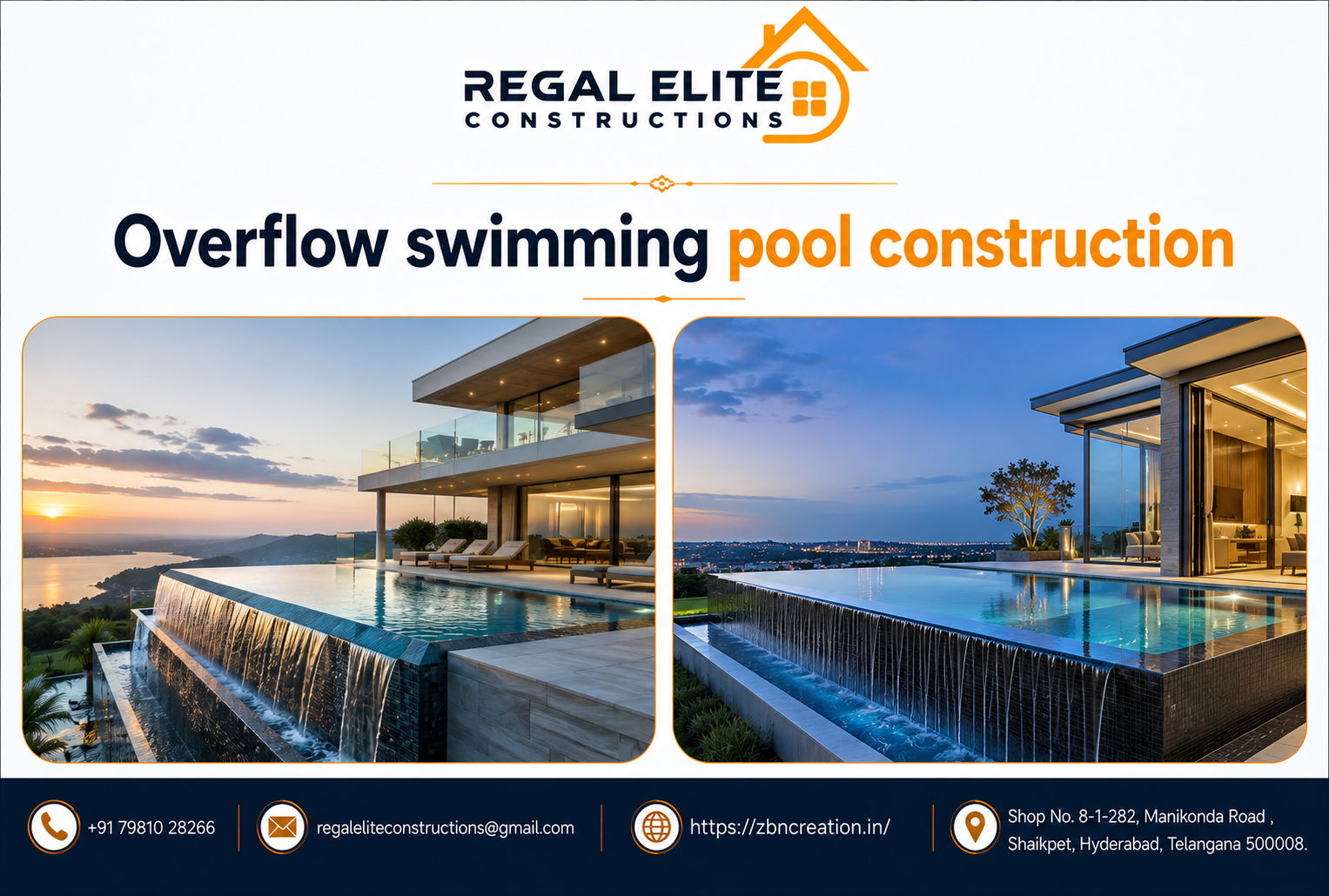
This detailed guide explains the complete journey from initial site assessment to final handover. It is written for homeowners, architects, developers, hospitality operators and project managers who want a pool that looks elegant while operating reliably. Every major decision is covered in practical language, including structure, hydraulics, balance tanks, circulation, filtration, safety, materials, energy efficiency, maintenance and contractor selection.
Introduction: Building a Pool That Looks Effortless and Performs Precisely
Overflow swimming pool construction requires close coordination between design intent and technical execution. An overflow pool creates a calm, architectural water surface that appears to merge with the surrounding deck. Achieving that visual effect requires far more than attractive tiles and a powerful pump. The structure, hydraulic calculations, edge detailing, surge storage, waterproofing, filtration, and finishing materials must all work together. A well-planned project turns a technical system into a refined outdoor feature that remains comfortable, clean, and visually balanced. The most valuable decisions are made before site work begins, because later corrections can affect cost, schedule, appearance and long-term reliability.
During Overflow swimming pool construction, the project team should document assumptions, dimensions, levels, material standards and testing requirements. Clear drawings help civil, plumbing, electrical, waterproofing, tiling and landscape teams work toward the same result. They also reduce confusion about responsibilities and make quotation comparisons more meaningful.
A professional approach to Overflow swimming pool construction also considers how the facility will be operated after handover. Access for cleaning, safe chemical storage, equipment servicing, drainage, replacement space and owner training are not secondary matters. They determine whether the pool remains enjoyable or becomes difficult and expensive to manage.
For this stage, owners should request written recommendations rather than relying only on verbal assurances. Drawings, product data, inspection records and test reports create accountability. They also provide useful references when future maintenance, upgrades or repairs are required. A premium result comes from consistent attention to details that may not be visible after completion.
What Makes an Overflow Pool Different
Overflow swimming pool construction requires close coordination between design intent and technical execution. In a conventional skimmer pool, the water level sits below the coping and is drawn through wall-mounted skimmers. In an overflow system, water reaches the top edge and spills into a perimeter channel or selected overflow edge. It is then collected in a balance tank, filtered, treated, and returned to the pool. This continuous movement removes floating debris efficiently and produces a smooth, mirror-like appearance. The most valuable decisions are made before site work begins, because later corrections can affect cost, schedule, appearance and long-term reliability.
During Overflow swimming pool construction, the project team should document assumptions, dimensions, levels, material standards and testing requirements. Clear drawings help civil, plumbing, electrical, waterproofing, tiling and landscape teams work toward the same result. They also reduce confusion about responsibilities and make quotation comparisons more meaningful.
A professional approach to Overflow swimming pool construction also considers how the facility will be operated after handover. Access for cleaning, safe chemical storage, equipment servicing, drainage, replacement space and owner training are not secondary matters. They determine whether the pool remains enjoyable or becomes difficult and expensive to manage.
For this stage, owners should request written recommendations rather than relying only on verbal assurances. Drawings, product data, inspection records and test reports create accountability. They also provide useful references when future maintenance, upgrades or repairs are required. A premium result comes from consistent attention to details that may not be visible after completion.
Why Hyderabad Properties Choose Overflow Pools
Overflow swimming pool construction requires close coordination between design intent and technical execution. Hyderabad homeowners increasingly use pools as part of the overall architecture rather than as separate recreational features. Villas, farmhouses, boutique resorts, clubs, and premium residential projects benefit from the clean geometry of an overflow edge. The design can visually widen a compact courtyard, connect an indoor living area with the landscape, or create a dramatic view toward gardens, terraces, and open plots. The most valuable decisions are made before site work begins, because later corrections can affect cost, schedule, appearance and long-term reliability.
During Overflow swimming pool construction, the project team should document assumptions, dimensions, levels, material standards and testing requirements. Clear drawings help civil, plumbing, electrical, waterproofing, tiling and landscape teams work toward the same result. They also reduce confusion about responsibilities and make quotation comparisons more meaningful.
A professional approach to Overflow swimming pool construction also considers how the facility will be operated after handover. Access for cleaning, safe chemical storage, equipment servicing, drainage, replacement space and owner training are not secondary matters. They determine whether the pool remains enjoyable or becomes difficult and expensive to manage.
For this stage, owners should request written recommendations rather than relying only on verbal assurances. Drawings, product data, inspection records and test reports create accountability. They also provide useful references when future maintenance, upgrades or repairs are required. A premium result comes from consistent attention to details that may not be visible after completion.
Site Study and Feasibility
Overflow swimming pool construction requires close coordination between design intent and technical execution. Before design begins, the site must be studied for soil condition, access, ground level, drainage, structural loading, underground utilities, and the relationship between the pool and nearby buildings. A sloping site may support an infinity edge, while a flat site may suit a full perimeter overflow. Proper feasibility work prevents costly changes after excavation and helps the project team select an efficient structural and hydraulic concept. The most valuable decisions are made before site work begins, because later corrections can affect cost, schedule, appearance and long-term reliability.
During Overflow swimming pool construction, the project team should document assumptions, dimensions, levels, material standards and testing requirements. Clear drawings help civil, plumbing, electrical, waterproofing, tiling and landscape teams work toward the same result. They also reduce confusion about responsibilities and make quotation comparisons more meaningful.
A professional approach to Overflow swimming pool construction also considers how the facility will be operated after handover. Access for cleaning, safe chemical storage, equipment servicing, drainage, replacement space and owner training are not secondary matters. They determine whether the pool remains enjoyable or becomes difficult and expensive to manage.
For this stage, owners should request written recommendations rather than relying only on verbal assurances. Drawings, product data, inspection records and test reports create accountability. They also provide useful references when future maintenance, upgrades or repairs are required. A premium result comes from consistent attention to details that may not be visible after completion.
Pool Planning and User Requirements
Overflow swimming pool construction requires close coordination between design intent and technical execution. Every pool should begin with a clear understanding of how it will be used. A family pool needs comfortable entry steps, safe depths, easy supervision, and practical maintenance access. A fitness pool may need a longer swimming lane. A hospitality pool needs stronger circulation, higher bather-load capacity, and durable finishes. Planning around real use improves safety, operating cost, and long-term satisfaction. The most valuable decisions are made before site work begins, because later corrections can affect cost, schedule, appearance and long-term reliability.
During Overflow swimming pool construction, the project team should document assumptions, dimensions, levels, material standards and testing requirements. Clear drawings help civil, plumbing, electrical, waterproofing, tiling and landscape teams work toward the same result. They also reduce confusion about responsibilities and make quotation comparisons more meaningful.
A professional approach to Overflow swimming pool construction also considers how the facility will be operated after handover. Access for cleaning, safe chemical storage, equipment servicing, drainage, replacement space and owner training are not secondary matters. They determine whether the pool remains enjoyable or becomes difficult and expensive to manage.
For this stage, owners should request written recommendations rather than relying only on verbal assurances. Drawings, product data, inspection records and test reports create accountability. They also provide useful references when future maintenance, upgrades or repairs are required. A premium result comes from consistent attention to details that may not be visible after completion.
Architectural Design and Visual Balance
Overflow swimming pool construction requires close coordination between design intent and technical execution. The best overflow pools feel connected to the building, deck, garden, and surrounding views. Designers study proportions, sightlines, sun movement, privacy, nighttime lighting, and the transition between indoor and outdoor areas. The waterline should align cleanly with architectural elements. Material selection should create contrast without making the space feel busy. Simplicity usually delivers the most premium result. The most valuable decisions are made before site work begins, because later corrections can affect cost, schedule, appearance and long-term reliability.
During Overflow swimming pool construction, the project team should document assumptions, dimensions, levels, material standards and testing requirements. Clear drawings help civil, plumbing, electrical, waterproofing, tiling and landscape teams work toward the same result. They also reduce confusion about responsibilities and make quotation comparisons more meaningful.
A professional approach to Overflow swimming pool construction also considers how the facility will be operated after handover. Access for cleaning, safe chemical storage, equipment servicing, drainage, replacement space and owner training are not secondary matters. They determine whether the pool remains enjoyable or becomes difficult and expensive to manage.
For this stage, owners should request written recommendations rather than relying only on verbal assurances. Drawings, product data, inspection records and test reports create accountability. They also provide useful references when future maintenance, upgrades or repairs are required. A premium result comes from consistent attention to details that may not be visible after completion.
Structural Engineering
Overflow swimming pool construction requires close coordination between design intent and technical execution. A swimming pool is a water-retaining structure that must resist soil pressure, water pressure, settlement, temperature movement, and sometimes groundwater uplift. Structural engineers determine wall thickness, base slab design, reinforcement, joints, and support conditions. Overflow channels and balance tanks must also be integrated structurally. Accurate engineering is essential because small movement can damage waterproofing, tiles, and edge alignment. The most valuable decisions are made before site work begins, because later corrections can affect cost, schedule, appearance and long-term reliability.
During Overflow swimming pool construction, the project team should document assumptions, dimensions, levels, material standards and testing requirements. Clear drawings help civil, plumbing, electrical, waterproofing, tiling and landscape teams work toward the same result. They also reduce confusion about responsibilities and make quotation comparisons more meaningful.
A professional approach to Overflow swimming pool construction also considers how the facility will be operated after handover. Access for cleaning, safe chemical storage, equipment servicing, drainage, replacement space and owner training are not secondary matters. They determine whether the pool remains enjoyable or becomes difficult and expensive to manage.
For this stage, owners should request written recommendations rather than relying only on verbal assurances. Drawings, product data, inspection records and test reports create accountability. They also provide useful references when future maintenance, upgrades or repairs are required. A premium result comes from consistent attention to details that may not be visible after completion.
Hydraulic Design
Overflow swimming pool construction requires close coordination between design intent and technical execution. The hydraulic system controls how water moves through the pool, overflow channel, balance tank, pumps, filters, treatment equipment, and return inlets. Pipe sizes, flow rates, pump head, turnover time, channel capacity, and inlet placement must be calculated together. Poor hydraulic design can cause noisy overflow, uneven water movement, air entering the pump line, weak filtration, or excessive electricity consumption. The most valuable decisions are made before site work begins, because later corrections can affect cost, schedule, appearance and long-term reliability.
During Overflow swimming pool construction, the project team should document assumptions, dimensions, levels, material standards and testing requirements. Clear drawings help civil, plumbing, electrical, waterproofing, tiling and landscape teams work toward the same result. They also reduce confusion about responsibilities and make quotation comparisons more meaningful.
A professional approach to Overflow swimming pool construction also considers how the facility will be operated after handover. Access for cleaning, safe chemical storage, equipment servicing, drainage, replacement space and owner training are not secondary matters. They determine whether the pool remains enjoyable or becomes difficult and expensive to manage.
For this stage, owners should request written recommendations rather than relying only on verbal assurances. Drawings, product data, inspection records and test reports create accountability. They also provide useful references when future maintenance, upgrades or repairs are required. A premium result comes from consistent attention to details that may not be visible after completion.
Balance Tank Design
Overflow swimming pool construction requires close coordination between design intent and technical execution. The balance tank is one of the most important parts of an overflow pool. It stores displaced water when swimmers enter the pool and collects water from the overflow channel. Its size must account for bather displacement, wave action, channel volume, operating level, and safety reserve. The tank requires level sensors, accessible cleaning points, ventilation, waterproofing, and properly arranged suction connections. The most valuable decisions are made before site work begins, because later corrections can affect cost, schedule, appearance and long-term reliability.
During Overflow swimming pool construction, the project team should document assumptions, dimensions, levels, material standards and testing requirements. Clear drawings help civil, plumbing, electrical, waterproofing, tiling and landscape teams work toward the same result. They also reduce confusion about responsibilities and make quotation comparisons more meaningful.
A professional approach to Overflow swimming pool construction also considers how the facility will be operated after handover. Access for cleaning, safe chemical storage, equipment servicing, drainage, replacement space and owner training are not secondary matters. They determine whether the pool remains enjoyable or becomes difficult and expensive to manage.
For this stage, owners should request written recommendations rather than relying only on verbal assurances. Drawings, product data, inspection records and test reports create accountability. They also provide useful references when future maintenance, upgrades or repairs are required. A premium result comes from consistent attention to details that may not be visible after completion.
Overflow Channel and Grating
Overflow swimming pool construction requires close coordination between design intent and technical execution. The overflow channel must collect water evenly without splashing or creating excessive noise. Its width, depth, slope, outlet spacing, and connection to the balance tank should be coordinated carefully. Grating can be selected in stone, engineered material, PVC, or stainless steel depending on design and budget. It should be slip-resistant, removable for cleaning, and strong enough for expected foot traffic. The most valuable decisions are made before site work begins, because later corrections can affect cost, schedule, appearance and long-term reliability.
During Overflow swimming pool construction, the project team should document assumptions, dimensions, levels, material standards and testing requirements. Clear drawings help civil, plumbing, electrical, waterproofing, tiling and landscape teams work toward the same result. They also reduce confusion about responsibilities and make quotation comparisons more meaningful.
A professional approach to Overflow swimming pool construction also considers how the facility will be operated after handover. Access for cleaning, safe chemical storage, equipment servicing, drainage, replacement space and owner training are not secondary matters. They determine whether the pool remains enjoyable or becomes difficult and expensive to manage.
For this stage, owners should request written recommendations rather than relying only on verbal assurances. Drawings, product data, inspection records and test reports create accountability. They also provide useful references when future maintenance, upgrades or repairs are required. A premium result comes from consistent attention to details that may not be visible after completion.
Waterproofing Strategy
Overflow swimming pool construction requires close coordination between design intent and technical execution. Waterproofing should be treated as a complete system rather than a single coating. Concrete quality, curing, joint treatment, pipe penetrations, surface preparation, corner reinforcement, waterproof membrane, protective layers, tile adhesive, and grout all affect performance. Water-retaining tests should be completed before final finishes. Early inspection makes it easier to correct defects before expensive materials are installed. The most valuable decisions are made before site work begins, because later corrections can affect cost, schedule, appearance and long-term reliability.
During Overflow swimming pool construction, the project team should document assumptions, dimensions, levels, material standards and testing requirements. Clear drawings help civil, plumbing, electrical, waterproofing, tiling and landscape teams work toward the same result. They also reduce confusion about responsibilities and make quotation comparisons more meaningful.
A professional approach to Overflow swimming pool construction also considers how the facility will be operated after handover. Access for cleaning, safe chemical storage, equipment servicing, drainage, replacement space and owner training are not secondary matters. They determine whether the pool remains enjoyable or becomes difficult and expensive to manage.
For this stage, owners should request written recommendations rather than relying only on verbal assurances. Drawings, product data, inspection records and test reports create accountability. They also provide useful references when future maintenance, upgrades or repairs are required. A premium result comes from consistent attention to details that may not be visible after completion.
Filtration and Water Treatment
Overflow swimming pool construction requires close coordination between design intent and technical execution. Clear water depends on correct filtration, circulation, disinfection, and regular testing. Sand filters, glass media filters, or cartridge systems may be considered based on project size and maintenance preferences. Chlorine, salt chlorination, ultraviolet support, ozone support, or automated dosing can be selected according to usage. Equipment should be sized for the actual pool volume and expected bather load. The most valuable decisions are made before site work begins, because later corrections can affect cost, schedule, appearance and long-term reliability.
During Overflow swimming pool construction, the project team should document assumptions, dimensions, levels, material standards and testing requirements. Clear drawings help civil, plumbing, electrical, waterproofing, tiling and landscape teams work toward the same result. They also reduce confusion about responsibilities and make quotation comparisons more meaningful.
A professional approach to Overflow swimming pool construction also considers how the facility will be operated after handover. Access for cleaning, safe chemical storage, equipment servicing, drainage, replacement space and owner training are not secondary matters. They determine whether the pool remains enjoyable or becomes difficult and expensive to manage.
For this stage, owners should request written recommendations rather than relying only on verbal assurances. Drawings, product data, inspection records and test reports create accountability. They also provide useful references when future maintenance, upgrades or repairs are required. A premium result comes from consistent attention to details that may not be visible after completion.
Pump Room Planning
Overflow swimming pool construction requires close coordination between design intent and technical execution. The pump room must be dry, ventilated, accessible, and organized for safe maintenance. Equipment should have enough clearance for servicing, replacement, and inspection. Valves and pipes should be labeled clearly. Floor drainage, electrical protection, lighting, and noise control should be included. A carefully planned plant room reduces downtime and helps technicians identify problems quickly. The most valuable decisions are made before site work begins, because later corrections can affect cost, schedule, appearance and long-term reliability.
During Overflow swimming pool construction, the project team should document assumptions, dimensions, levels, material standards and testing requirements. Clear drawings help civil, plumbing, electrical, waterproofing, tiling and landscape teams work toward the same result. They also reduce confusion about responsibilities and make quotation comparisons more meaningful.
A professional approach to Overflow swimming pool construction also considers how the facility will be operated after handover. Access for cleaning, safe chemical storage, equipment servicing, drainage, replacement space and owner training are not secondary matters. They determine whether the pool remains enjoyable or becomes difficult and expensive to manage.
For this stage, owners should request written recommendations rather than relying only on verbal assurances. Drawings, product data, inspection records and test reports create accountability. They also provide useful references when future maintenance, upgrades or repairs are required. A premium result comes from consistent attention to details that may not be visible after completion.
Energy Efficiency
Overflow swimming pool construction requires close coordination between design intent and technical execution. Efficient design lowers long-term operating expenses. Variable-speed pumps can match flow to filtration, overflow operation, cleaning, or water features. Hydraulic layouts with shorter pipe routes and fewer unnecessary bends reduce resistance. Efficient lighting, insulated hot-water lines, pool covers, and sensible operating schedules also help. Energy decisions should be made during design rather than added after construction. The most valuable decisions are made before site work begins, because later corrections can affect cost, schedule, appearance and long-term reliability.
During Overflow swimming pool construction, the project team should document assumptions, dimensions, levels, material standards and testing requirements. Clear drawings help civil, plumbing, electrical, waterproofing, tiling and landscape teams work toward the same result. They also reduce confusion about responsibilities and make quotation comparisons more meaningful.
A professional approach to Overflow swimming pool construction also considers how the facility will be operated after handover. Access for cleaning, safe chemical storage, equipment servicing, drainage, replacement space and owner training are not secondary matters. They determine whether the pool remains enjoyable or becomes difficult and expensive to manage.
For this stage, owners should request written recommendations rather than relying only on verbal assurances. Drawings, product data, inspection records and test reports create accountability. They also provide useful references when future maintenance, upgrades or repairs are required. A premium result comes from consistent attention to details that may not be visible after completion.
Material Selection
Overflow swimming pool construction requires close coordination between design intent and technical execution. Pool finishes must withstand constant water exposure, treatment chemicals, cleaning, sunlight, and temperature changes. Porcelain tiles, glass mosaics, natural stone, and specialized pool coatings each have different benefits. Deck materials should remain comfortable underfoot and provide good slip resistance. Coping and overflow edges require precise fabrication because uneven levels can disturb the visual waterline. The most valuable decisions are made before site work begins, because later corrections can affect cost, schedule, appearance and long-term reliability.
During Overflow swimming pool construction, the project team should document assumptions, dimensions, levels, material standards and testing requirements. Clear drawings help civil, plumbing, electrical, waterproofing, tiling and landscape teams work toward the same result. They also reduce confusion about responsibilities and make quotation comparisons more meaningful.
A professional approach to Overflow swimming pool construction also considers how the facility will be operated after handover. Access for cleaning, safe chemical storage, equipment servicing, drainage, replacement space and owner training are not secondary matters. They determine whether the pool remains enjoyable or becomes difficult and expensive to manage.
For this stage, owners should request written recommendations rather than relying only on verbal assurances. Drawings, product data, inspection records and test reports create accountability. They also provide useful references when future maintenance, upgrades or repairs are required. A premium result comes from consistent attention to details that may not be visible after completion.
Lighting Design
Overflow swimming pool construction requires close coordination between design intent and technical execution. Lighting should support safety and mood without creating glare. Underwater lights need correct spacing, beam direction, electrical protection, and accessible junction arrangements. Warm landscape lighting can highlight plants and textures, while subtle step lighting improves movement around the deck. Automation can provide different scenes for family use, entertaining, and quiet evening settings. The most valuable decisions are made before site work begins, because later corrections can affect cost, schedule, appearance and long-term reliability.
During Overflow swimming pool construction, the project team should document assumptions, dimensions, levels, material standards and testing requirements. Clear drawings help civil, plumbing, electrical, waterproofing, tiling and landscape teams work toward the same result. They also reduce confusion about responsibilities and make quotation comparisons more meaningful.
A professional approach to Overflow swimming pool construction also considers how the facility will be operated after handover. Access for cleaning, safe chemical storage, equipment servicing, drainage, replacement space and owner training are not secondary matters. They determine whether the pool remains enjoyable or becomes difficult and expensive to manage.
For this stage, owners should request written recommendations rather than relying only on verbal assurances. Drawings, product data, inspection records and test reports create accountability. They also provide useful references when future maintenance, upgrades or repairs are required. A premium result comes from consistent attention to details that may not be visible after completion.
Safety and Accessibility
Overflow swimming pool construction requires close coordination between design intent and technical execution. Safety begins with depth planning, non-slip surfaces, visible steps, controlled access, proper electrical systems, and dependable water quality. Children and non-swimmers need additional protection through barriers, supervision, alarms, or covers where appropriate. Handrails, shallow ledges, and comfortable entries improve accessibility. Local regulations and project-specific safety requirements should be reviewed before construction. The most valuable decisions are made before site work begins, because later corrections can affect cost, schedule, appearance and long-term reliability.
During Overflow swimming pool construction, the project team should document assumptions, dimensions, levels, material standards and testing requirements. Clear drawings help civil, plumbing, electrical, waterproofing, tiling and landscape teams work toward the same result. They also reduce confusion about responsibilities and make quotation comparisons more meaningful.
A professional approach to Overflow swimming pool construction also considers how the facility will be operated after handover. Access for cleaning, safe chemical storage, equipment servicing, drainage, replacement space and owner training are not secondary matters. They determine whether the pool remains enjoyable or becomes difficult and expensive to manage.
For this stage, owners should request written recommendations rather than relying only on verbal assurances. Drawings, product data, inspection records and test reports create accountability. They also provide useful references when future maintenance, upgrades or repairs are required. A premium result comes from consistent attention to details that may not be visible after completion.
Construction Sequence
Overflow swimming pool construction requires close coordination between design intent and technical execution. A disciplined sequence helps maintain quality. Typical stages include survey, excavation, soil preparation, structural base, reinforcement, plumbing sleeves, concrete work, curing, waterproofing, water testing, tile installation, channel detailing, equipment installation, deck finishing, commissioning, and handover. Each stage should be inspected before the next one begins because concealed errors become expensive to repair later. The most valuable decisions are made before site work begins, because later corrections can affect cost, schedule, appearance and long-term reliability.
During Overflow swimming pool construction, the project team should document assumptions, dimensions, levels, material standards and testing requirements. Clear drawings help civil, plumbing, electrical, waterproofing, tiling and landscape teams work toward the same result. They also reduce confusion about responsibilities and make quotation comparisons more meaningful.
A professional approach to Overflow swimming pool construction also considers how the facility will be operated after handover. Access for cleaning, safe chemical storage, equipment servicing, drainage, replacement space and owner training are not secondary matters. They determine whether the pool remains enjoyable or becomes difficult and expensive to manage.
For this stage, owners should request written recommendations rather than relying only on verbal assurances. Drawings, product data, inspection records and test reports create accountability. They also provide useful references when future maintenance, upgrades or repairs are required. A premium result comes from consistent attention to details that may not be visible after completion.
Quality Control
Overflow swimming pool construction requires close coordination between design intent and technical execution. Quality control should include reinforcement checks, concrete testing, level surveys, pressure testing of pipes, waterproofing inspection, water-retention testing, electrical testing, equipment commissioning, and water chemistry checks. Overflow edges need especially accurate leveling. Even a small difference can cause water to spill heavily in one area while remaining below the edge in another. The most valuable decisions are made before site work begins, because later corrections can affect cost, schedule, appearance and long-term reliability.
During Overflow swimming pool construction, the project team should document assumptions, dimensions, levels, material standards and testing requirements. Clear drawings help civil, plumbing, electrical, waterproofing, tiling and landscape teams work toward the same result. They also reduce confusion about responsibilities and make quotation comparisons more meaningful.
A professional approach to Overflow swimming pool construction also considers how the facility will be operated after handover. Access for cleaning, safe chemical storage, equipment servicing, drainage, replacement space and owner training are not secondary matters. They determine whether the pool remains enjoyable or becomes difficult and expensive to manage.
For this stage, owners should request written recommendations rather than relying only on verbal assurances. Drawings, product data, inspection records and test reports create accountability. They also provide useful references when future maintenance, upgrades or repairs are required. A premium result comes from consistent attention to details that may not be visible after completion.
Cost Planning
Overflow swimming pool construction requires close coordination between design intent and technical execution. Budget depends on pool size, depth, structural conditions, overflow type, access, finish materials, equipment brand, automation, heating, water features, and landscaping. The lowest initial quotation may exclude essential items such as a properly sized balance tank, high-quality waterproofing, adequate filtration, or commissioning. A transparent scope helps owners compare proposals based on performance rather than headline price. The most valuable decisions are made before site work begins, because later corrections can affect cost, schedule, appearance and long-term reliability.
During Overflow swimming pool construction, the project team should document assumptions, dimensions, levels, material standards and testing requirements. Clear drawings help civil, plumbing, electrical, waterproofing, tiling and landscape teams work toward the same result. They also reduce confusion about responsibilities and make quotation comparisons more meaningful.
A professional approach to Overflow swimming pool construction also considers how the facility will be operated after handover. Access for cleaning, safe chemical storage, equipment servicing, drainage, replacement space and owner training are not secondary matters. They determine whether the pool remains enjoyable or becomes difficult and expensive to manage.
For this stage, owners should request written recommendations rather than relying only on verbal assurances. Drawings, product data, inspection records and test reports create accountability. They also provide useful references when future maintenance, upgrades or repairs are required. A premium result comes from consistent attention to details that may not be visible after completion.
Common Mistakes to Avoid
Overflow swimming pool construction requires close coordination between design intent and technical execution. Frequent mistakes include undersized balance tanks, uneven overflow edges, poor drainage, inaccessible pump rooms, untested pipework, weak waterproofing preparation, and equipment selected only by price. Another mistake is finalizing the architectural appearance before confirming hydraulic requirements. Design and engineering should develop together so that the premium look is supported by reliable operation. The most valuable decisions are made before site work begins, because later corrections can affect cost, schedule, appearance and long-term reliability.
During Overflow swimming pool construction, the project team should document assumptions, dimensions, levels, material standards and testing requirements. Clear drawings help civil, plumbing, electrical, waterproofing, tiling and landscape teams work toward the same result. They also reduce confusion about responsibilities and make quotation comparisons more meaningful.
A professional approach to Overflow swimming pool construction also considers how the facility will be operated after handover. Access for cleaning, safe chemical storage, equipment servicing, drainage, replacement space and owner training are not secondary matters. They determine whether the pool remains enjoyable or becomes difficult and expensive to manage.
For this stage, owners should request written recommendations rather than relying only on verbal assurances. Drawings, product data, inspection records and test reports create accountability. They also provide useful references when future maintenance, upgrades or repairs are required. A premium result comes from consistent attention to details that may not be visible after completion.
Maintenance Requirements
Overflow swimming pool construction requires close coordination between design intent and technical execution. Regular maintenance includes skimming, brushing, vacuuming, filter cleaning, balance-tank inspection, channel cleaning, chemical testing, and checking pumps and sensors. Overflow systems collect surface debris efficiently, but channels and gratings still require attention. Preventive servicing is more economical than waiting for equipment failure or water-quality problems. The most valuable decisions are made before site work begins, because later corrections can affect cost, schedule, appearance and long-term reliability.
During Overflow swimming pool construction, the project team should document assumptions, dimensions, levels, material standards and testing requirements. Clear drawings help civil, plumbing, electrical, waterproofing, tiling and landscape teams work toward the same result. They also reduce confusion about responsibilities and make quotation comparisons more meaningful.
A professional approach to Overflow swimming pool construction also considers how the facility will be operated after handover. Access for cleaning, safe chemical storage, equipment servicing, drainage, replacement space and owner training are not secondary matters. They determine whether the pool remains enjoyable or becomes difficult and expensive to manage.
For this stage, owners should request written recommendations rather than relying only on verbal assurances. Drawings, product data, inspection records and test reports create accountability. They also provide useful references when future maintenance, upgrades or repairs are required. A premium result comes from consistent attention to details that may not be visible after completion.
Renovation and Upgrades
Overflow swimming pool construction requires close coordination between design intent and technical execution. Existing pools can sometimes be converted to overflow systems, but feasibility depends on structure, surrounding levels, space for a channel, and room for a balance tank. Renovation may also include new finishes, improved filtration, automated dosing, efficient pumps, LED lighting, deck replacement, or leak repair. A detailed survey is required before promising a particular conversion. The most valuable decisions are made before site work begins, because later corrections can affect cost, schedule, appearance and long-term reliability.
During Overflow swimming pool construction, the project team should document assumptions, dimensions, levels, material standards and testing requirements. Clear drawings help civil, plumbing, electrical, waterproofing, tiling and landscape teams work toward the same result. They also reduce confusion about responsibilities and make quotation comparisons more meaningful.
A professional approach to Overflow swimming pool construction also considers how the facility will be operated after handover. Access for cleaning, safe chemical storage, equipment servicing, drainage, replacement space and owner training are not secondary matters. They determine whether the pool remains enjoyable or becomes difficult and expensive to manage.
For this stage, owners should request written recommendations rather than relying only on verbal assurances. Drawings, product data, inspection records and test reports create accountability. They also provide useful references when future maintenance, upgrades or repairs are required. A premium result comes from consistent attention to details that may not be visible after completion.
Choosing the Right Contractor
Overflow swimming pool construction requires close coordination between design intent and technical execution. A suitable contractor should demonstrate experience in water-retaining structures, hydraulic design, waterproofing systems, equipment installation, and precise finishing. Ask for a clear scope, material specifications, construction schedule, testing process, warranty terms, and maintenance guidance. Strong coordination between architect, structural engineer, MEP team, pool specialist, and landscape contractor is a major advantage. The most valuable decisions are made before site work begins, because later corrections can affect cost, schedule, appearance and long-term reliability.
During Overflow swimming pool construction, the project team should document assumptions, dimensions, levels, material standards and testing requirements. Clear drawings help civil, plumbing, electrical, waterproofing, tiling and landscape teams work toward the same result. They also reduce confusion about responsibilities and make quotation comparisons more meaningful.
A professional approach to Overflow swimming pool construction also considers how the facility will be operated after handover. Access for cleaning, safe chemical storage, equipment servicing, drainage, replacement space and owner training are not secondary matters. They determine whether the pool remains enjoyable or becomes difficult and expensive to manage.
For this stage, owners should request written recommendations rather than relying only on verbal assurances. Drawings, product data, inspection records and test reports create accountability. They also provide useful references when future maintenance, upgrades or repairs are required. A premium result comes from consistent attention to details that may not be visible after completion.
Project Handover and Commissioning
Overflow swimming pool construction requires close coordination between design intent and technical execution. Handover should include system balancing, water treatment setup, pump and filter operation, sensor testing, lighting checks, cleaning procedures, warranty documents, equipment manuals, and a maintenance schedule. Owners or facility staff should receive practical training. Commissioning is not merely switching on the pump; it verifies that the entire system performs as designed. The most valuable decisions are made before site work begins, because later corrections can affect cost, schedule, appearance and long-term reliability.
During Overflow swimming pool construction, the project team should document assumptions, dimensions, levels, material standards and testing requirements. Clear drawings help civil, plumbing, electrical, waterproofing, tiling and landscape teams work toward the same result. They also reduce confusion about responsibilities and make quotation comparisons more meaningful.
A professional approach to Overflow swimming pool construction also considers how the facility will be operated after handover. Access for cleaning, safe chemical storage, equipment servicing, drainage, replacement space and owner training are not secondary matters. They determine whether the pool remains enjoyable or becomes difficult and expensive to manage.
For this stage, owners should request written recommendations rather than relying only on verbal assurances. Drawings, product data, inspection records and test reports create accountability. They also provide useful references when future maintenance, upgrades or repairs are required. A premium result comes from consistent attention to details that may not be visible after completion.
Conclusion
Overflow swimming pool construction requires close coordination between design intent and technical execution. A premium overflow pool is the result of integrated design, engineering, craftsmanship, and commissioning. The most successful projects hide complex systems behind a calm visual surface. By investing in accurate planning, structural integrity, reliable waterproofing, balanced hydraulics, efficient equipment, and disciplined maintenance, property owners can enjoy a feature that remains beautiful and dependable for years. The most valuable decisions are made before site work begins, because later corrections can affect cost, schedule, appearance and long-term reliability.
During Overflow swimming pool construction, the project team should document assumptions, dimensions, levels, material standards and testing requirements. Clear drawings help civil, plumbing, electrical, waterproofing, tiling and landscape teams work toward the same result. They also reduce confusion about responsibilities and make quotation comparisons more meaningful.
A professional approach to Overflow swimming pool construction also considers how the facility will be operated after handover. Access for cleaning, safe chemical storage, equipment servicing, drainage, replacement space and owner training are not secondary matters. They determine whether the pool remains enjoyable or becomes difficult and expensive to manage.
For this stage, owners should request written recommendations rather than relying only on verbal assurances. Drawings, product data, inspection records and test reports create accountability. They also provide useful references when future maintenance, upgrades or repairs are required. A premium result comes from consistent attention to details that may not be visible after completion.
Comparison of Common Pool Systems
| System | Water Level | Visual Effect | Technical Complexity | Typical Application |
|---|---|---|---|---|
| Skimmer pool | Below coping | Traditional framed waterline | Moderate | Homes and compact sites |
| Full perimeter overflow | Level with all edges | Mirror-like continuous surface | High | Luxury villas, clubs and resorts |
| Infinity edge | Overflow on selected side | Water appears to merge with view | High | Sloping sites and scenic locations |
| Deck-level overflow | Near deck level | Clean contemporary appearance | High | Modern residential and hospitality projects |
Authoritative Technical and Safety Resources
Owners and project teams can improve decision-making by consulting recognized technical and public-health resources. Useful references include the World Health Organization guidance on recreational water environments, CDC Healthy Swimming resources, Pool & Hot Tub Alliance, National Swimming Pool Foundation resources, ASTM International standards, and International Organization for Standardization. These links provide general guidance; project-specific design must still be completed by qualified professionals familiar with local regulations and site conditions.
Frequently Asked Questions
What is an overflow swimming pool?
It is a pool in which water reaches the edge and spills into a channel or catch basin. The collected water moves to a balance tank, passes through filtration and treatment equipment, and returns through pool inlets. This creates strong surface circulation and a clean architectural waterline.
Is an overflow pool more expensive than a skimmer pool?
Usually yes, because it requires an overflow channel, balance tank, additional waterproofing, more detailed level control, greater plumbing coordination and often premium finishing. The final difference depends on size, site access, equipment, materials and whether the system overflows on one edge or around the full perimeter.
How large should the balance tank be?
There is no single universal size. It should be calculated from pool surface area, bather displacement, wave action, channel volume, operating level, expected usage and reserve capacity. An undersized tank can cause water loss, unstable pump operation and poor overflow performance.
Can an existing pool be converted into an overflow pool?
Sometimes, but conversion requires enough surrounding space, suitable structural conditions, a feasible channel layout and room for a balance tank and additional pipework. The existing pool must be surveyed carefully before a conversion scope and budget are confirmed.
How long does construction take?
Duration depends on pool size, structural complexity, soil condition, access, weather, material availability, curing periods and coordination with the main building and landscape works. A premium residential project may take several months from detailed design through commissioning.
Which waterproofing system is best?
The best system is one compatible with the concrete substrate, joints, penetrations, tile adhesive, grout and operating conditions. Workmanship and surface preparation are as important as product selection. A complete method statement and water-retention test should be required.
Does an overflow pool use more electricity?
It can, especially when the overflow effect runs continuously at high flow. Variable-speed pumps, efficient pipe sizing and programmed operating modes can reduce consumption. The hydraulic design should distinguish between filtration flow and display overflow flow where possible.
How often should pool water be tested?
Testing frequency depends on bather load, weather, treatment method and property type. Residential pools should be checked regularly, while commercial or hospitality pools generally require more frequent monitoring and documented records. pH and disinfectant levels must remain within safe operating ranges.
Are overflow pools safe for children?
They can be designed safely, but no pool is automatically safe. Controlled access, supervision, barriers, non-slip surfaces, visible depth changes, safe electrical installation and suitable entry points are essential. Local regulations should always be followed.
What causes uneven overflow around the edge?
Common causes include inaccurate edge levels, insufficient flow, blocked channels, poor inlet placement, settlement or incorrect commissioning. Precise surveying during construction and hydraulic balancing during startup are necessary to achieve an even spill.
What maintenance does the channel need?
The grating should be removed periodically so leaves, dust, hair and other debris can be cleaned from the channel. Outlets must remain clear, and the channel surface should be inspected for staining, damaged grout or waterproofing concerns.
How do I choose a contractor?
Review completed projects, technical drawings, engineering support, waterproofing procedures, equipment specifications, testing processes, warranty terms and after-sales service. Select a team that can explain the complete system rather than focusing only on appearance or price.
Start With a Clear Technical Plan
Successful Overflow swimming pool construction begins with a site-specific design, transparent scope, coordinated engineering and measurable quality checks. Discuss dimensions, intended use, finishes, equipment, maintenance expectations and budget before excavation starts.
Visit the ZBN Creation homepage for the incoming website link requested for this article.
Contact Details
Phone: +91 8977773809
Email: zbn.creation@gmail.com
Website: https://zbncreation.in/