
Swimming Pool Designer & Contractor in Hyderabad: Complete Design and Construction Guide
A professionally planned swimming pool can transform an ordinary residential, farmhouse, villa, resort or commercial property into a valuable lifestyle destination. However, achieving an attractive pool requires more than selecting tiles and deciding its dimensions. An experienced Swimming pool Designer & Contractor must coordinate architecture, structural engineering, waterproofing, circulation, filtration, lighting, safety and finishing as one integrated project.
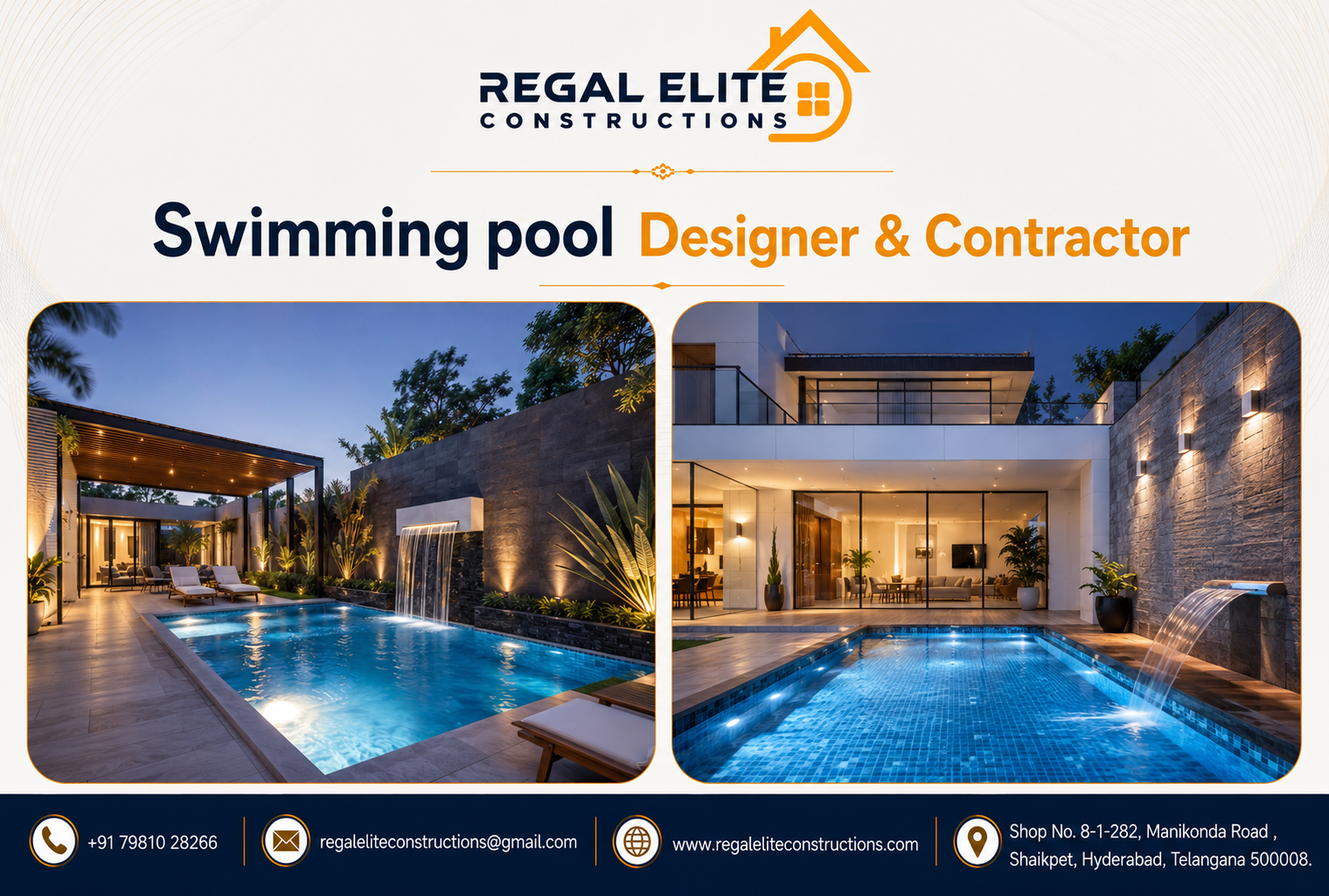
Regal Elite Constructions provides complete swimming pool planning and execution services for property owners across Hyderabad. By appointing one dependable Swimming pool Designer & Contractor, clients can receive coordinated support from the first site inspection through construction, equipment installation, testing and final handover.
Contents
- Why professional pool planning matters
- Designer versus contractor
- Types of swimming pools
- Site planning and feasibility
- Swimming pool design process
- Construction stages
- Structural engineering
- Waterproofing systems
- Filtration and circulation
- Pool finishes and materials
- Swimming pool safety
- Automation and lighting
- Cost considerations
- Long-term maintenance
- How to choose a contractor
- Frequently asked questions
Why Hiring a Professional Swimming Pool Designer & Contractor Matters
A swimming pool permanently holds a large volume of water while remaining exposed to soil movement, temperature changes, weather conditions and constant hydraulic pressure. Small planning or installation mistakes can therefore cause serious problems, including water leakage, cracked finishes, inefficient filtration, uneven circulation and excessive maintenance expenses.
A qualified Swimming pool Designer & Contractor studies the property before recommending the dimensions or shape of a pool. The assessment normally considers available land, access for excavation equipment, soil condition, surrounding buildings, utility lines, drainage levels, sunlight, privacy, landscaping and the intended number of users.
Professional planning is particularly important in Hyderabad because site conditions differ considerably between localities. Certain properties have rocky excavation conditions, while others contain filled or moisture-sensitive soil. A knowledgeable Swimming pool Designer & Contractor develops the proposed structural and construction method after considering the actual site rather than using the same specification everywhere.
Good design also makes the pool easier to operate. The positions of inlets, drains, skimmers, balance tanks, pumps and filters affect how efficiently the water moves through the system. When these components are coordinated by an experienced Swimming pool Designer & Contractor, the finished pool can provide cleaner water, improved energy efficiency and more convenient maintenance.
One Team from Concept to Completion
Working with an integrated Swimming pool Designer & Contractor reduces communication gaps between the people preparing drawings and those completing the work on site. Architectural appearance, engineering requirements, equipment specifications and finishing details can be reviewed together before construction begins.
What Is the Difference Between a Pool Designer and a Pool Contractor?
A pool designer concentrates on planning, appearance, dimensions, functionality, user experience and integration with the property. A contractor manages excavation, civil construction, plumbing, waterproofing, electrical work, equipment, finishing and site coordination. Choosing a company that operates as both a Swimming pool Designer & Contractor gives the owner a single point of responsibility.
During the planning stage, the Swimming pool Designer & Contractor discusses who will use the pool, how frequently it will be used and whether it is intended for relaxation, children, fitness, entertainment, hospitality or commercial operation. These answers influence depth, shape, steps, safety features, equipment capacity and surrounding amenities.
During execution, the same Swimming pool Designer & Contractor translates those decisions into structural dimensions, plumbing routes, construction levels and material specifications. This continuity helps prevent situations in which attractive drawings cannot be constructed efficiently or important technical systems interfere with the final design.
| Responsibility | Pool Designer | Pool Contractor | Integrated Service |
|---|---|---|---|
| Site analysis | Studies layout and visual opportunities | Checks access and construction requirements | Combines design and execution feasibility |
| Pool planning | Creates shape, depth and appearance | Reviews buildability | Produces coordinated practical plans |
| Engineering | Coordinates desired form | Executes structural specifications | Connects appearance with structural performance |
| Equipment | Plans locations discreetly | Installs technical systems | Balances performance, access and aesthetics |
| Project control | Reviews design intent | Manages site activities | Provides one accountable project team |
Types of Pools a Swimming Pool Designer & Contractor Can Create
The right pool category depends on the property, budget, visual preference and intended usage. Before making a recommendation, a Swimming pool Designer & Contractor should assess both the available site and the owner’s long-term expectations.
Residential Swimming Pools
Residential pools can be designed for villas, independent houses and gated communities. A residential Swimming pool Designer & Contractor usually prioritises family comfort, privacy, child-friendly access, simple operation and manageable maintenance.
Farmhouse Swimming Pools
Farmhouse pools often become central entertainment features. The Swimming pool Designer & Contractor can connect the pool with lawns, outdoor kitchens, gazebos, decks, landscape lighting and gathering spaces.
Infinity-Edge Pools
An infinity pool creates the visual effect of water extending beyond one edge. A specialised Swimming pool Designer & Contractor must calculate the overflow edge, catch basin, balance tank and recirculation system carefully.
Rooftop Swimming Pools
Rooftop pools demand detailed structural analysis, load planning, drainage and waterproofing. Only an appropriately qualified Swimming pool Designer & Contractor should proceed after the existing or proposed building structure has been assessed.
Resort and Hotel Pools
Hospitality pools need attractive visual appeal, high circulation performance and convenient operational access. The Swimming pool Designer & Contractor must consider peak usage, guest safety, plant-room capacity and maintenance procedures.
Lap and Fitness Pools
Fitness-oriented pools require adequate length, consistent depth, clear swimming lanes and minimal obstructions. A Swimming pool Designer & Contractor can optimise the proportions for exercise without wasting unnecessary site area.
Skimmer Pools
A skimmer pool maintains the water surface below the surrounding deck. Surface water enters one or more skimmer openings before moving toward the filtration equipment. This system can be practical for private properties and is often more economical than a complete overflow arrangement.
The number and placement of skimmers should not be selected randomly. The Swimming pool Designer & Contractor needs to consider pool dimensions, prevailing wind, return inlet locations and hydraulic capacity. Poor positioning can leave debris circulating in sections of the pool instead of reaching the filtration system.
Overflow Pools
In an overflow pool, water reaches the surrounding edge and flows into a channel. It then enters a balance tank before being returned through the filtration system. An experienced Swimming pool Designer & Contractor coordinates channel levels extremely carefully because even minor level differences can create inconsistent overflow.
Overflow pools are popular for luxury villas, resorts and properties where a seamless water surface is part of the design. They require additional plumbing, a balance tank and greater technical planning, but a capable Swimming pool Designer & Contractor can deliver a highly refined appearance and effective surface-water removal.
Site Planning and Swimming Pool Feasibility
A successful project begins with an accurate survey. The Swimming pool Designer & Contractor should measure the available area and identify property boundaries, structural elements, access routes, existing drains, plumbing lines, electrical services, trees and surrounding levels.
The pool should not be treated as an isolated rectangle. A professional Swimming pool Designer & Contractor studies how people will approach the pool, where they will sit, how wet users will enter the house, where equipment can be serviced and how landscaping will influence cleanliness.
Purpose and User Profile
A family pool may require broad entry steps, moderate depths and a visible shallow area. A fitness pool may require a long uninterrupted swimming path. A resort pool may need multiple activity zones. The Swimming pool Designer & Contractor translates these operational needs into dimensions and features.
Owners should communicate whether young children, elderly family members or non-swimmers will regularly use the area. This allows the Swimming pool Designer & Contractor to consider handrails, shallow ledges, slip-resistant surfaces, controlled access and clearly defined depth changes.
Sunlight and Orientation
Sun exposure affects water temperature, comfort, evaporation and the position of shaded seating. The Swimming pool Designer & Contractor can study the movement of sunlight across the property and position the pool where it receives useful daylight without creating excessive glare in primary seating areas.
Privacy and Views
For villas and farmhouses, privacy is often as important as the pool itself. A Swimming pool Designer & Contractor may coordinate screen walls, planting, pergolas or level changes to reduce unwanted views while preserving ventilation and visual openness.
Excavation Access
Machinery access can influence construction time and cost. On restricted urban plots, excavation material may need to be removed through narrow passages or by smaller equipment. The Swimming pool Designer & Contractor should account for these limitations before confirming the quotation and programme.
Plant-Room Location
The plant room contains important filtration, circulation and treatment equipment. A responsible Swimming pool Designer & Contractor positions it where technicians can access it safely without disturbing the pool’s appearance. It should have suitable ventilation, drainage, electrical provisions and protection from weather.
The Swimming Pool Design Process
Design development should be systematic rather than based on one reference photograph. A good Swimming pool Designer & Contractor combines the owner’s preferred style with measurements, engineering constraints, circulation requirements and realistic maintenance considerations.
1. Initial Consultation
The consultation establishes the project goals, location, expected dimensions, preferred style, usage and approximate investment range. At this stage, the Swimming pool Designer & Contractor should also explain which features have major effects on cost and construction complexity.
2. Site Inspection
During inspection, the Swimming pool Designer & Contractor reviews access, levels, existing structures, soil exposure, utility connections, surface drainage and potential plant-room positions. Photographs and measurements help the team prepare an accurate concept.
3. Concept Layout
The concept layout defines the pool shape, placement, approximate depths, entry steps, deck, landscaping relationships and equipment areas. A thoughtful Swimming pool Designer & Contractor keeps sufficient movement space around the water rather than making the pool so large that the deck becomes unusable.
4. Three-Dimensional Visualisation
Three-dimensional views can help owners understand the relationship between water, finishes, landscaping, buildings and lighting. The Swimming pool Designer & Contractor may use these views to compare design options before structural work begins.
5. Technical Drawings
Technical documentation may include setting-out plans, structural details, sections, plumbing routes, inlet locations, drainage, electrical provisions, lighting points and finishing schedules. The Swimming pool Designer & Contractor uses these drawings to coordinate trades and reduce assumptions during construction.
6. Material Selection
Materials should be selected for performance as well as appearance. The Swimming pool Designer & Contractor can guide the owner regarding waterline tiles, internal finishes, coping, decks, grating, stone and other surfaces that will remain exposed to moisture and chemicals.
7. Final Budget and Programme
After the scope is defined, the Swimming pool Designer & Contractor can prepare a more meaningful quotation. The quotation should identify included work, equipment categories, finishing allowances, exclusions, payment stages and approximate project duration.
Swimming Pool Construction Process
Pool construction involves multiple dependent stages. Completing them in the correct order is essential because concealed mistakes are difficult to correct after finishing. A competent Swimming pool Designer & Contractor maintains quality checks throughout the project instead of inspecting only at handover.
Stage 1: Setting Out
The approved dimensions and levels are marked on site. The Swimming pool Designer & Contractor confirms clearances, deck widths and connections with surrounding structures before excavation begins.
Stage 2: Excavation
Excavation removes soil to the required depth while allowing space for the pool structure and working clearances. The Swimming pool Designer & Contractor must monitor excavation boundaries so the shell is not placed incorrectly within the property.
Stage 3: Base Preparation
The excavated surface is trimmed, compacted or otherwise prepared according to the engineering requirement. Blinding concrete may be installed to provide a clean working base. The Swimming pool Designer & Contractor checks levels before reinforcement work proceeds.
Stage 4: Reinforcement and Embedded Services
Steel reinforcement is installed according to the structural design. Plumbing sleeves, drains, inlets and lighting niches must be coordinated at this stage. An organised Swimming pool Designer & Contractor ensures embedded services are fixed securely before concrete placement.
Stage 5: Concrete Pool Shell
The concrete shell forms the primary structural body of the pool. Concrete quality, placement, vibration, joint treatment and curing all influence performance. The Swimming pool Designer & Contractor should supervise this stage carefully rather than leaving it entirely to uncoordinated labour.
Stage 6: Plumbing Installation
Pool plumbing connects drains, skimmers, overflow systems, inlets, vacuum points, water features and equipment. The Swimming pool Designer & Contractor should pressure-test concealed lines before they are covered to reduce the risk of hidden leakage.
Stage 7: Surface Preparation and Waterproofing
The shell is checked and prepared for the specified waterproofing system. Junctions, penetrations and construction joints require careful detailing. A dependable Swimming pool Designer & Contractor follows compatible product and application requirements instead of mixing unrelated systems.
Stage 8: Water Testing
Testing provides an opportunity to identify water loss before expensive finishes are completed. The Swimming pool Designer & Contractor should record water levels and inspect the structure, penetrations and plumbing during the test period.
Stage 9: Tiling and Finishing
The selected internal surface, waterline tile, coping and deck are installed after the underlying systems have been approved. The Swimming pool Designer & Contractor pays close attention to alignment, slopes, movement joints and transitions between wet and dry areas.
Stage 10: Equipment and Electrical Work
Pumps, filters, treatment equipment, control panels and underwater lights are connected. The Swimming pool Designer & Contractor should ensure electrical work is carried out by qualified personnel and coordinated with appropriate protective devices and earthing requirements.
Stage 11: Commissioning
The system is filled, inspected and operated. Flow, filtration, equipment controls, lighting and treatment functions are checked. The Swimming pool Designer & Contractor should also demonstrate basic operation and maintenance procedures to the owner or facility team.
For additional information about pool categories, project benefits, features and construction stages, read Regal Elite Constructions’ guide to best swimming pool construction in Hyderabad for homes, villas and resorts .
Structural Engineering for Swimming Pools
A pool shell must resist water pressure from inside and soil or groundwater pressure from outside. Structural requirements can vary with pool dimensions, depth, soil conditions, supporting structures and nearby foundations. An experienced Swimming pool Designer & Contractor coordinates appropriate engineering rather than copying reinforcement details from an unrelated project.
The challenge becomes greater for rooftop pools, elevated pools, infinity edges and pools located close to existing buildings. In such circumstances, the Swimming pool Designer & Contractor must coordinate with a structural engineer and confirm that the supporting structure can safely accommodate all relevant loads.
Construction Joints
Whenever concrete placement is divided into stages, construction joints require careful planning. A knowledgeable Swimming pool Designer & Contractor specifies the joint treatment, water stops or other details needed for the chosen construction method.
Settlement and Ground Conditions
Filled soil, loose soil or inconsistent bearing conditions can increase the risk of movement. The Swimming pool Designer & Contractor may recommend further investigation, improved base preparation or an adjusted structural approach where site conditions require it.
Surrounding Structures
The pool should not compromise compound walls, buildings, retaining walls or neighbouring property. The Swimming pool Designer & Contractor reviews excavation proximity and construction sequencing before work begins near existing structures.
Swimming Pool Waterproofing
Waterproofing is one of the most important elements in the entire project. Decorative tiles and grout should not be treated as the only barrier against leakage. The Swimming pool Designer & Contractor should plan waterproofing as a complete system that includes shell preparation, joints, penetrations, corners and compatible finishing materials.
Surface Preparation
The waterproofing surface should be stable, clean and properly prepared. Voids, projections, weak areas and cracks require treatment. The Swimming pool Designer & Contractor checks that preparation work is complete before membrane application starts.
Pipe Penetrations
Every inlet, drain, light niche and pipe penetration creates a critical junction. A professional Swimming pool Designer & Contractor coordinates these details during both structural and waterproofing work, reducing reliance on temporary repairs later.
Compatibility
Waterproofing products, adhesives, grout and internal finishes should be compatible with one another and suitable for continuous immersion. The Swimming pool Designer & Contractor follows approved technical guidance rather than selecting each material independently.
Testing Before Finishing
Testing before tiling allows defects to be identified while repairs remain accessible. The Swimming pool Designer & Contractor should avoid rushing into finishing merely to make the project appear close to completion.
Pool Filtration and Circulation Systems
The filtration system removes suspended impurities and supports water clarity. Its performance depends on equipment capacity, circulation design, operating duration and maintenance. A responsible Swimming pool Designer & Contractor sizes the system according to the pool volume and intended usage.
Pool Pump
The pump moves water through suction points, filtration equipment, treatment systems and return inlets. Oversized equipment can waste energy, while undersized equipment may deliver inadequate circulation. The Swimming pool Designer & Contractor should select the pump using hydraulic requirements rather than choosing only by motor rating.
Pool Filter
Common filter categories include sand, cartridge and diatomaceous earth systems. The appropriate choice depends on project requirements, available maintenance capability and local operating conditions. The Swimming pool Designer & Contractor should explain routine cleaning and replacement requirements before final selection.
Main Drains and Suction Points
Suction components should be planned carefully for circulation and safety. A professional Swimming pool Designer & Contractor uses suitable covers, arrangements and installation practices rather than treating drains as basic plumbing openings.
Return Inlets
Return inlets introduce filtered water back into the pool. Their direction and distribution influence circulation. The Swimming pool Designer & Contractor positions them to reduce stagnant zones and help move surface debris toward collection points.
Balance Tank
Overflow and infinity pools generally require a balance tank to accommodate displaced water and maintain circulation. The Swimming pool Designer & Contractor considers bather load, overflow volume, operating levels, make-up water and access for cleaning.
Water Treatment
Treatment may involve controlled chemical dosing, salt chlorination, ultraviolet systems or combinations selected for the application. The Swimming pool Designer & Contractor should provide suitable equipment space and explain that treatment technology does not eliminate the need for monitoring and maintenance.
Swimming Pool Finishes and Deck Materials
Finishes determine much of the pool’s visual character, but appearance should not be the only criterion. A good Swimming pool Designer & Contractor considers immersion suitability, slip resistance, cleanability, colour stability and compatibility with the waterproofing system.
Mosaic Tiles
Mosaic tiles can follow curves and provide detailed colour combinations. The Swimming pool Designer & Contractor should specify suitable adhesive and grout and ensure the substrate is prepared to receive the chosen tile format.
Large-Format Pool Tiles
Larger tiles can create a clean, contemporary look but require accurate surfaces and careful joint planning. The Swimming pool Designer & Contractor evaluates the tile manufacturer’s intended application before approval.
Natural Stone
Natural stone is frequently used for coping, decks and water features. Different stones respond differently to moisture, chemicals and weather. The Swimming pool Designer & Contractor considers texture, absorption, sealing requirements and surface temperature.
Porcelain Pavers
Outdoor-grade porcelain can provide consistent dimensions and a variety of finishes. The Swimming pool Designer & Contractor should choose products that are suitable for wet outdoor areas and install them with proper slopes and edge details.
Deck Drainage
Pool decks should direct rainwater and splash water toward appropriate drainage points instead of allowing contaminated surface water to enter the pool. The Swimming pool Designer & Contractor establishes levels early because drainage corrections are difficult after finishing.
| Material | Main Advantage | Planning Consideration |
|---|---|---|
| Mosaic tile | Flexible design and colour options | Requires careful joint and grout workmanship |
| Porcelain tile | Modern appearance and consistent finish | Confirm immersion or wet-area suitability |
| Natural stone | Premium connection with landscaping | Check porosity, texture and maintenance |
| Textured pavers | Practical deck surface | Coordinate slopes and drainage |
| Rendered finish | Continuous visual appearance | Requires suitable application system |
Swimming Pool Safety Planning
Safety should be integrated into the design rather than added after construction. The Swimming pool Designer & Contractor can plan controlled access, suitable deck surfaces, safe steps, handrails, lighting and clear depth transitions according to the users and property type.
Restricted Access
Homes with children should have a reliable method of preventing unsupervised pool access. The Swimming pool Designer & Contractor can reserve space for suitable barriers, gates, covers or other protective measures based on the final property layout.
Slip-Resistant Surfaces
Highly polished materials can become dangerous when wet. The Swimming pool Designer & Contractor should recommend deck, step and coping surfaces intended for wet environments while still supporting the desired design style.
Steps and Handrails
Entry steps should be visible, comfortable and appropriately proportioned. Handrails may be valuable for children, elderly users and rehabilitation settings. The Swimming pool Designer & Contractor should determine these requirements before finalising the shell.
Depth Planning
Depth should reflect actual use rather than the assumption that a deeper pool is always better. The Swimming pool Designer & Contractor can create shallow relaxation areas, swimming zones and transitions suitable for the expected users.
Underwater Lighting
Good lighting improves evening visibility and atmosphere. The Swimming pool Designer & Contractor positions underwater fixtures to minimise glare, illuminate steps and support safe movement without creating unpleasant bright spots.
Essential Safety Considerations
- Continuous adult supervision whenever children are near water
- Controlled access to residential and farmhouse pools
- Slip-resistant deck, coping and step materials
- Visible depth transitions and safe entry points
- Properly designed suction fittings and protective covers
- Qualified electrical installation and protective devices
- Suitable rescue equipment for larger or commercial facilities
- Clear operating and emergency procedures for resorts and clubs
Lighting, Water Features and Smart Pool Automation
Modern controls can improve convenience by scheduling pumps, filtration, lights and selected water features. A technology-focused Swimming pool Designer & Contractor plans control requirements before construction so conduits, panels and equipment positions remain organised.
Underwater LED Lighting
LED fixtures are available in single-colour and colour-changing versions. The Swimming pool Designer & Contractor determines the number and placement according to pool dimensions, surface colour and the desired evening atmosphere.
Waterfalls and Cascade Features
Water features can mask background noise and create an attractive focal point. However, the Swimming pool Designer & Contractor must coordinate hydraulic capacity, water loss, splash control, waterproofing and maintenance access.
Automatic Level Control
Automatic systems can help maintain the operational water level, particularly in overflow pools. The Swimming pool Designer & Contractor should still provide appropriate overflow and drainage arrangements to address faults or unexpected conditions.
Variable-Speed Pumps
Where suitable, variable-speed technology allows the circulation rate to be adjusted for different operations. An energy-conscious Swimming pool Designer & Contractor considers filtration requirements, equipment compatibility and lifecycle operating costs.
Remote Monitoring
Selected systems allow owners or operators to review equipment status and control settings through connected devices. The Swimming pool Designer & Contractor should ensure that manual operation remains understandable and accessible when planning automated features.
Swimming Pools for Villas and Independent Houses
A villa pool should complement the architecture and daily lifestyle of the residents. A residential Swimming pool Designer & Contractor can align the pool with living rooms, patios, garden spaces and entertainment areas to create a natural indoor-outdoor connection.
Privacy screening, shaded seating, outdoor showers and convenient access to washrooms can be as important as water dimensions. The Swimming pool Designer & Contractor should therefore prepare a complete activity-zone plan instead of concentrating only on the structural shell.
For smaller residential plots, the pool can incorporate benches, spa jets, compact steps or a counter-current system. A creative Swimming pool Designer & Contractor can deliver a valuable experience even when the available land does not support a large conventional pool.
Swimming Pools for Farmhouses
Farmhouse pools often serve larger groups during weekends, celebrations and family gatherings. A farmhouse Swimming pool Designer & Contractor should anticipate increased seating, wider decks, night lighting, convenient changing facilities and safe circulation around the entertainment zone.
The pool may be integrated with lawns, pergolas, barbecue areas, outdoor dining, guest rooms and landscape features. The Swimming pool Designer & Contractor coordinates these elements so that service routes and drainage do not interfere with recreation.
Because farmhouse properties may remain unused for several days, equipment scheduling and maintenance planning are especially important. The Swimming pool Designer & Contractor can specify accessible filtration equipment and provide operational guidance to the caretaker or facility manager.
Swimming Pools for Resorts, Hotels and Clubs
Commercial and hospitality pools experience higher user loads than most private pools. The Swimming pool Designer & Contractor must understand expected occupancy, operating hours, treatment requirements, staff access and guest circulation.
Resort pools may include children’s areas, shallow loungers, decorative water features and connected landscape zones. The Swimming pool Designer & Contractor should define each area clearly and ensure that technical equipment can support the complete system.
Plant rooms for commercial pools require practical working space. Pumps, filters, valves and treatment systems should not be packed so tightly that technicians cannot inspect them. A professional Swimming pool Designer & Contractor gives maintenance access the same attention as visible design.
Infinity Pool Design and Construction
Infinity pools are visually impressive but technically more complex than standard skimmer pools. The Swimming pool Designer & Contractor must achieve an accurate overflow edge, appropriate catch channel, correctly sized balance tank and reliable recirculation.
The viewing direction should be selected carefully. An infinity edge creates its strongest effect when aligned with a landscape, skyline, garden or distant horizon. A design-oriented Swimming pool Designer & Contractor studies eye level and surrounding features before confirming the edge position.
Water movement, wind and bather displacement influence overflow behaviour. The Swimming pool Designer & Contractor should calculate the hydraulic arrangement and ensure that the catch system can handle normal operation without unnecessary water loss.
Rooftop Swimming Pool Design
A rooftop pool should never be planned solely as an architectural addition. Water, shell construction, finishes and users create considerable loads. A rooftop Swimming pool Designer & Contractor must coordinate with structural professionals before dimensions and depth are finalised.
Rooftop pools also require careful drainage and waterproofing around the external deck. The Swimming pool Designer & Contractor needs to distinguish between water retained inside the pool and rain or splash water that must be removed safely from surrounding areas.
Equipment vibration, pump noise and access for future repairs should be reviewed. An experienced Swimming pool Designer & Contractor plans these service requirements without compromising occupied rooms beneath or beside the pool.
Swimming Pool Construction Cost in Hyderabad
There is no reliable universal rate for every swimming pool because the total investment depends on site and specification. A professional Swimming pool Designer & Contractor should prepare the estimate after understanding the project instead of providing a misleading figure based only on surface area.
Pool Size and Depth
Larger and deeper pools require additional excavation, structure, waterproofing, finishing and water-treatment capacity. The Swimming pool Designer & Contractor can help owners select useful dimensions rather than paying for areas that will rarely be used.
Soil and Site Access
Rock excavation, restricted access, high groundwater or weak soil can influence the execution method. The Swimming pool Designer & Contractor should identify visible site constraints and clearly explain whether further investigation may be required.
Skimmer or Overflow System
An overflow system generally includes channels, gratings, additional plumbing and a balance tank. The Swimming pool Designer & Contractor can compare its appearance and operational benefits with the lower-complexity skimmer option.
Finishing Materials
Tile type, natural stone, coping and deck materials influence both initial cost and long-term upkeep. The Swimming pool Designer & Contractor should provide realistic allowances so the budget is not based on finishes that do not match the owner’s expectations.
Filtration Equipment
Equipment capacity, brand category, automation and treatment options affect the quotation. A responsible Swimming pool Designer & Contractor focuses on suitable performance and serviceability rather than choosing the cheapest available equipment.
Special Features
Infinity edges, waterfalls, heating, spa jets, automatic covers and advanced controls can increase complexity. The Swimming pool Designer & Contractor should price these items separately so the owner can prioritise features transparently.
| Cost Factor | How It Influences the Project |
|---|---|
| Pool dimensions | Changes excavation, structure, waterproofing, finishes and equipment capacity |
| Site condition | Affects excavation method, preparation, access and construction duration |
| Hydraulic system | Skimmer, overflow and infinity systems have different equipment requirements |
| Finish selection | Influences visual quality, installation time and maintenance |
| Automation | Adds controls, sensors, equipment and electrical coordination |
| Landscape integration | May add decks, drainage, planting, lighting, pergolas and seating |
Common Swimming Pool Construction Mistakes
Selecting a Contractor Only by the Lowest Quote
A very low quotation may omit engineering, testing, high-quality equipment, complete waterproofing details or necessary finishing work. Before appointing a Swimming pool Designer & Contractor, owners should compare scope, materials, equipment and responsibilities—not only the final total.
Beginning Construction Without Final Drawings
Starting excavation before finalising dimensions, levels, equipment and deck details can create repeated changes. A disciplined Swimming pool Designer & Contractor completes essential planning before major site work begins.
Ignoring the Plant Room
An undersized plant room makes maintenance difficult and can cause poor ventilation or unsafe access. The Swimming pool Designer & Contractor should allocate practical service space from the beginning.
Depending on Tiles for Waterproofing
Tiles improve appearance and protect the surface, but they should not replace a properly detailed waterproofing strategy. The Swimming pool Designer & Contractor must treat the structural shell, joints and membrane as an integrated system.
Poor Deck Slopes
Incorrect slopes cause water to collect or flow into the pool. The Swimming pool Designer & Contractor establishes finished levels before paving and verifies drainage throughout installation.
Insufficient Testing
Concealed plumbing and waterproofing should be tested before covering them. A quality-focused Swimming pool Designer & Contractor builds testing stages into the programme instead of relying on visual inspection alone.
Swimming Pool Maintenance After Construction
Even a well-constructed pool requires regular operation and maintenance. The Swimming pool Designer & Contractor should provide basic handover guidance, equipment information and recommended maintenance routines.
Daily or Frequent Checks
- Observe water clarity and water level
- Remove visible leaves and floating debris
- Confirm pumps and circulation are operating normally
- Check for unusual equipment noise or leakage
- Keep the surrounding deck clean and unobstructed
Weekly Tasks
- Test and adjust water chemistry as required
- Brush pool surfaces and clean the waterline
- Vacuum settled debris
- Empty skimmer and pump baskets
- Review filter pressure and clean or backwash when necessary
The exact routine depends on usage, weather, pool volume and treatment system. The Swimming pool Designer & Contractor should explain the installed equipment rather than giving generic instructions that may not match the project.
Water Conservation
Leaks, unnecessary backwashing, uncontrolled overflow and evaporation can increase water use. A resource-conscious Swimming pool Designer & Contractor can consider accurate level controls, efficient filtration, leak detection and suitable pool covers where appropriate.
Energy Efficiency
Operating schedules and properly selected pumps can significantly influence electricity consumption. The Swimming pool Designer & Contractor should match equipment operation to the actual hydraulic and treatment requirements rather than running every component continuously without review.
How to Choose the Right Swimming Pool Designer & Contractor
The company selected for the project will influence design quality, structural performance, equipment reliability and future maintenance. Property owners should evaluate the complete capabilities of a Swimming pool Designer & Contractor before signing an agreement.
Review Relevant Experience
Ask whether the team has completed projects similar to your proposed pool. A Swimming pool Designer & Contractor experienced in private villa pools may require additional capabilities for a large resort, rooftop or infinity-edge project.
Request a Detailed Scope
The proposal should identify what is included in design, excavation, civil work, waterproofing, plumbing, electrical work, equipment, finishing and commissioning. A transparent Swimming pool Designer & Contractor should also identify exclusions.
Check Equipment Specifications
Equipment descriptions should include useful capacity and category information rather than vague statements such as “complete filtration system.” A professional Swimming pool Designer & Contractor explains why equipment has been selected.
Understand the Payment Schedule
Payments should correspond with identifiable project stages. The Swimming pool Designer & Contractor should document the commercial terms, variation procedure and responsibilities before commencing work.
Ask About Testing and Commissioning
Confirm how plumbing, waterproofing, electrical systems and equipment will be tested. A reliable Swimming pool Designer & Contractor considers commissioning an essential project stage rather than simply filling the pool and leaving the site.
Discuss Handover Support
Owners should receive basic operating guidance and available equipment documentation. An accountable Swimming pool Designer & Contractor should explain the recommended maintenance approach and whom to contact when service support is required.
Why Consider Regal Elite Constructions?
Regal Elite Constructions offers coordinated construction, interior and swimming pool solutions for residential, farmhouse and commercial properties. Clients searching for a Swimming pool Designer & Contractor can discuss pool planning, structural work, filtration, finishes, landscape integration and project execution with one team.
Visit the Regal Elite Constructions homepage to explore the company’s construction and swimming pool services.
Authoritative Swimming Pool Safety and Efficiency Resources
Pool owners and facility managers can also review the following authoritative resources for general guidance. Project-specific engineering, electrical work, public-health obligations and local approvals should always be confirmed with appropriate professionals and authorities.
- CDC Healthy Swimming Resources – Information about healthier and safer swimming practices.
- CDC Pool Safety and Healthy Swimming Guidance – Practical recommendations for pool users and families.
- EPA WaterSense Pool Water Efficiency – Guidance on reducing unnecessary pool water consumption.
- U.S. Department of Energy Pool Heating Guidance – Information about efficient swimming pool heating options.
- Pool & Hot Tub Alliance Standards and Codes – Industry resources concerning pool and spa standards.
- World Health Organization Drowning Prevention Information – Global information concerning drowning risks and prevention.
- Consumer Product Safety Commission Pool and Spa Safety – Safety information for residential pool and spa environments.
Frequently Asked Questions
1. What services does a Swimming pool Designer & Contractor provide?
A full-service Swimming pool Designer & Contractor can manage site inspection, concept planning, technical coordination, excavation, structural construction, waterproofing, plumbing, filtration, electrical work, tiling, decking, testing and commissioning. The exact scope should be confirmed in the written proposal.
2. How much does swimming pool construction cost in Hyderabad?
Cost depends on dimensions, depth, soil, site access, structural specifications, skimmer or overflow systems, equipment, finishes and additional features. A Swimming pool Designer & Contractor normally needs a site visit and a defined scope before providing an accurate estimate.
3. How long does it take to construct a swimming pool?
The duration varies with pool size, excavation conditions, structural complexity, weather, material availability and finishing requirements. The Swimming pool Designer & Contractor should provide a stage-based programme after finalising the drawings and specifications.
4. Which pool is suitable for a villa?
Rectangular skimmer pools, overflow pools and compact infinity pools can all suit villas. The best option depends on plot size, architecture, budget and usage. A residential Swimming pool Designer & Contractor can compare the available systems after inspecting the property.
5. Can a swimming pool be built on a rooftop?
A rooftop pool may be possible when the supporting structure is appropriately designed or verified. The project requires structural, waterproofing, drainage and service coordination. A rooftop Swimming pool Designer & Contractor should work with qualified structural and electrical professionals before construction begins.
6. What is the difference between a skimmer pool and an overflow pool?
A skimmer pool maintains the water below deck level and collects surface water through skimmer openings. An overflow pool allows water to enter a surrounding channel and balance tank. The Swimming pool Designer & Contractor can explain differences in appearance, construction, equipment and cost.
7. Is waterproofing necessary for a concrete swimming pool?
Yes. Concrete construction alone should not be assumed to provide the complete waterproofing solution. A professional Swimming pool Designer & Contractor coordinates shell quality, joints, penetrations, compatible waterproofing products and testing before decorative finishing.
8. Which filtration system is best for a residential pool?
The correct filtration system depends on pool volume, usage, available plant-room space and maintenance preferences. A Swimming pool Designer & Contractor should calculate the required circulation and recommend suitable pump and filter capacities.
9. Does a swimming pool require daily maintenance?
The pool should be inspected frequently, but not every maintenance task is performed daily. Water testing, cleaning and equipment servicing follow different schedules. The Swimming pool Designer & Contractor or maintenance provider should create a routine for the installed system and actual usage.
10. Can an old swimming pool be renovated?
Many pools can be renovated by repairing surfaces, upgrading waterproofing, replacing tiles, improving circulation, changing lights or installing new equipment. A Swimming pool Designer & Contractor should first inspect the structure and identify the cause of existing defects.
11. Are infinity pools more expensive than standard pools?
Infinity pools are generally more complex because they require an overflow edge, catch system, balance tank, additional plumbing and precise levels. An infinity-pool Swimming pool Designer & Contractor can prepare a cost comparison based on the actual site and selected edge configuration.
12. Can a small property have a luxury swimming pool?
Yes. Compact pools can include elegant lighting, a shallow lounge ledge, spa jets, premium finishes or a counter-current system. A creative Swimming pool Designer & Contractor can focus on proportions and functionality rather than attempting to copy an oversized design.
13. How deep should a residential swimming pool be?
Depth should reflect the users and intended activities. Family and relaxation pools frequently benefit from practical shallow and moderate-depth zones. The Swimming pool Designer & Contractor should avoid unsafe or sudden transitions and account for children and non-swimmers.
14. What should be included in a pool construction quotation?
The quotation should describe design, excavation, structure, waterproofing, plumbing, electrical work, equipment, finishes, deck work, testing, exclusions and payment stages. A trustworthy Swimming pool Designer & Contractor should avoid unclear lump-sum descriptions that make comparison difficult.
15. Why is a plant room necessary?
The plant room houses filtration, circulation, treatment and control equipment. A well-planned plant room provides drainage, ventilation and safe maintenance access. The Swimming pool Designer & Contractor should locate it close enough for efficient hydraulics without affecting the pool’s appearance.
Conclusion
A successful swimming pool combines architecture, engineering, hydraulic performance, safety, comfort and maintainability. Focusing only on appearance or selecting a contractor solely by price can expose owners to leakage, inefficient equipment, poor water circulation and costly repairs.
An experienced Swimming pool Designer & Contractor evaluates the site, understands the intended use, develops coordinated drawings, selects compatible systems and supervises construction through testing and commissioning. This complete approach is valuable for villas, farmhouses, independent houses, resorts, hotels, clubs and other commercial properties.
Regal Elite Constructions assists clients who need a dependable Swimming pool Designer & Contractor in Hyderabad. The team can help develop customised pools that complement the property while addressing structure, waterproofing, filtration, lighting, finishing and long-term usability.
Contact Us :
Phone: +91 79810 28266
Email: regaleliteconstructions@gmail.com
Address:
Shop No. 8-1-282, Manikonda Road,
Shaikpet, Hyderabad, Telangana 500008.
Website: https://regaleliteconstructions.com/
Call Now Request a Consultation